Frequently Asked Questions
Q: What does Exodus 22:13 mean?
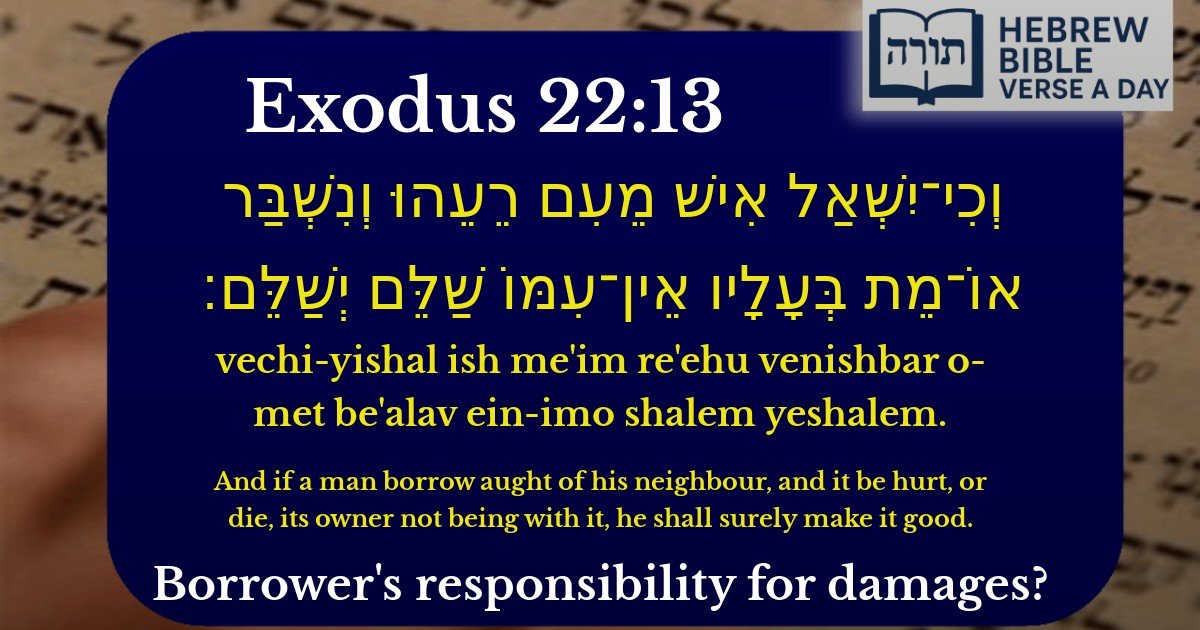
A: Exodus 22:13 discusses the responsibility of someone who borrows an item (or animal) from another person. If the borrowed item gets damaged or dies while in the borrower's care—and the owner was not present at the time—the borrower must fully compensate the owner. This teaches the importance of taking responsibility for borrowed property.
Q: Why is this law about borrowing important in Judaism?
A: This law emphasizes honesty, responsibility, and trustworthiness in financial and personal dealings. The Torah places great importance on ethical behavior, especially when borrowing from others. The Talmud (Bava Metzia 96b) discusses this verse in detail, explaining the borrower's obligations and the conditions under which compensation is required.
Q: What can we learn from Exodus 22:13 today?
A: This verse teaches us to be careful and responsible when borrowing things from others. If something happens to the borrowed item, we must take accountability and repay the owner fairly. This principle applies to all aspects of life—whether borrowing physical objects, money, or even trust. The Rambam (Hilchot She’elah u’Pikadon) elaborates on these laws, showing their relevance in daily conduct.
Q: Does this law apply if the owner was present when the item was damaged?
A: No, according to Rashi on this verse, if the owner was present when the damage occurred, the borrower is not held fully responsible. The reasoning is that the owner could have intervened to prevent harm. This exception highlights the Torah’s fairness in assessing responsibility based on circumstances.
Q: How does Jewish law define 'borrowing' in this context?
A: In Jewish law (Halacha), borrowing (שאלה - 'She’elah') refers to taking an item with the owner’s permission for temporary use, without payment. The borrower assumes responsibility for the item’s safety unless exempted by specific conditions (like the owner being present). The Talmud (Bava Metzia) and later halachic works discuss the nuances of these obligations.


Context in the Torah
This verse appears in Shemot (Exodus) 22:13 as part of the Mishpatim (Laws) section, which details civil and monetary laws. The verse addresses the responsibility of a borrower (sho'el) when borrowed property is damaged or dies in their care.
Rashi's Explanation
Rashi (Exodus 22:13) clarifies that this law applies specifically when:
Halachic Implications (Rambam)
Rambam (Hilchot She'elah uPikadon 1:2-3) elaborates on this principle:
Talmudic Discussion (Bava Metzia 95a-96b)
The Talmud analyzes scenarios where the borrower's liability may be waived:
Midrashic Insight (Mechilta d'Rabbi Yishmael)
The Mechilta emphasizes the ethical dimension: even though the borrower may not be at fault, the Torah insists on restitution to maintain trust (emunah) between neighbors. This reflects the broader principle of dinei mamonot (monetary laws) ensuring fairness in interpersonal dealings.
Practical Application (Shulchan Aruch)
Shulchan Aruch (Choshen Mishpat 340:1-3) codifies these rules: