Frequently Asked Questions
Q: What does Exodus 22:16 mean?
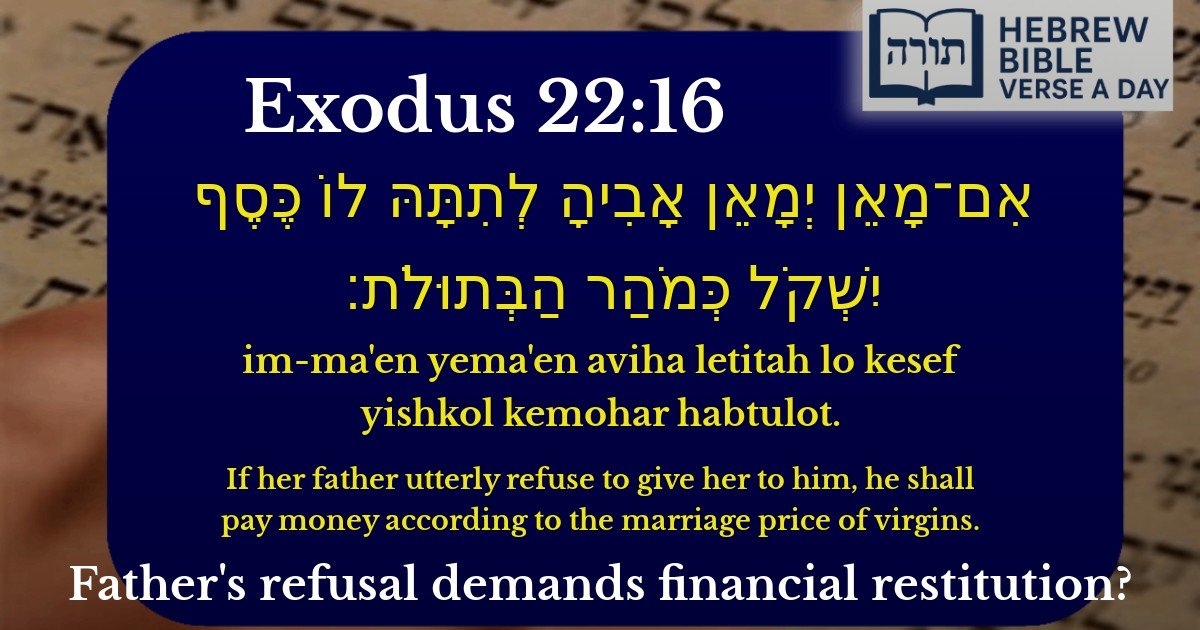
A: Exodus 22:16 discusses the laws regarding a man who seduces a virgin who is not engaged. If her father refuses to allow the man to marry her, the man must still pay the standard dowry ('mohar') for virgins. This teaches about responsibility and the sanctity of relationships, as explained in traditional Jewish sources like Rashi and the Talmud (Kiddushin 12b).
Q: Why is the father's consent important in this verse?
A: In Jewish law, a father has a role in his daughter's marriage arrangements, especially when she is young. The verse highlights the father's authority in deciding whether to permit the marriage or not. This reflects the Torah's emphasis on family structure and proper marital agreements, as discussed in the Talmud (Kiddushin 2a) and Rambam's Mishneh Torah (Ishut 3:1).
Q: What is the 'mohar' (marriage price) mentioned in this verse?
A: The 'mohar' refers to the dowry or payment traditionally given to the bride's family in biblical times. In this case, even if the father refuses the marriage, the man must still pay the standard amount for virgins as a form of compensation. The Talmud (Ketubot 10a) and Rashi explain that this amount was typically 50 shekels of silver, based on Deuteronomy 22:29.
Q: How does this law apply today in Jewish practice?
A: While the specific monetary payment is not practiced today, the underlying principles remain relevant. Jewish law (halacha) still emphasizes the importance of mutual consent, family involvement, and proper marriage procedures (kiddushin). The verse teaches about accountability in relationships, as discussed in Rambam's Mishneh Torah (Ishut 1:1-2) and Shulchan Aruch (Even HaEzer 26).
Q: What lesson can we learn from Exodus 22:16?
A: This verse teaches the importance of respecting boundaries, taking responsibility for one's actions, and upholding the sanctity of marriage. The Torah emphasizes that relationships must be built on proper foundations, not coercion. As the Talmud (Kiddushin 41a) states, marriage requires thoughtful consideration and mutual respect between families.


Context in Torah
This verse (Exodus 22:16) appears in the section of Mishpatim (Laws), which details civil and interpersonal laws. It follows the case of a man who seduces an unbetrothed virgin and must now either marry her (with her father's consent) or pay the standard mohar (marriage price) for virgins if the father refuses the marriage.
Rashi's Explanation
Rashi (Exodus 22:16) clarifies that the phrase "im-ma'en yema'en" ("if he utterly refuses") implies the father has absolute authority in this matter. Even if the daughter wishes to marry the seducer, the father may veto the union. The payment (kesef yishkol) is fixed at fifty silver shekels, as derived from Deuteronomy 22:29, which discusses a similar case of rape rather than seduction.
Rambam's Legal Perspective
In Hilchot Na'arah Betulah (Laws of a Virgin Maiden 1:3-4), Rambam codifies this law, stating that the seducer must pay the full mohar even if the father refuses the marriage. This payment compensates for the diminished marital prospects of the woman, as virginity was highly valued in biblical marital customs.
Talmudic Discussion (Ketubot 39a)
The Talmud analyzes this verse in relation to other biblical passages about seduction and rape. Key points include:
Midrashic Insight (Mechilta d'Rabbi Yishmael)
The Midrash connects this law to the broader principle of protecting women's dignity and maintaining proper marital standards in Israel. The requirement for payment serves both as compensation and as a deterrent against irresponsible behavior that could damage a woman's social standing.
Halachic Implications
Later halachic authorities (including the Shulchan Aruch, Even HaEzer 177) discuss how these biblical laws evolved in rabbinic jurisprudence. While the exact biblical penalty may not apply today, the underlying principles of:
remain foundational to Jewish family law.