Frequently Asked Questions
Q: What does Exodus 22:22 mean?
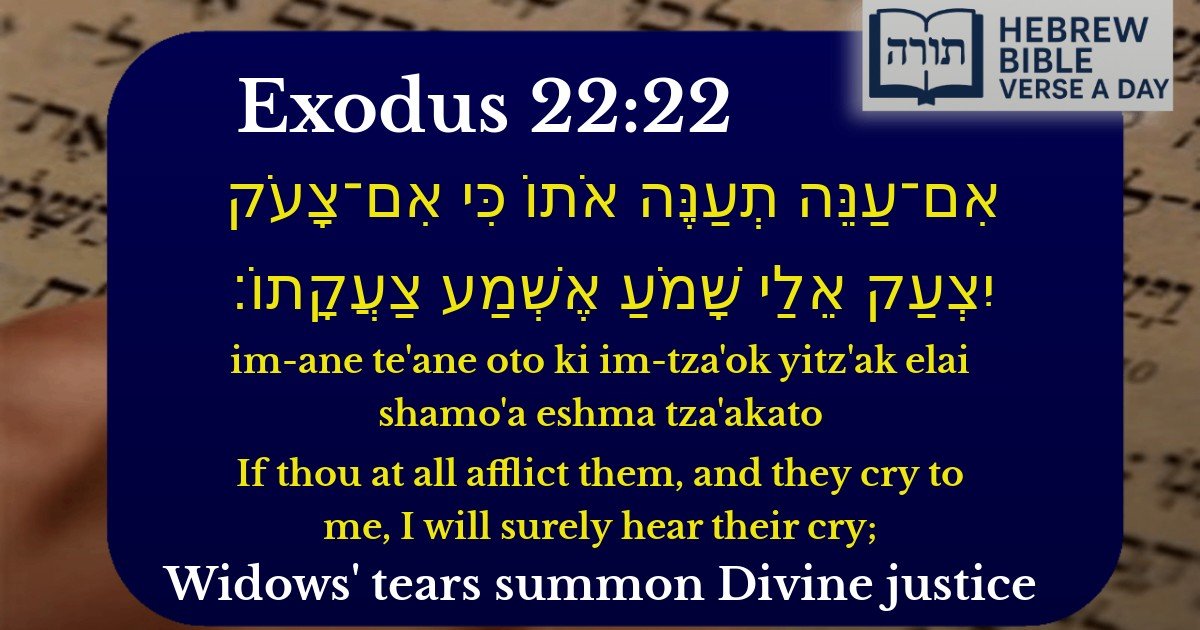
A: Exodus 22:22 warns against oppressing the vulnerable, such as widows or orphans. The verse states that if they are mistreated and cry out to Hashem, He will surely hear their cry. Rashi explains that the double language ('עַנֵּה תְעַנֶּה' and 'שָׁמֹעַ אֶשְׁמַע') emphasizes that even a single act of oppression will not go unnoticed by Hashem.
Q: Why is Exodus 22:22 important in Judaism?
A: This verse is important because it highlights the Torah's strong emphasis on protecting the weak and vulnerable in society. The Rambam (Hilchos De'os 6:10) teaches that causing pain to orphans and widows is especially severe because they have no one to rely on except Hashem. The Talmud (Bava Metzia 59b) also derives from this verse that Hashem responds swiftly to the cries of the oppressed.
Q: How does Exodus 22:22 apply today?
A: This verse teaches us to be extra careful not to take advantage of or mistreat those who are vulnerable in society, such as orphans, widows, or anyone in a weakened position. The Sefer HaChinuch (Mitzvah 63) explains that this mitzvah applies in all times and places, reminding us that Hashem watches over those who cannot defend themselves and holds oppressors accountable.
Q: What can we learn from the double language in Exodus 22:22?
A: The double expressions ('If you at all afflict them' and 'I will surely hear') teach us two important lessons: 1) Even a small amount of oppression is significant in Hashem's eyes, and 2) Hashem's response to the cries of the oppressed is certain and immediate. The Midrash (Shemos Rabbah 31:1) explains that this shows how carefully Hashem protects those who have no other protector.
Q: Who is included in the warning of Exodus 22:22?
A: While the verse specifically mentions widows and orphans (in the surrounding context), Jewish tradition extends this principle to all vulnerable people. The Ibn Ezra explains that these groups are mentioned because they were particularly vulnerable in ancient society, but the Rambam (Hilchos De'os 6:10) applies the lesson to anyone in a weak or defenseless position, including converts, the poor, and the socially marginalized.


Context in the Torah
The verse (Exodus 22:22) appears in the context of laws concerning the proper treatment of vulnerable individuals, particularly widows and orphans. The Torah emphasizes that oppression of these individuals will not go unnoticed by Hashem, who hears their cries and responds.
Grammatical and Linguistic Analysis
The phrase "אִם־עַנֵּה תְעַנֶּה" uses a doubled verb form (infinitive absolute followed by imperfect), which Rashi explains as an emphatic construction meaning "if you dare oppress them." The repetition underscores the severity of the sin. The doubling of "שָׁמֹעַ אֶשְׁמַע" ("I will surely hear") similarly emphasizes Hashem's attentive response.
Halachic and Ethical Implications
Midrashic Interpretations
The Mechilta comments that the verse implies even a single cry from an oppressed individual ascends before Hashem, unlike human judges who may require multiple witnesses. The Midrash Tanchuma (Mishpatim 10) adds that Hashem's response is swift—"I will hear" in this world, and "I will surely hear" in the World to Come—indicating both immediate and eternal justice.
Practical Lessons