Frequently Asked Questions
Q: What does 'Keep thee far from a false matter' mean in Exodus 23:7?
A: This verse teaches the importance of staying far away from falsehood, including lying, deceit, or any form of dishonesty. Rashi explains that one should not even come close to a false matter, emphasizing the severity of dishonesty in Jewish law. The Torah requires us to uphold truth in all aspects of life.
Q: Why does the Torah say not to kill the innocent and righteous?
A: The Torah strictly forbids harming innocent or righteous individuals, as it goes against justice and divine will. Rambam (Hilchot Sanhedrin) explains that judges must be extremely careful in legal proceedings to avoid wrongful convictions. This verse reinforces the sanctity of human life and the importance of fair judgment.
Q: What lesson can we learn from 'for I will not justify the wicked'?
A: This phrase teaches that Hashem does not approve of wickedness, even if human courts make mistakes. The Talmud (Sanhedrin 6b) discusses how divine justice ensures ultimate fairness. We learn that while humans may err, Hashem’s judgment is perfect, and wrongdoing will never be truly justified.
Q: How does Exodus 23:7 apply to everyday life today?
A: This verse reminds us to be truthful in business, speech, and judgment. The Shulchan Aruch (Choshen Mishpat) details laws against fraud and false testimony, applying this principle practically. Whether in court or daily interactions, we must uphold honesty and protect the innocent.
Q: Why is avoiding falsehood so important in Judaism?
A: Truth is a foundational value in Judaism, as falsehood undermines trust and justice. The Midrash (Shemot Rabbah) states that truth is Hashem’s 'seal.' The Talmud (Shabbat 55a) teaches that dishonesty is among the sins the earth cannot tolerate. Living truthfully brings us closer to divine righteousness.


General Interpretation
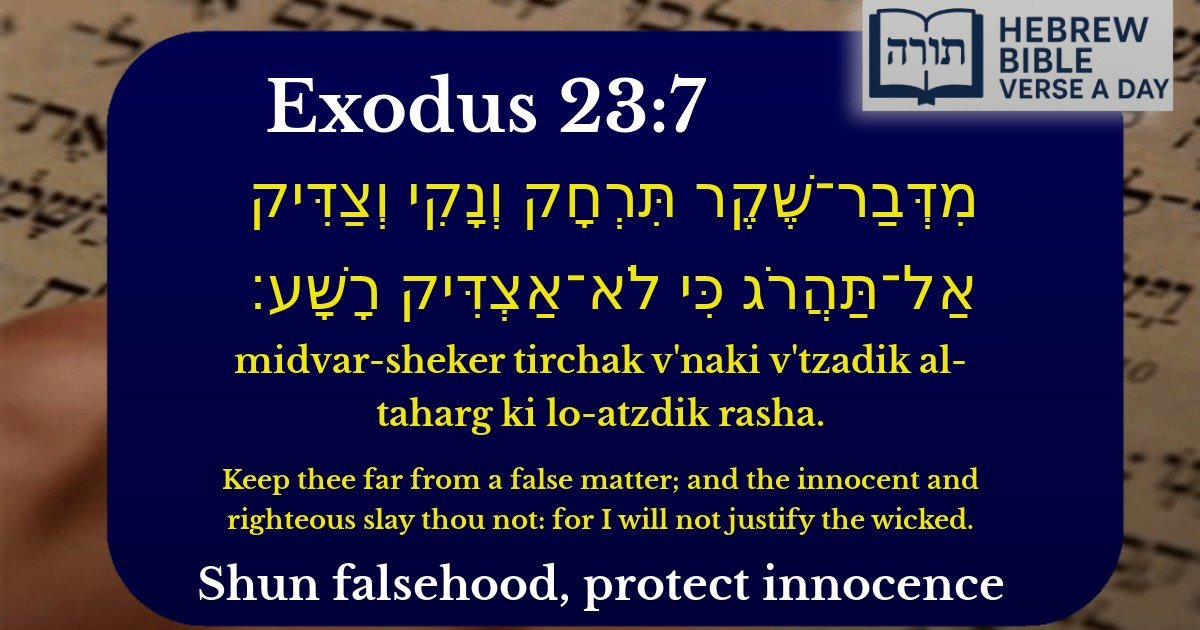
The verse (Exodus 23:7) commands strict adherence to truth and justice, particularly in legal matters. Rashi explains that "מִדְּבַר־שֶׁקֶר תִּרְחָק" ("Keep thee far from a false matter") means one must distance oneself from any falsehood, even if it seems minor. The Rambam (Hilchot Sanhedrin 20:1) elaborates that judges must be exceedingly careful to avoid any hint of false testimony or improper influence in court proceedings.
Innocent and Righteous
The phrase "וְנָקִי וְצַדִּיק אַל־תַּהֲרֹג" ("the innocent and righteous slay thou not") is understood by the Talmud (Sanhedrin 33b) as a prohibition against convicting an innocent person in court. The Sifrei (Devarim 17:6) emphasizes that even if a person appears guilty, if there is reasonable doubt, they must not be punished. The term "צַדִּיק" ("righteous") further implies that even those who are known for their righteousness must not be wrongfully accused or condemned.
Divine Justice
The conclusion of the verse, "כִּי לֹא־אַצְדִּיק רָשָׁע" ("for I will not justify the wicked"), is interpreted by the Midrash (Shemot Rabbah 30:19) as a warning that Hashem will not overlook injustice. The Ibn Ezra notes that this phrase serves as a reminder that human courts must emulate Divine justice—never excusing the guilty nor condemning the innocent.
Practical Halachic Implications