Frequently Asked Questions
Q: What does 'And the Lord spoke to Moshe, saying' mean in Exodus 25:1?
A: This phrase introduces a new communication from Hashem to Moshe. In Jewish tradition, this wording indicates that Moshe received divine instruction to transmit to the Jewish people. Rashi explains that this phrasing ('saying') means Moshe was to repeat these words exactly to the Israelites.
Q: Why does the Torah repeatedly say 'And the Lord spoke to Moshe'?
A: The repetition emphasizes that every word in the Torah comes directly from Hashem. The Rambam (Maimonides) teaches in his 13 Principles of Faith that the entire Torah was given to Moshe from Heaven. Each instance reminds us of the divine origin of the commandments.
Q: What important event follows Exodus 25:1?
A: This verse introduces the instructions for building the Mishkan (Tabernacle). The Midrash teaches that this follows the giving of the Torah at Mount Sinai, showing that after receiving the Torah, the Jewish people needed a physical place for the Divine Presence to dwell among them.
Q: Why does the Torah specify that Hashem spoke to Moshe and not others?
A: Moshe was the greatest prophet who ever lived (Deuteronomy 34:10). The Talmud (Yevamot 49b) explains that while other prophets received visions, Moshe spoke to Hashem 'face to face,' making him uniquely qualified to transmit Hashem's exact words to the people.
Q: How does this verse relate to us today?
A: This teaches us that just as Hashem communicated with Moshe to guide the Jewish people then, we believe Hashem continues to guide us through the Torah's eternal wisdom. The Ohr HaChaim explains that every generation can find personal relevance in these divine communications.

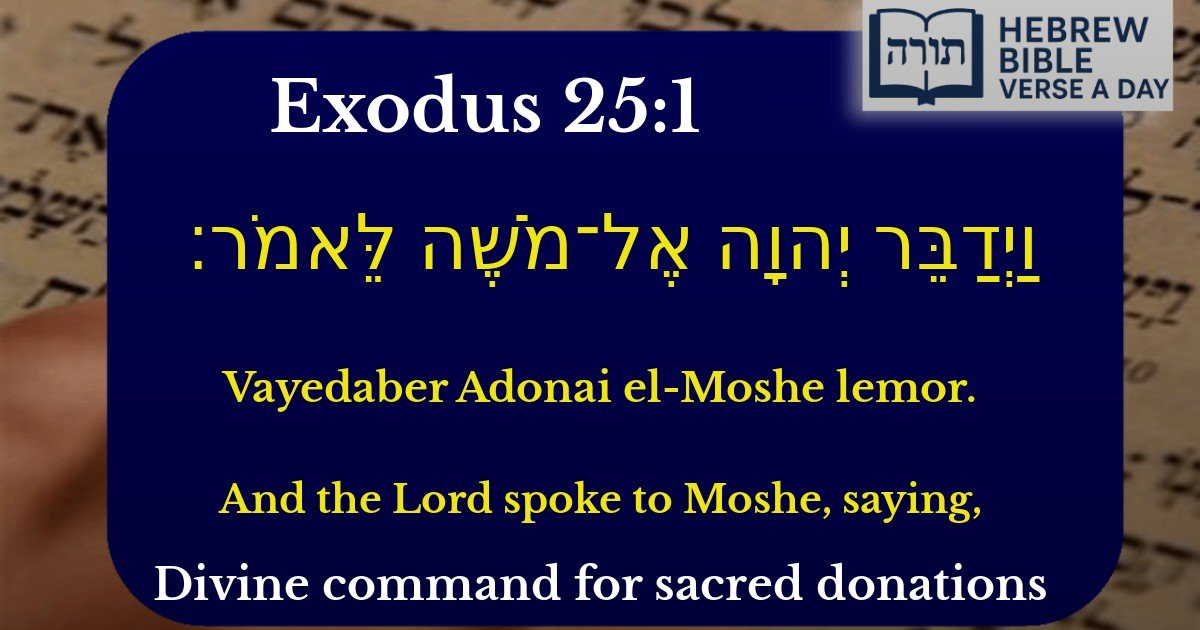

The Divine Communication to Moshe
The verse "וַיְדַבֵּר יְהוָה אֶל־מֹשֶׁה לֵּאמֹר" ("And the Lord spoke to Moshe, saying") appears frequently in the Torah, marking the transmission of divine commandments and teachings. Rashi (on Shemot 6:2) explains that this phrase emphasizes the direct and clear communication between Hashem and Moshe, distinguishing Moshe's prophecy from that of other prophets. Unlike others who received visions or parables, Moshe heard Hashem's words with absolute clarity—"פה אל פה אדבר בו" ("mouth to mouth I speak with him," Bamidbar 12:8).
The Significance of "לֵּאמֹר"
The word "לֵּאמֹר" ("saying") is interpreted by the Midrash (Shemot Rabbah 28:6) as an instruction for Moshe to relay the divine message to Bnei Yisrael. The Rambam (Hilchos Yesodei HaTorah 7:6) elaborates that Moshe served as the intermediary to convey Torah to the nation, ensuring the transmission was precise and unaltered. This underscores the principle of משה קבל תורה מסיני ומסרה ליהושע ("Moshe received the Torah from Sinai and transmitted it to Yehoshua," Pirkei Avos 1:1).
The Unique Prophecy of Moshe
Broader Implications in Torah Transmission
The Ohr HaChaim (on Shemot 6:2) highlights that this phrasing establishes the authority of Moshe Rabbeinu as the definitive teacher of Torah. Any deviation from his teachings would undermine the divine origin of halacha. This principle is foundational to the Orthodox Jewish belief in תורה מן השמים (Torah from Heaven) and the binding nature of the Oral Torah as transmitted through Moshe.