Frequently Asked Questions
Q: What does Exodus 25:3 mean when it mentions gold, silver, and brass?
A: This verse refers to the materials the Israelites were commanded to donate for building the Mishkan (Tabernacle). Gold represents the highest level of sanctity, silver was used for the sockets of the Mishkan, and brass (copper) was used for the altar and other utensils (Rashi on Exodus 25:3).
Q: Why did Hashem ask for these specific materials for the Mishkan?
A: The three metals correspond to different levels of spiritual refinement. Gold, the most precious, was used for the holiest items like the Ark. Silver was for foundational elements, and brass for items related to atonement, teaching us that every Jew can contribute according to their ability (Midrash Tanchuma, Terumah 5).
Q: What lesson can we learn today from Exodus 25:3 about giving?
A: The verse teaches that all contributions - whether 'gold' (great) or 'brass' (modest) - are valuable when given with pure intentions. The Talmud (Bava Basra 9b) explains that the main thing is the sincerity behind the gift, not its monetary value.
Q: How were the gold, silver and brass used in the Mishkan?
A: Gold covered the Ark and menorah, silver made the sockets that held the Mishkan's beams, and brass formed the altar and its utensils (Rambam, Hilchos Beis Habechira 1:17-19). Each material had a specific purpose in serving Hashem.
Q: Why does the verse say 'take' instead of 'give' these offerings?
A: Rashi explains that giving to holy causes is actually 'taking' - we receive more spiritual benefit than we give. The Midrash (Shemos Rabbah 33:1) says it was an honor for the Israelites to contribute to Hashem's dwelling place.


Context in the Torah
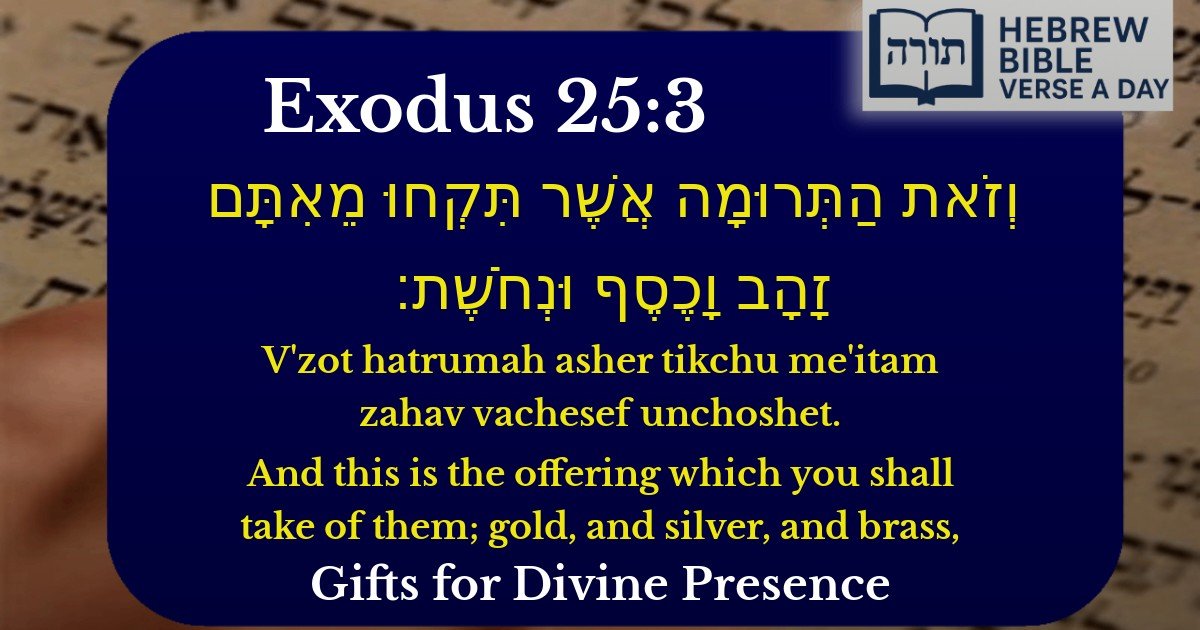
The verse (Shemot 25:3) introduces the command to collect materials for the construction of the Mishkan (Tabernacle). The contributions of gold, silver, and brass were voluntary offerings from Bnei Yisrael, demonstrating their dedication to the Divine service.
Rashi's Commentary
Rashi explains that the term "תְּרוּמָה" (offering) implies a separation or elevation, as these materials were consecrated for a sacred purpose. He notes that the gold was used for the Aron (Ark) and Keruvim (Cherubim), the silver for the Adanim (sockets), and the brass for the Mizbeach (Altar) and other vessels.
Symbolism of the Metals
According to the Midrash (Tanchuma, Terumah 5), the three metals represent different levels of spiritual refinement:
Rambam's Perspective
The Rambam (Hilchos Beis HaBechira 1:12-13) emphasizes that the voluntary nature of these contributions teaches that the Mishkan—and by extension, all Divine service—must be built with generosity and heartfelt willingness, not coercion.
Chassidic Insight (Ohr HaChaim)
The Ohr HaChaim highlights that the phrase "אֲשֶׁר תִּקְחוּ מֵאִתָּם" (which you shall take from them) suggests that Moshe was to receive these gifts with dignity, ensuring the donors felt their contributions were valued. This reflects the principle of כבוד הבריות (honoring people) even in the context of a mitzvah.