Frequently Asked Questions
Q: What does 'And let them make me a sanctuary; that I may dwell among them' mean?
A: This verse (Exodus 25:8) commands the Jewish people to build the Mishkan (Tabernacle), a portable sanctuary in the desert, so that Hashem's presence can dwell among them. Rashi explains that the Mishkan was a physical place where the Divine Presence would rest, symbolizing a close relationship between Hashem and the Jewish people.
Q: Why was the Mishkan (sanctuary) so important?
A: The Mishkan was essential because it served as a dwelling place for Hashem's presence among the Jewish people, especially after the revelation at Mount Sinai. The Rambam (Mishneh Torah, Hilchot Beit HaBechirah) teaches that the Mishkan (and later the Beit HaMikdash, the Holy Temple) was the center of Jewish worship, where sacrifices were offered and the Divine Presence was most felt.
Q: Does this verse still apply today without the Mishkan or Temple?
A: While we no longer have the Mishkan or Beit HaMikdash, the Talmud (Berachot 8a) teaches that every synagogue is considered a 'mikdash me'at' (a small sanctuary), where Hashem's presence dwells. Additionally, the Midrash (Shemot Rabbah 33:1) explains that each person can make their heart a dwelling place for Hashem through Torah study and mitzvot.
Q: What can we learn from 'that I may dwell among them'?
A: The phrase teaches that Hashem desires closeness with the Jewish people. The Sforno explains that the Divine Presence does not dwell in a physical structure alone but within the hearts of those who serve Hashem sincerely. This teaches us that spirituality is not confined to a building but extends to how we live our lives with holiness.
Q: How does the concept of the Mishkan relate to Shabbat and the home?
A: Just as the Mishkan was a place of holiness, the Jewish home is called a 'mikdash me'at' (small sanctuary). The Shulchan Aruch (Orach Chaim 242) teaches that through Shabbat candles, a set Shabbat table, and Torah learning, we bring the sanctity of the Mishkan into our homes.

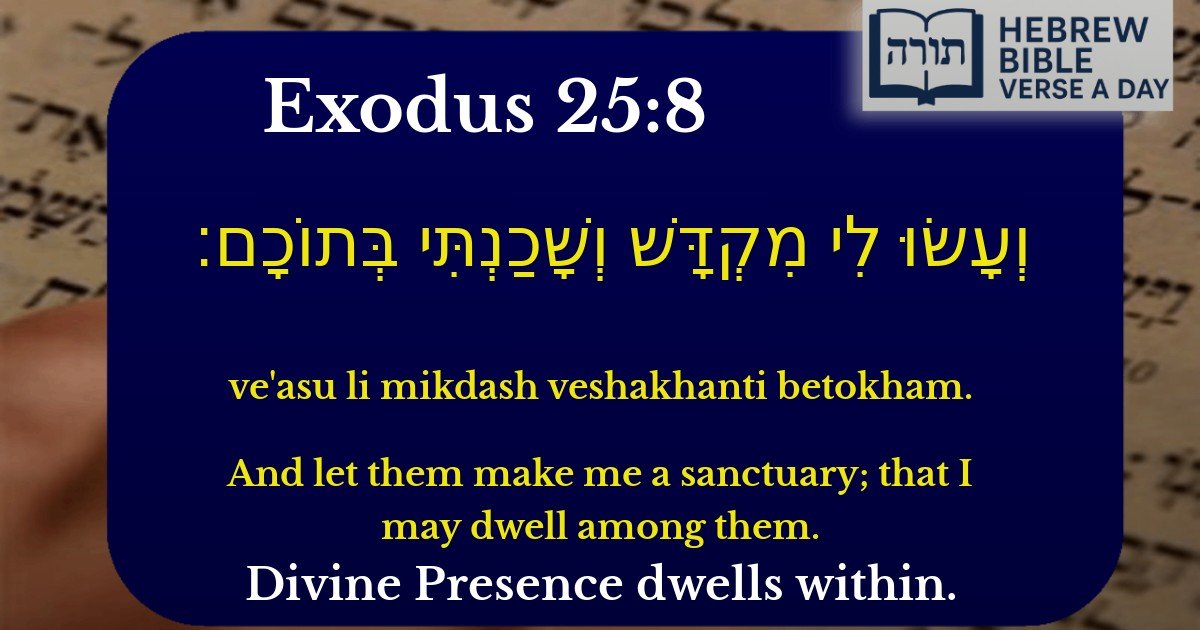

The Command to Build the Mishkan
The verse (Shemot 25:8) states: "וְעָשׂוּ לִי מִקְדָּשׁ וְשָׁכַנְתִּי בְּתוֹכָם" ("And let them make Me a sanctuary, that I may dwell among them"). Rashi explains that this refers to the construction of the Mishkan (Tabernacle), a temporary sanctuary built in the wilderness, which later served as the model for the permanent Beit HaMikdash (Temple) in Jerusalem. The purpose of the Mishkan was to create a dwelling place for the Divine Presence (Shechinah) among Bnei Yisrael.
The Nature of the Divine Presence
The Ramban (Nachmanides) elaborates that the Mishkan was not merely a physical structure but a continuation of the revelation at Har Sinai, where Hashem's Presence descended. The phrase "וְשָׁכַנְתִּי בְּתוֹכָם" ("that I may dwell among them") emphasizes that the Shechinah resides not just in the Mishkan itself but within each individual Jew. The Sforno adds that this indwelling is contingent upon the moral and spiritual state of the people.
Symbolism and Deeper Meaning
Halachic and Philosophical Implications
The Rambam (Hilchot Beit HaBechirah 1:1) derives from this verse the eternal mitzvah to build a Beit HaMikdash when possible. The Ohr HaChaim highlights that the Mishkan was a means to elevate physical materials (gold, wood, etc.) into vessels of holiness, demonstrating that the physical world can be sanctified through divine service.