

Join Our Newsletter To Be Informed When New Videos Are Posted
Hebrew Text
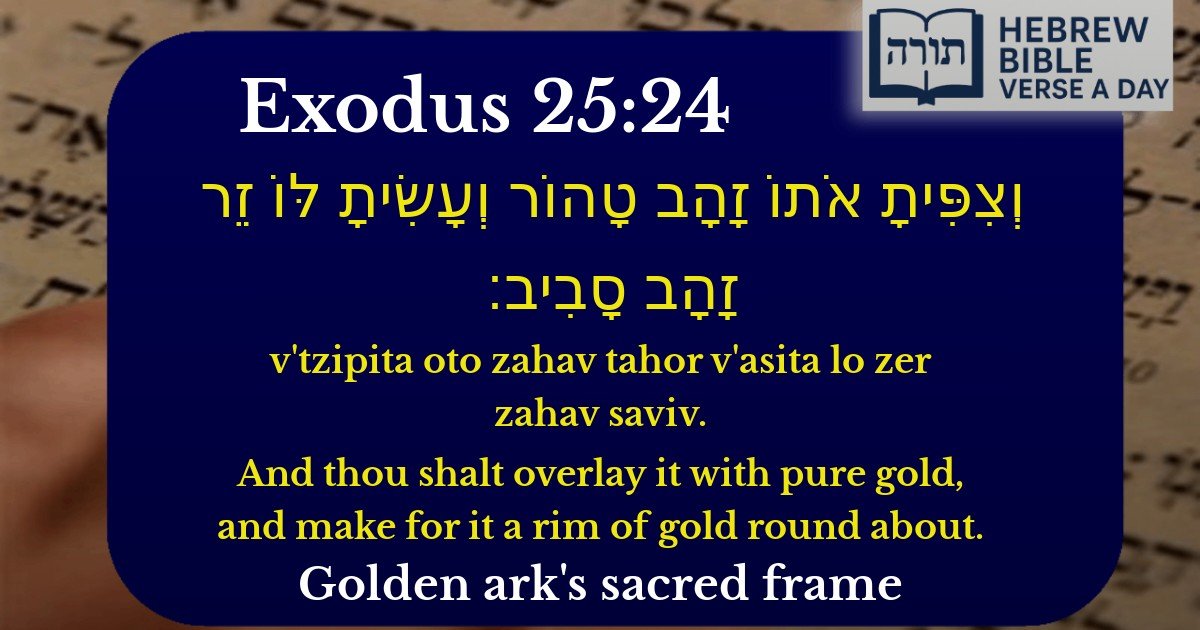
וְצִפִּיתָ אֹתוֹ זָהָב טָהוֹר וְעָשִׂיתָ לּוֹ זֵר זָהָב סָבִיב׃
English Translation
And thou shalt overlay it with pure gold, and make for it a rim of gold round about.
Transliteration
V'tzipita oto zahav tahor v'asita lo zer zahav saviv.
Hebrew Leining Text
וְצִפִּיתָ֥ אֹת֖וֹ זָהָ֣ב טָה֑וֹר וְעָשִׂ֥יתָ לּ֛וֹ זֵ֥ר זָהָ֖ב סָבִֽיב׃
🎵 Listen to leining
Parasha Commentary
📚 Talmud Citations
This verse is quoted in the Talmud.
📖 Yoma 72b
The verse is cited in a discussion about the construction and sanctity of the Ark of the Covenant, emphasizing the importance of its gold overlay and rim.
📖 Menachot 28b
Referenced in the context of the detailed requirements for the construction of sacred vessels, highlighting the commandment to overlay the Ark with pure gold.
Overview of the Verse
The verse (Exodus 25:11) describes the commandment to overlay the Ark of the Covenant (Aron HaKodesh) with pure gold and to fashion a golden rim (zer zahav) around it. This instruction is part of the detailed construction of the Mishkan (Tabernacle), emphasizing the sanctity and splendor of the Ark, which housed the Tablets of the Covenant.
Rashi's Commentary
Rashi explains that the phrase "וְצִפִּיתָ אֹתוֹ זָהָב טָהוֹר" ("And thou shalt overlay it with pure gold") refers to covering the Ark's wooden structure (shittim wood) entirely with gold, both inside and outside (Exodus 25:11). This dual overlay symbolizes the importance of inner and outer purity—aligning one's outward actions with inner sincerity in serving Hashem.
Regarding the "זֵר זָהָב סָבִיב" ("rim of gold round about"), Rashi notes that this was a decorative crown-like molding encircling the Ark's top edge, signifying the Torah's majesty and the honor due to it.
Rambam's Perspective
In Hilchot Beit HaBechirah, Rambam (Maimonides) discusses the Ark's construction as a model for sanctity in divine service. The use of pure gold (zahav tahor) underscores that objects dedicated to holiness must be of the highest quality, free from imperfections—both materially and spiritually.
Midrashic Insights
Symbolism in Talmudic Thought
The Talmud (Yoma 72b) derives from this verse that a Torah scholar must be morally impeccable, like the Ark's flawless gold. The rim's circular form (saviv) hints at the Torah's all-encompassing wisdom, which has no end.
Practical Halachic Implications
Later commentators, such as the Kli Yakar, expand on the requirement for tahor (pure) gold, teaching that mitzvot performed with ulterior motives (lo lishmah) lack the purity of those done sincerely. The Ark's construction thus serves as a paradigm for ideal divine service.