Frequently Asked Questions
Q: What does Exodus 25:34 mean when it describes the Menorah's bowls, bulbs, and flowers?
A: Exodus 25:34 describes the intricate design of the Menorah (candelabrum) in the Mishkan (Tabernacle). According to Rashi, the 'bowls' (גְבִעִים) were cup-like shapes, the 'bulbs' (כַּפְתֹּרֶיהָ) were round knobs, and the 'flowers' (פְרָחֶיהָ) were decorative blossoms. These details emphasize the beauty and precision required in fulfilling the mitzvah of constructing the Menorah as commanded by Hashem.
Q: Why are the Menorah's bowls described as 'almond-shaped' in Exodus 25:34?
A: The Torah specifies that the bowls were 'made like almonds' (מְשֻׁקָּדִים) because the almond tree is known for its swift growth and blossoming (as seen in Jeremiah 1:11-12). The Midrash teaches that this symbolizes diligence in Torah study and mitzvot—just as almonds grow quickly, we should be quick to fulfill Hashem's will. Rambam also notes that the almond motif reflects precision in craftsmanship for the Mishkan.
Q: What lesson can we learn from the detailed design of the Menorah in Exodus 25:34?
A: The Menorah's detailed design teaches us the importance of hiddur mitzvah (beautifying commandments). The Talmud (Shabbat 22b) explains that every part of the Menorah had spiritual significance, reminding us to perform mitzvot with care and beauty. Just as the Menorah's bowls, bulbs, and flowers were meticulously crafted, we should strive to elevate our mitzvot with attention and sincerity.
Q: How does the Menorah's description in Exodus 25:34 apply to us today?
A: Although we no longer have the Menorah of the Mishkan, the verse reminds us to bring light into the world through Torah and mitzvot. The Sages compare the Menorah to wisdom (Proverbs 6:23), and its almond-shaped bowls symbolize urgency in spiritual growth. Today, we can 'illuminate' by studying Torah, doing acts of kindness, and striving for spiritual beauty in our lives.

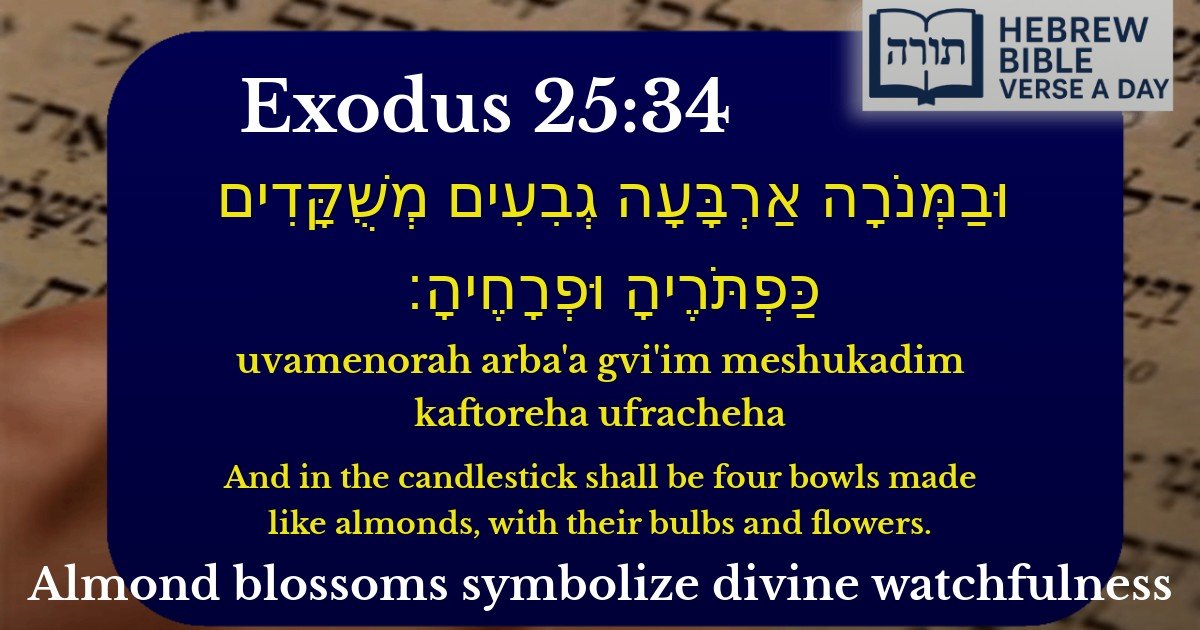

Explanation of the Menorah's Design
The verse (Shemot 25:34) describes the intricate details of the Menorah's construction, specifically mentioning its four almond-shaped bowls (gvi'im), bulbs (kaptorim), and flowers (perachim). According to Rashi, these elements were not merely decorative but carried deep symbolic meaning. The almond shape (meshukadim) alludes to the almond tree, which blossoms quickly—a reminder of Hashem's swift justice (as seen in Yirmiyahu 1:11-12).
Symbolism of the Almond
The Ramban elaborates that the almond motif represents diligence in Torah study, as the almond tree is among the first to bloom in spring, symbolizing the urgency with which one should pursue mitzvot. The Talmud (Menachot 28b) further explains that the Menorah's design was Divinely instructed to Moshe in exact detail, emphasizing the precision required in avodat Hashem (service of G-d).
Structural Interpretation
Rabbeinu Bachya notes that the four bowls correspond to the four directions of the world, indicating that the light of Torah must shine outward to all humanity. The bulbs (kaptorim) and flowers (perachim) symbolize growth and spiritual flourishing, as taught in Midrash Tanchuma (Behaalotecha 5), which connects them to the flourishing of righteous deeds.