Frequently Asked Questions
Q: What does Exodus 25:35 mean in the description of the Menorah?
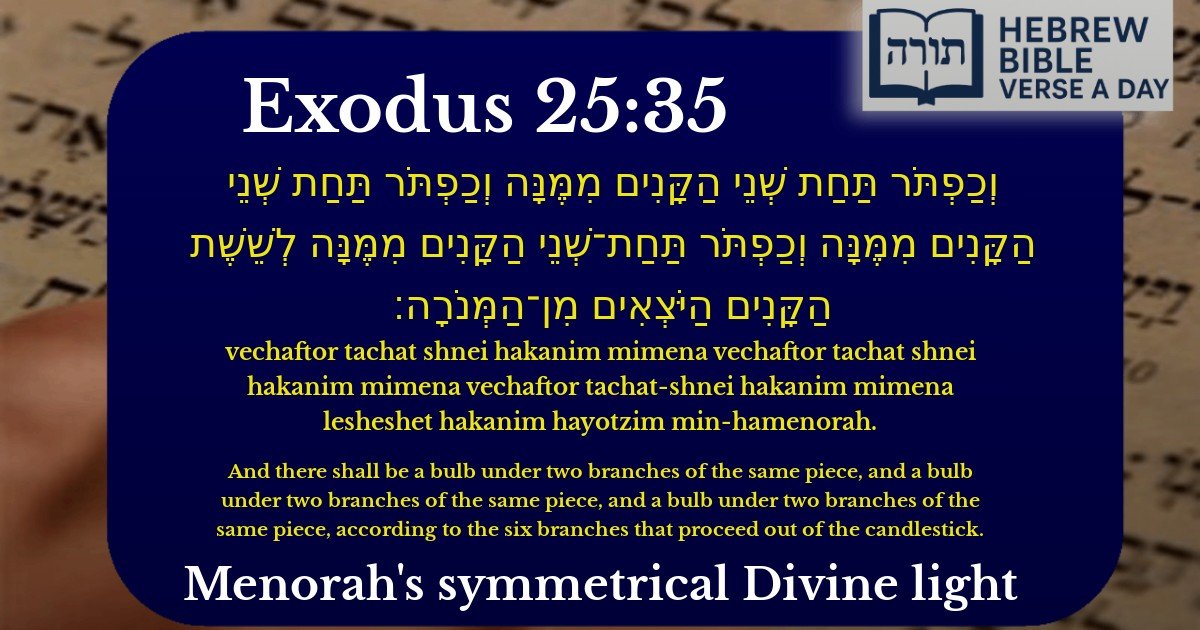
A: Exodus 25:35 describes the design of the Menorah (candelabrum) in the Mishkan (Tabernacle). It specifies that there should be a 'bulb' (כַּפְתֹּר - kaphtor) under each pair of the six branches extending from the central stem. According to Rashi, these 'bulbs' were ornamental knobs or cups that decorated the Menorah, adding to its beauty and sanctity as a holy vessel.
Q: Why is the Menorah's design described in such detail in the Torah?
A: The Torah provides precise details about the Menorah's construction because it was a sacred vessel used in the Mishkan (and later the Temple) for the mitzvah of kindling the lights. The Rambam explains that every detail has spiritual significance, teaching us the importance of beauty and precision in serving Hashem. The Menorah also symbolizes wisdom and Divine light, as mentioned in Proverbs 6:23, 'For a commandment is a lamp, and the Torah is light.'
Q: What can we learn from the repeated phrase 'a bulb under two branches' in Exodus 25:35?
A: The repetition emphasizes the symmetry and balance in the Menorah's design, teaching us the importance of order and harmony in spiritual matters. The Talmud (Menachot 28b) discusses how the Menorah had to be made from a single piece of gold, hammered into shape, symbolizing unity and dedication. The bulbs (kaphtorim) under each pair of branches may also hint at the idea that spiritual growth (represented by the branches) must be supported by strong foundations (the bulbs).
Q: How does the Menorah's design apply to us today?
A: Although we no longer have the Temple Menorah, its lessons remain relevant. The Midrash (Bamidbar Rabbah 15:7) compares the Menorah to the Jewish people, who must spread light (Torah and mitzvot) in the world. Just as the Menorah's branches all faced the center, we must direct our actions toward serving Hashem with unity. Additionally, the attention to detail teaches us that even small acts of holiness matter.
Q: What is the significance of the six branches and the central stem in the Menorah?
A: The six branches (three on each side) plus the central stem make seven lights in total, representing completeness, as seven is a significant number in Judaism (e.g., seven days of Creation). The Talmud (Shabbat 22b) explains that the Menorah symbolizes the light of Torah and wisdom. The central stem represents the unchanging truth of Torah, while the branches show how Torah wisdom spreads in all directions, illuminating the world.


Context of the Verse
This verse (Shemot 25:35) describes the design of the Menorah in the Mishkan (Tabernacle). The Menorah had a central shaft with six branches extending from it—three on each side—and each pair of branches had a kafTor (bulb or knob) beneath them. The repetition emphasizes the symmetrical and precise construction commanded by Hashem.
Explanation of the Term KafTor
Rashi explains that kafTor refers to a rounded ornament shaped like an apple or pomegranate, serving as a decorative element on the Menorah. The Rambam (Hilchot Beit HaBechira 3:4) describes it as a bulb-like protrusion, emphasizing its aesthetic and structural role in unifying the branches.
Symbolism of the Menorah's Design
Halachic Precision
The Talmud (Menachot 28b) derives from this verse that the Menorah must be made from a single block of gold, hammered into shape—teaching the importance of unity and integrity in sacred service. The repetition of "under two branches" stresses that each kafTor must align precisely with the paired branches, reflecting the meticulousness required in fulfilling mitzvot.
Connection to the Beit HaMikdash
The Zohar (Terumah 152a) links the Menorah's structure to the spiritual light that emanated from the Beit HaMikdash. The kafTorim signify the hidden potential within Torah, which blossoms when studied with dedication—just as a bulb contains the potential for growth.