Frequently Asked Questions
Q: What does Exodus 26:2 mean when it describes the curtains for the Mishkan (Tabernacle)?
A: This verse specifies the exact measurements (28 cubits long and 4 cubits wide) for the curtains that would form the covering of the Mishkan. According to Rashi, these precise dimensions were commanded by Hashem to ensure the Mishkan's sanctity and proper construction. The uniformity ('one measure') teaches us about the importance of order and precision in holy matters.
Q: Why were the curtains of the Mishkan made with such specific measurements?
A: The Rambam explains in Hilchot Beit HaBechirah that every detail of the Mishkan's construction had spiritual significance. The specific measurements (28x4 cubits) reflect divine wisdom and symbolize the harmony required in serving Hashem. The Midrash Tanchuma also teaches that these measurements parallel cosmic structures, connecting the earthly Mishkan to heavenly patterns.
Q: What can we learn today from the uniform measurements of the Mishkan's curtains?
A: The Talmud (Yoma 72a) derives from this verse that just as the curtains shared one measure, the Jewish people must strive for unity in serving Hashem. In our daily lives, this teaches us the value of consistency in mitzvah observance and working together harmoniously in holy endeavors, like building communities and synagogues.
Q: How long is a 'cubit' (amah) in modern measurements?
A: According to the Chazon Ish (Orach Chaim 39), an amah is approximately 48-57 cm (19-22.5 inches). However, there are differing opinions among Rishonim - Rambam holds it's about 48 cm while the Chazon Ish's stricter view is about 57 cm. The exact length has halachic implications for building succahs, mikva'os, and other structures today.
Q: Why does the Torah give such detailed instructions about the Mishkan's construction?
A: The Sforno explains that these precise details teach us that serving Hashem requires careful attention to both spiritual intentions and physical execution. Just as the curtains had exact measurements, our mitzvot today require proper kavanah (intention) and ma'aseh (action). The Midrash (Shemot Rabbah 33:1) compares this to a king giving exact blueprints for his palace - every detail reflects honor for the Divine Presence.

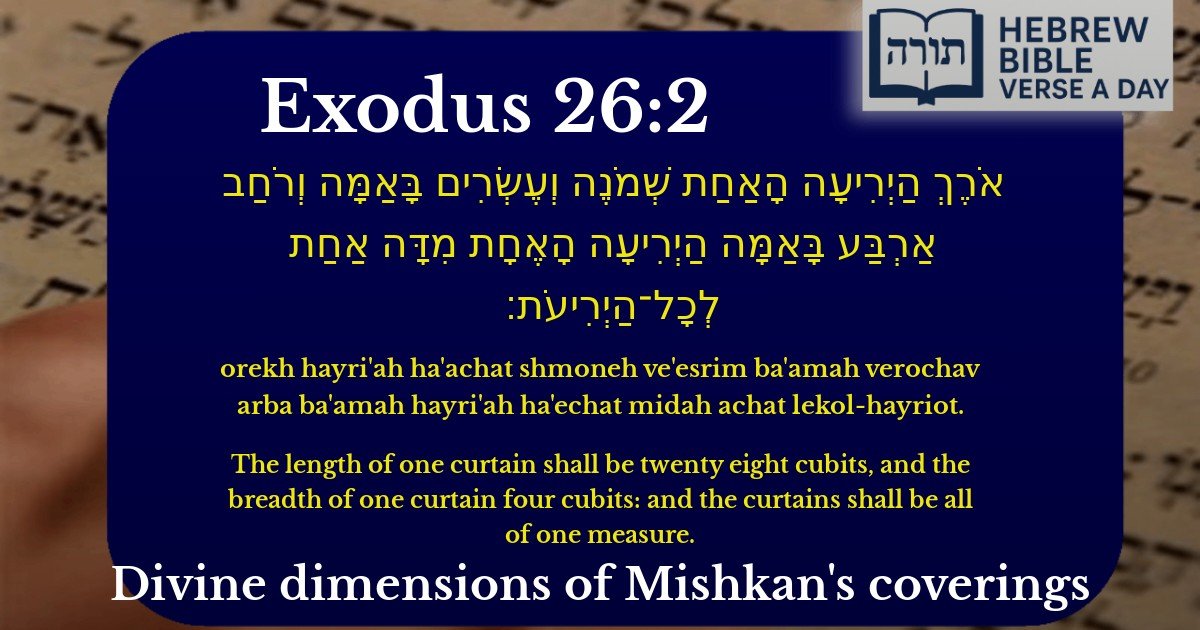

Dimensions of the Mishkan's Curtains
The verse (Exodus 26:2) describes the measurements of the curtains (yeriot) for the Mishkan (Tabernacle). Each curtain was to be 28 cubits in length and 4 cubits in width, with all curtains sharing the same uniform measurement. Rashi explains that these dimensions were divinely ordained to ensure the Mishkan's structural integrity and spiritual significance.
Symbolism of the Measurements
According to the Midrash (Shemot Rabbah 35:6), the number 28 (twenty-eight cubits) alludes to the 28 generations from Adam until the giving of the Torah, emphasizing that the Mishkan represents the culmination of divine revelation. The width of 4 cubits corresponds to the four directions of the world, symbolizing that Hashem's presence in the Mishkan encompasses all of creation.
Uniformity in Construction
The Rambam (Hilchot Beit HaBechirah 1:15) derives from the phrase "מִדָּה אַחַת לְכָל־הַיְרִיעֹת" ("one measure for all the curtains") that precision in fulfilling divine commandments is essential. The Talmud (Menachot 99a) further teaches that uniformity in the Mishkan's construction reflects the unity of Klal Yisrael in serving Hashem.
Practical Implications