Frequently Asked Questions
Q: What is the meaning of Exodus 26:11?
A: Exodus 26:11 describes the construction of the Mishkan (Tabernacle), specifically how the curtains of the tent were to be connected using brass clasps and loops. This ensured that the Mishkan would be one unified structure, symbolizing unity in serving Hashem. Rashi explains that these clasps held the curtains together firmly, representing the importance of unity among the Jewish people in their divine service.
Q: Why were brass clasps used in the Mishkan?
A: Brass (nechoshet) was used for the clasps because it is a durable metal, symbolizing strength and permanence in connecting the parts of the Mishkan. The Midrash (Shemot Rabbah 35:2) teaches that every material used in the Mishkan had spiritual significance, and brass represents steadfastness in fulfilling Hashem's commandments.
Q: What lesson can we learn from the Mishkan's curtains being joined together?
A: The joining of the Mishkan's curtains teaches the importance of unity among the Jewish people. Just as the clasps connected the separate curtains into one structure, we must work to unite despite our differences. The Talmud (Sanhedrin 27b) compares this to how all Jews are responsible for one another, bound together like the parts of the Mishkan.
Q: How does the concept of 'that it may be one' apply today?
A: The principle of the Mishkan being 'one' applies today in how we build Jewish communities and synagogues. Just as the Mishkan was unified through its construction, we must strive for unity in our congregations and families. The Rambam (Hilchos Beis HaBechira 1:12) derives from this that a synagogue, like the Mishkan, should be a place that brings people together in service of Hashem.
Q: Why were there exactly fifty clasps in the Mishkan?
A: The fifty brass clasps correspond to the fifty gates of understanding (Sha'arei Binah) mentioned in Kabbalistic teachings (Tikunei Zohar 13). This connection shows that proper unity (represented by the clasps) leads to higher spiritual understanding. Additionally, the number fifty relates to the counting of the Omer towards Shavuos, emphasizing spiritual preparation and unity.


Explanation of the Verse
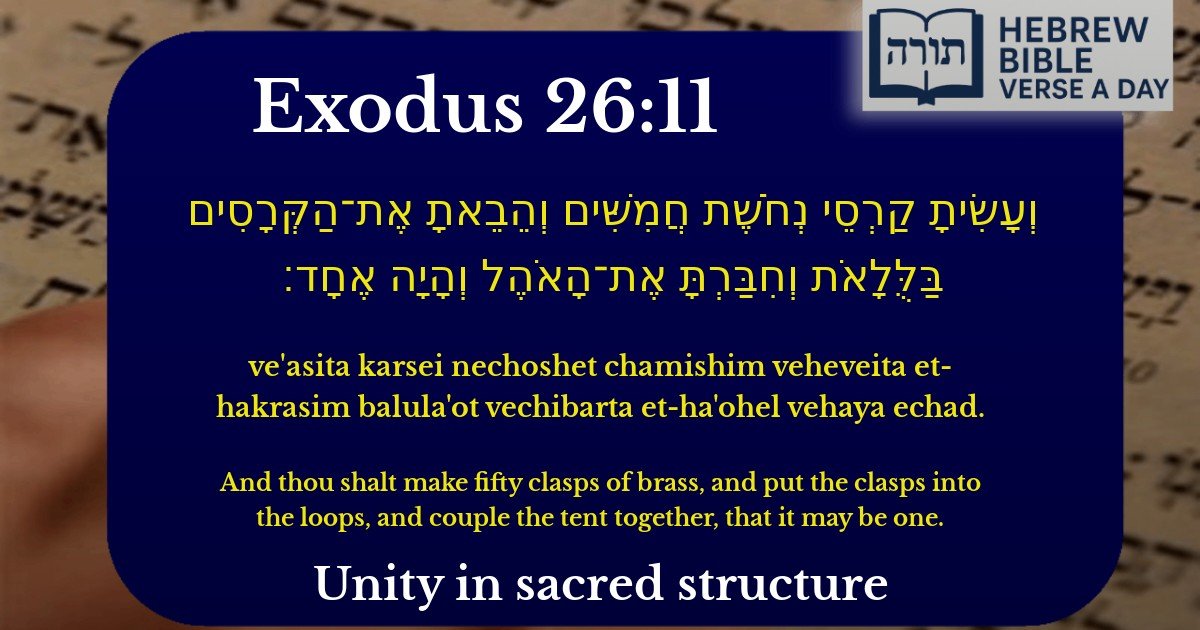
The verse (Shemot 26:11) describes the construction of the Mishkan (Tabernacle), specifically the joining of the curtains using brass clasps (karsei nechoshet) and loops (lula'ot). The purpose was to unify the structure so that it would be "one" (vehaya echad).
Rashi's Commentary
Rashi explains that the fifty brass clasps were used to connect the two sets of curtains (each consisting of five curtains) that formed the roof of the Mishkan. The clasps ensured that the curtains would remain securely fastened, symbolizing the unity of the Jewish people in serving Hashem. Rashi emphasizes that the Mishkan was a single, cohesive structure, reflecting the harmony required in divine service.
Symbolism of Brass (Nechoshet)
The choice of brass (nechoshet) for the clasps is significant. The Midrash (Shemot Rabbah 35:2) notes that brass represents strength and durability, as it does not rust. This symbolizes the enduring nature of the covenant between Hashem and Israel. Additionally, the Kli Yakar suggests that brass, being less precious than gold or silver, teaches humility—even the "lower" materials have a vital role in the Mishkan.
Unity of the Mishkan
The phrase vehaya echad ("that it may be one") underscores the importance of unity in the Mishkan's construction. The Talmud (Yoma 72a) compares the Mishkan to the Jewish people: just as the Mishkan's components were joined seamlessly, so too must Klal Yisrael be united in purpose. The Rambam (Hilchos Beis HaBechirah 1:12) extends this idea, teaching that the Mishkan's unity reflects the oneness of Hashem.
Practical Lessons