Frequently Asked Questions
Q: What is the significance of the ram skins dyed red and the taĥash skins covering the Mishkan (Tabernacle)?
A: According to Rashi (Exodus 26:14), the ram skins dyed red (עֹרֹת אֵילִם מְאָדָּמִים) served as the inner covering of the Mishkan, while the taĥash skins (עֹרֹת תְּחָשִׁים) were the outermost layer. The red dye symbolized atonement, as the ram is associated with the binding of Yitzchak (Akeidah), where a ram was sacrificed in place of Yitzchak. The taĥash was a rare, colorful animal that appeared specifically for this purpose (Midrash Tanchuma, Terumah 6).
Q: What was the taĥash (תְּחָשׁ) mentioned in the verse?
A: The Talmud (Shabbat 28b) explains that the taĥash was a unique, multi-colored animal that existed only during the time of the Mishkan’s construction. Its skin was used as the outermost covering for the Mishkan. The Midrash (Bereishit Rabbah 16:4) describes it as having radiant, multicolored skin, symbolizing beauty and distinction in the service of Hashem.
Q: Why were there multiple coverings for the Mishkan?
A: The Mishkan had four layers of coverings (Exodus 26:1-14), each serving a spiritual and practical purpose. The outer taĥash skin provided protection from the elements, while the inner layers (including the ram skins) symbolized different aspects of holiness and atonement. The Ramban (Exodus 26:1) explains that the multiple layers reflect the Mishkan’s sanctity, shielding the inner holiness from the outside world.
Q: How does the covering of the Mishkan apply to us today?
A: The Sages teach that the Mishkan serves as a model for personal and communal holiness. Just as the Mishkan had protective and beautiful coverings, we must also 'cover' and elevate our physical lives with holiness. The ram skins remind us of dedication (like the Akeidah), and the taĥash skins teach that uniqueness in serving Hashem is precious (based on teachings from the Kli Yakar, Exodus 26:14).

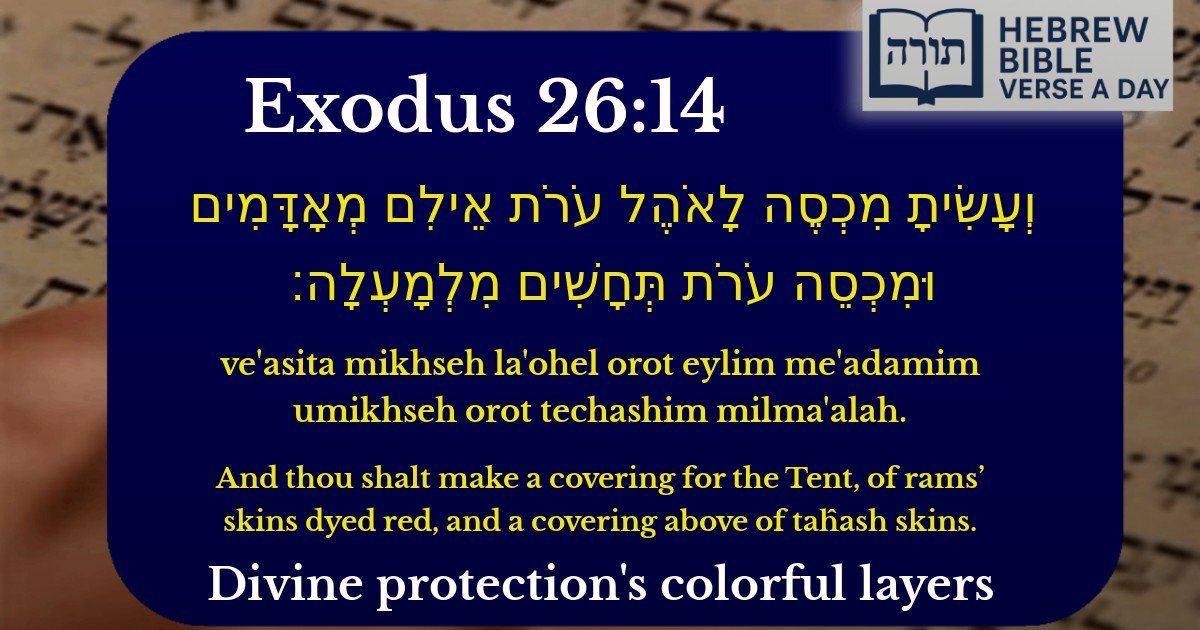

The Coverings of the Mishkan
The verse (Shemot 26:14) describes two coverings for the Mishkan (Tabernacle): the lower covering of ram skins dyed red (orot eilim me'adamim) and the upper covering of tachash skins. These materials served both practical and symbolic purposes in the construction of the Mishkan.
Rams' Skins Dyed Red
Rashi (on Shemot 26:14) explains that the ram skins were dyed red to beautify the Mishkan. The Ramban adds that these skins came from the rams sacrificed during the consecration of the Kohanim (Shemot 29), symbolizing dedication and atonement. The red dye (me'adamim) may allude to the concept of mesirut nefesh (self-sacrifice), as red often represents blood and life-force in Torah symbolism.
The Tachash Covering
The upper covering was made of tachash skins, a material shrouded in mystery. The Talmud (Shabbat 28a) debates its nature, with opinions ranging from a rare, multi-colored animal created specifically for the Mishkan (Rabbi Yehuda) to a type of processed leather (Rabbi Nechemia). The Midrash (Bamidbar Rabbah 12:11) describes the tachash as having radiant, multi-colored skin, symbolizing the diversity and unity of Klal Yisrael.
Symbolic Layers
Practical Halachic Implications
The Kli Yakar notes that the tachash covering was placed above the ram skins, indicating that spiritual goals (represented by the radiant upper layer) must surpass physical preparations (the dyed skins below). This mirrors the relationship between ruchniyut (spirituality) and gashmiyut (physicality) in avodat Hashem.