Frequently Asked Questions
Q: What is the significance of the colors used in the Parochet (veil)?
A: The colors of the Parochet (blue, purple, and scarlet) represent different spiritual concepts. Blue (techelet) symbolizes the heavens and divine connection, purple (argaman) represents royalty and dignity, and scarlet (tola'at shani) signifies atonement and sacrifice. The fine twined linen (shesh) reflects purity. Together, they create a sacred atmosphere for the Mishkan (Tabernacle). Rashi and the Midrash explain that these materials were chosen to reflect the grandeur and holiness of the space they adorned.
Q: Why were the Keruvim (cherubim) woven into the Parochet?
A: The Keruvim woven into the Parochet served as a reminder of divine protection and the relationship between Hashem and the Jewish people. According to the Talmud (Yoma 54a), the Keruvim symbolized love—when the Jewish people followed Hashem’s will, they faced each other; when they strayed, they turned away. Their presence on the Parochet emphasized that the Mishkan was a place of closeness to the Divine.
Q: What was the purpose of the Parochet in the Mishkan?
A: The Parochet served as a divider between the Kodesh (Holy Place) and the Kodesh HaKodashim (Holy of Holies), where the Aron (Ark) rested. Only the Kohen Gadol (High Priest) could pass beyond it, and only on Yom Kippur. The Rambam explains that this separation emphasized the supreme holiness of the innermost chamber, teaching reverence for the sacred space where the Divine Presence dwelled.
Q: How does the Parochet relate to us today?
A: Although we no longer have the Mishkan or Beit HaMikdash (Temple), the Parochet teaches us about creating boundaries for holiness in our lives. Just as the Parochet separated the most sacred space, we set boundaries—such as tefillah (prayer), Shabbat, and mitzvot—to elevate our connection with Hashem. The Midrash Tanchuma (Terumah 10) compares the Parochet to the heavens, reminding us that holiness is accessible through sincere devotion.
Q: Who made the Parochet, and what does 'ma'aseh choshev' mean?
A: The Parochet was crafted by skilled artisans, as the verse states it was made with 'ma'aseh choshev' (artistic work). Rashi explains this refers to intricate weaving with multiple layers and designs. The Talmud (Yoma 72a) teaches that such craftsmanship required wisdom and intention, reflecting how every detail of the Mishkan was made with devotion to honor Hashem.

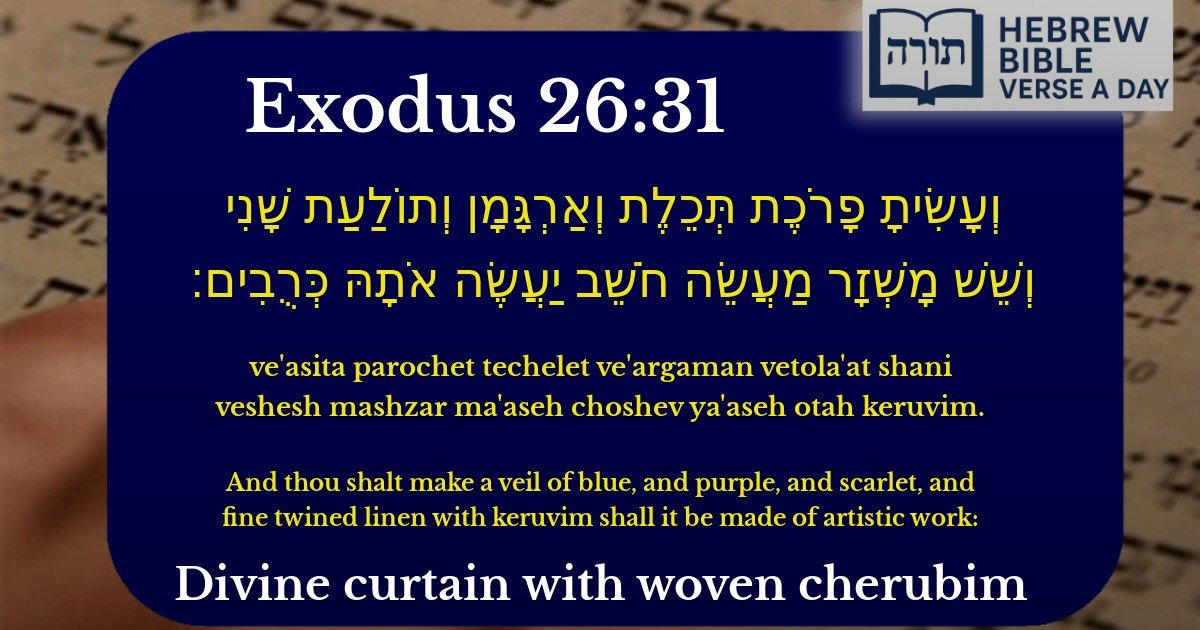

The Parochet: A Sacred Partition
The verse describes the construction of the Parochet (veil) that separated the Holy of Holies (Kodesh HaKodashim) from the rest of the Mishkan (Tabernacle). According to Rashi (Exodus 26:31), the Parochet was woven from four materials: blue (techelet), purple (argaman), scarlet (tola'at shani), and fine twined linen (shesh mashzar). These materials symbolize different aspects of divine service and heavenly connection.
Symbolism of the Colors
The Keruvim (Cherubim) on the Parochet
The verse states that the Parochet was to be embroidered with Keruvim. Rashi (Exodus 26:31) explains that these were woven figures of angels, symbolizing divine protection and the presence of Hashem’s glory. The Talmud (Yoma 54a) teaches that the Keruvim on the Parochet faced each other when Bnei Yisrael fulfilled Hashem’s will, representing divine love and closeness.
The Parochet as a Spiritual Barrier
The Parochet served as a physical and spiritual boundary, emphasizing the sanctity of the Holy of Holies. The Ramban (Exodus 26:31) explains that just as the Parochet concealed the innermost sanctum, so too does Hashem’s presence remain hidden in this world, accessible only through sincere worship and spiritual refinement.