Frequently Asked Questions
Q: What is the 'screen' mentioned in Exodus 26:37?
A: The 'screen' (מָסָךְ) refers to the entrance curtain of the Mishkan (Tabernacle). According to Rashi, this was a beautifully woven curtain separating the Kodesh (Holy Place) from the outer courtyard, symbolizing the transition from the mundane to the sacred.
Q: Why were the pillars made of shittim wood and covered in gold?
A: Shittim wood (acacia) was durable and readily available in the wilderness, while the gold overlay represented holiness and purity. The Midrash teaches that the combination of wood (a humble material) and gold (a precious metal) teaches balance – we should remain grounded yet strive for spiritual refinement.
Q: What is the significance of the five pillars in Exodus 26:37?
A: The five pillars correspond to the five books of the Torah (Bereishit, Shemot, Vayikra, Bamidbar, Devarim), as taught in Kabbalistic sources. Just as these pillars supported the entrance to the Mishkan, the Torah is the foundation that allows us to enter into a relationship with Hashem.
Q: Why were the sockets made of brass (copper) instead of gold?
A: The Ramban explains that brass (נְחֹשֶׁת), being stronger than gold, was used for the sockets because they needed to bear the weight of the structure. This teaches that while spiritual beauty (gold) is important, practical foundations (brass) are equally necessary in serving Hashem.
Q: How does this verse apply to our lives today?
A: Just as the Mishkan's entrance required beautiful but functional construction, our homes and synagogues should be both aesthetically uplifting and practically designed for Torah living. The Talmud (Berachot 8a) teaches that the beauty of a shul inspires proper reverence, just as the golden pillars enhanced the Mishkan.

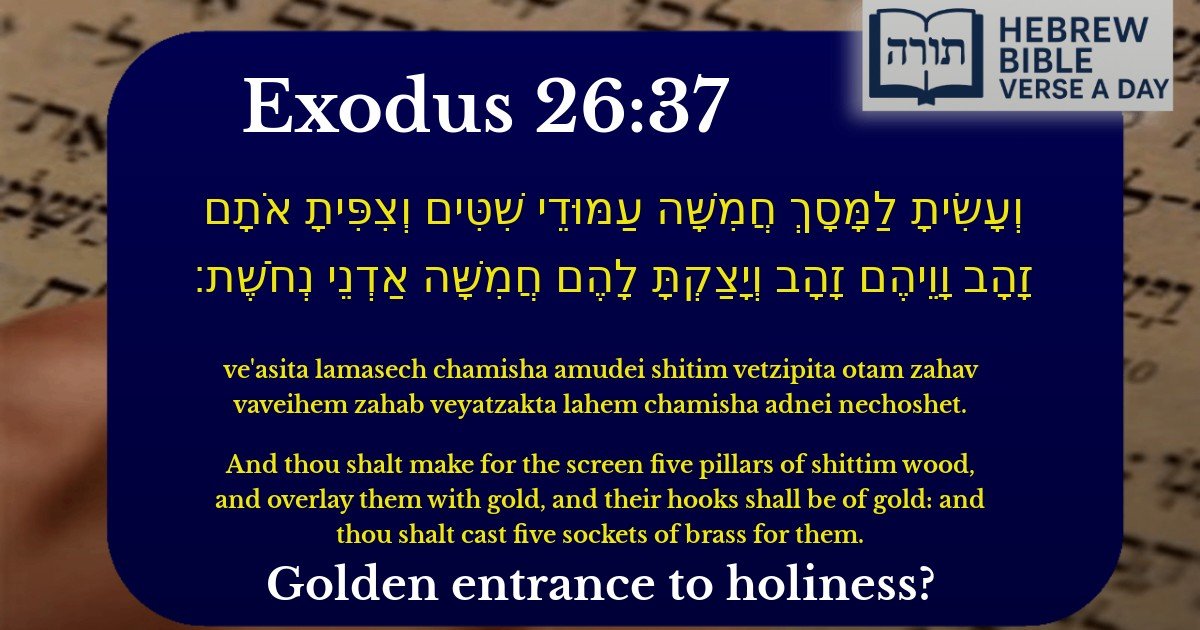

The Screen and Its Pillars in the Mishkan
The verse (Shemot 26:37) describes the construction of the masach (screen) at the entrance of the Mishkan, supported by five amudei shittim (acacia wood pillars) overlaid with gold. Rashi explains that this screen served as the entrance to the Ohel Moed (Tent of Meeting), separating the Kodesh (Holy Place) from the outer courtyard. The number five corresponds to the five books of the Torah, symbolizing that entry into holiness is governed by Torah principles.
Symbolism of the Materials
The Number Five and Its Significance
The Talmud (Menachot 88a) associates the number five with the five levels of the soul (nefesh, ruach, neshamah, chayah, yechidah), suggesting that the pillars allude to the complete devotion required in divine service. Additionally, the five pillars mirror the five fingers of a hand, symbolizing action—indicating that holiness is attained through mitzvot in deed.
The Golden Hooks (Vavim)
Rashi emphasizes that the vavim (hooks) were made of gold to ensure uniformity in beauty and function. The Vilna Gaon adds that the hooks symbolize the connection (vav means "hook" but also the Hebrew letter vav, meaning "and") between the physical structure and its spiritual purpose, binding the pillars to the screen seamlessly.