
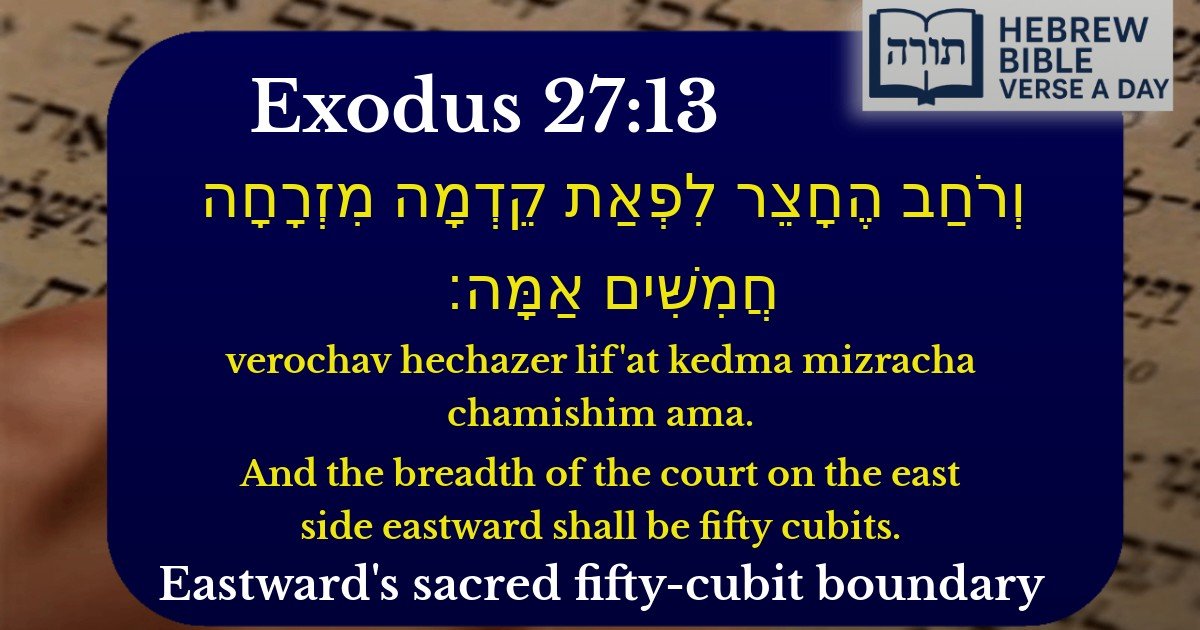

Exodus 27:13 - Eastward's sacred fifty-cubit boundary

Exodus 27:13 - שמות 27:13

Hebrew Text

וְרֹחַב הֶחָצֵר לִפְאַת קֵדְמָה מִזְרָחָה חֲמִשִּׁים אַמָּה׃

English Translation

And the breadth of the court on the east side eastward shall be fifty cubits.

Transliteration

Verochav hechazer lif'at kedma mizracha chamishim ama.

Hebrew Leining Text

וְרֹ֣חַב הֶֽחָצֵ֗ר לִפְאַ֛ת קֵ֥דְמָה מִזְרָ֖חָה חֲמִשִּׁ֥ים אַמָּֽה׃

🎵 Listen to leining

Parasha Commentary

Context in the Mishkan

The verse (Exodus 27:13) describes the dimensions of the courtyard (chatzer) surrounding the Mishkan (Tabernacle). The eastern side is specified as being fifty cubits wide. Rashi explains that this measurement is consistent with the overall structure of the courtyard, which was 100 cubits long (north to south) and 50 cubits wide (east to west). The symmetry reflects the precision required in constructing sacred space.

Symbolism of the East

The eastward direction (kedem) holds special significance in Jewish tradition. The Midrash (Bamidbar Rabbah 2:10) notes that the east is associated with the direction of the sunrise, symbolizing renewal and divine light. Rambam (Hilchot Beit HaBechirah 7:12) further emphasizes that the entrance to the Mishkan faced east, aligning with the natural order of the world and the movement of the sun, which reflects Hashem's glory.

Measurement of Fifty Cubits

The number fifty carries deep meaning in Jewish thought. The Talmud (Rosh Hashanah 21b) connects it to the fifty levels of understanding (binah), with the highest level being divine wisdom. The Zohar (Terumah 152a) suggests that the fifty cubits correspond to the fifty gates of holiness, representing spiritual elevation. Thus, the courtyard's breadth may symbolize the accessibility of divine wisdom to those who enter the sacred space.

Structural Parallels

  • The fifty-cubit width mirrors the dimensions of the Holy of Holies in the Beit HaMikdash (Temple), as noted by the Malbim on Exodus 26.
  • Rabbi Samson Raphael Hirsch highlights that the courtyard's open design (with its curtains and pillars) allowed for communal participation, emphasizing that holiness is not confined but accessible to all of Israel.

📚 Talmud Citations

This verse is not quoted in the Talmud.

Frequently Asked Questions

Q: What does Exodus 27:13 mean when it describes the width of the courtyard as fifty cubits?
A: This verse is part of the Torah's detailed instructions for building the Mishkan (Tabernacle). The 'fifty cubits' refers to the width of the eastern side of the courtyard surrounding the Mishkan. A cubit (amah) is an ancient measurement approximately 18-24 inches long. Rashi explains that these precise measurements were divinely commanded to create a sacred space where the Divine Presence could dwell among the Jewish people.
Q: Why is the east side of the Mishkan's courtyard specifically mentioned in Exodus 27:13?
A: The east side is emphasized because it was the main entrance to the Mishkan's courtyard (as explained in Exodus 27:16). The Midrash notes that the east holds special significance as the direction of the sunrise, symbolizing renewal and the light of Torah. The entrance faced eastward to teach that we should always be looking forward to spiritual growth and connection with Hashem.
Q: How big was fifty cubits in modern measurements?
A: Fifty cubits would be approximately 75-100 feet (23-30 meters), depending on whether we use the 18-inch or 24-inch cubit measurement. The Talmud (Eruvin 3b) discusses the exact length of a cubit, with opinions varying between these measurements. What's important is that the Torah gives precise dimensions to show that serving Hashem requires attention to detail in both physical and spiritual matters.
Q: What can we learn today from the detailed measurements of the Mishkan in Exodus 27:13?
A: The Rambam teaches that the precise measurements remind us that our service to Hashem must be exact and thoughtful. Just as the Mishkan required specific dimensions, our mitzvot today require proper intention and care. The Sages also derive from this that holiness isn't abstract - it manifests in physical spaces and actions when we dedicate them properly to divine service.
Q: Why does the Torah include so many details about the Mishkan's construction?
A: The Midrash explains that the detailed descriptions show how precious the Mishkan was to Hashem. Every measurement and material teaches spiritual lessons. For example, the number fifty corresponds to the fifty gates of understanding (Bamidbar Rabbah 12:21). The Talmud (Menachot 29a) also teaches that these details were given to Moses at Sinai to show that even the 'smallest' aspects of serving Hashem have eternal significance.