Frequently Asked Questions
Q: What does Exodus 27:14 mean in the context of the Mishkan (Tabernacle)?
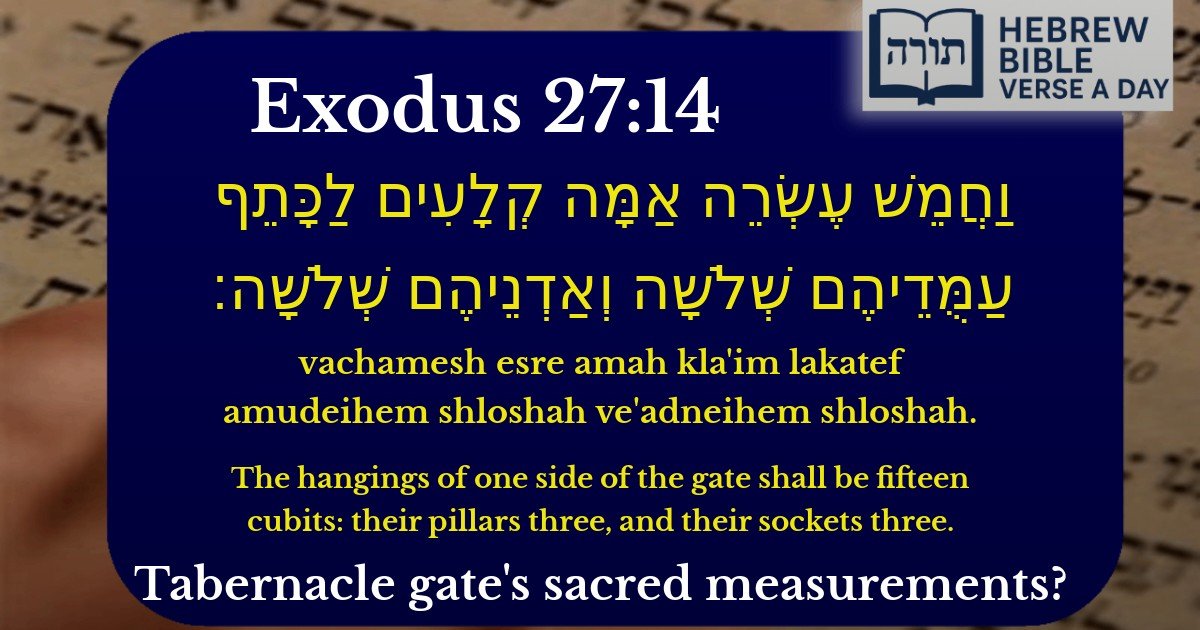
A: Exodus 27:14 describes the measurements and structure of the hangings (קְלָעִים) for one side of the courtyard entrance of the Mishkan. According to Rashi, this verse specifies that the hangings were 15 cubits long, supported by three pillars with three sockets (bases). This was part of the detailed design given by Hashem for the Mishkan's construction.
Q: Why does the Torah give such specific measurements for the Mishkan's courtyard?
A: The precise measurements in Exodus 27:14 (and throughout the Mishkan's description) teach us the importance of order and exactness in serving Hashem. The Rambam explains that every detail of the Mishkan had spiritual significance, and its construction reflected heavenly wisdom. The measurements were not arbitrary but carried deep meaning in connecting the physical and spiritual worlds.
Q: What is the significance of the number three in Exodus 27:14 (three pillars and three sockets)?
A: The number three in this verse (three pillars and three sockets) is significant in Jewish tradition. The Midrash often associates the number three with stability and completeness, like the three Patriarchs (Avraham, Yitzchak, and Yaakov) who established the Jewish people. Here, it may symbolize the strong foundation of the Mishkan as a place of divine service.
Q: How do the details in Exodus 27:14 apply to us today?
A: While we no longer have the Mishkan, the Talmud (Berachot 55a) teaches that the details of its construction provide eternal lessons. The careful measurements remind us to approach mitzvot with precision and mindfulness. Just as the Mishkan's structure had purpose, our actions in serving Hashem should be intentional and well-planned.
Q: What materials were used for the hangings and pillars in Exodus 27:14?
A: Earlier verses (Exodus 27:9-10) explain that the courtyard hangings were made of fine twisted linen, and the pillars were made of acacia wood overlaid with silver (as Rashi notes). The sockets (bases) were likely made of copper, as described in Exodus 27:10. These materials were chosen for their durability and beauty in honoring the Mishkan.


Context in the Mishkan
The verse (Exodus 27:14) describes the dimensions and structure of the hangings (kelaim) for one side of the courtyard entrance of the Mishkan (Tabernacle). According to Rashi, this refers to the south side of the eastern entrance, where the hangings measured 15 cubits in length, supported by three pillars (ammudim) with three corresponding sockets (adanim).
Symbolism of the Measurements
The Midrash (Shemot Rabbah 35:1) notes that the number 15 alludes to the 15 "Songs of Ascents" in Tehillim (Psalms 120-134), representing spiritual elevation. The three pillars, as explained by the Rambam in Hilchot Beit HaBechirah, symbolize the three pillars of the world: Torah, Avodah (service), and Gemilut Chasadim (acts of kindness) (Pirkei Avot 1:2).
Structural Details
Halachic Insights
The Talmud (Zevachim 59b) derives from this verse that the entrance to the Mishkan's courtyard required symmetry in its design. The Rambam (Hilchot Beit HaBechirah 1:12) later applies these principles to the Beit HaMikdash, emphasizing precision in sacred architecture.