Frequently Asked Questions
Q: What is the meaning of Exodus 28:10?
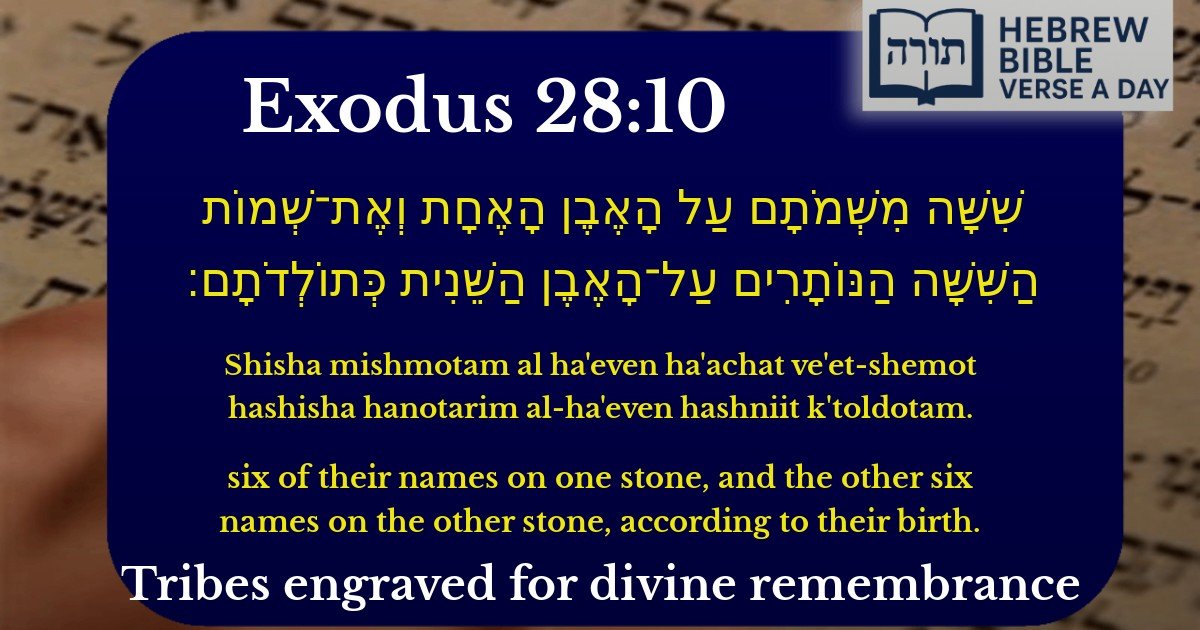
A: Exodus 28:10 describes how the names of the twelve tribes of Israel were to be engraved on two stones (six names on each stone) and placed on the shoulders of the Kohen Gadol's (High Priest's) ephod (a special garment). According to Rashi, this was a way for Hashem to always remember the tribes favorably, as their names were constantly before Him when the Kohen Gadol wore the ephod during service in the Mishkan (Tabernacle).
Q: Why were the names of the tribes engraved on stones?
A: The names were engraved on precious stones (shoham stones) to show the honor and importance of the tribes of Israel. The Talmud (Sotah 36a) explains that the stones served as a remembrance before Hashem, symbolizing that the Jewish people are always cherished. The Rambam (Hilchos Klei HaMikdash 9:9) also notes that this was part of the Kohen Gadol's sacred garments, which atoned for the people's sins.
Q: How were the names arranged on the stones?
A: The verse states that six names were on one stone and six on the other, arranged 'according to their birth' (כְּתוֹלְדֹתָם). Rashi explains that this means the names were listed in the order of the tribes' birth—Reuven, Shimon, Levi, Yehudah, Dan, and Naftali on one stone, and Gad, Asher, Yissachar, Zevulun, Yosef, and Binyamin on the other.
Q: What lesson can we learn from this verse today?
A: This verse teaches the importance of unity among the Jewish people. Even though the tribes were distinct, their names were equally honored on the Kohen Gadol's garments, showing that all Jews are precious before Hashem. The Midrash (Shemos Rabbah 38:8) emphasizes that just as the stones bore the names of all the tribes, every Jew has a unique role in serving Hashem while remaining part of one nation.


The Arrangement of the Tribes on the Stones
The verse (Shemot 28:10) describes the engraving of the names of the twelve tribes on the two stones of the choshen (breastplate) worn by the Kohen Gadol. Rashi explains that the names were divided equally—six on the first stone and six on the second—following the order of their birth. This division reflects the unity of the tribes while maintaining their individual distinctions.
Significance of the Order of Birth
The phrase "כְּתוֹלְדֹתָם" ("according to their birth") emphasizes the importance of lineage and the natural hierarchy established by Hashem. The Ramban notes that this arrangement honors the sanctity of each tribe’s unique role in Klal Yisrael, as their order of birth corresponds to their spiritual contributions.
Symbolism of the Two Stones
The Midrash Tanchuma (Tetzaveh 12) teaches that the two stones represent the unity of the tribes despite their differences. Just as the stones were united on the choshen, so too must the Jewish people remain united in service of Hashem. The division into six names per stone also alludes to the six days of creation, symbolizing that the tribes sustain the world through their righteousness.
The Kohen Gadol as a Unifying Force
The Talmud (Yoma 73a) explains that the choshen served as a means of divine communication, and the names of the tribes engraved upon it ensured that their merits were always before Hashem. The Sforno adds that the Kohen Gadol, by bearing these names, acted as an intermediary, embodying the collective spiritual aspirations of all twelve tribes.