Frequently Asked Questions
Q: Why did Aharon and his sons need to be washed with water before serving in the Mishkan?
A: According to Rashi and the Talmud (Yoma 28b), the washing symbolized purification and preparation for their sacred duties as kohanim (priests). Just as vessels used in the Temple required immersion, the kohanim needed this physical cleansing to represent spiritual readiness for divine service.
Q: Where exactly did the washing of Aharon and his sons take place?
A: The Torah specifies it was at the entrance of the Ohel Moed (Tent of Meeting). The Midrash (Sifra) explains this location was chosen to show that one must pass through purification before entering sacred spaces. The copper laver (kiyor) was later placed there for ongoing priestly washings (Shemos 30:18-20).
Q: Does the washing of kohanim have any relevance today?
A: While we no longer have the Temple service, the Rambam (Hilchos Biat Hamikdash 5) notes that kohanim still wash their hands before performing priestly blessings (Birkat Kohanim). This maintains a connection to the original sanctity described in our verse, teaching that spiritual acts require physical preparation.
Q: Why is water specifically used for this purification?
A: The Talmud (Ta'anis 2b) teaches that water represents Torah - just as water purifies, Torah purifies the soul. The Maharal explains that water's simple, life-sustaining nature makes it ideal for symbolizing the humility and clarity required for divine service.
Q: How many times were Aharon and his sons washed during their consecration?
A: The Talmud (Zevachim 19b) derives from the wording that they were washed once for this initial purification. However, Rashi notes that for regular Temple service, kohanim would wash their hands and feet daily from the copper laver (Shemos 30:19), showing that spiritual preparation must be ongoing.

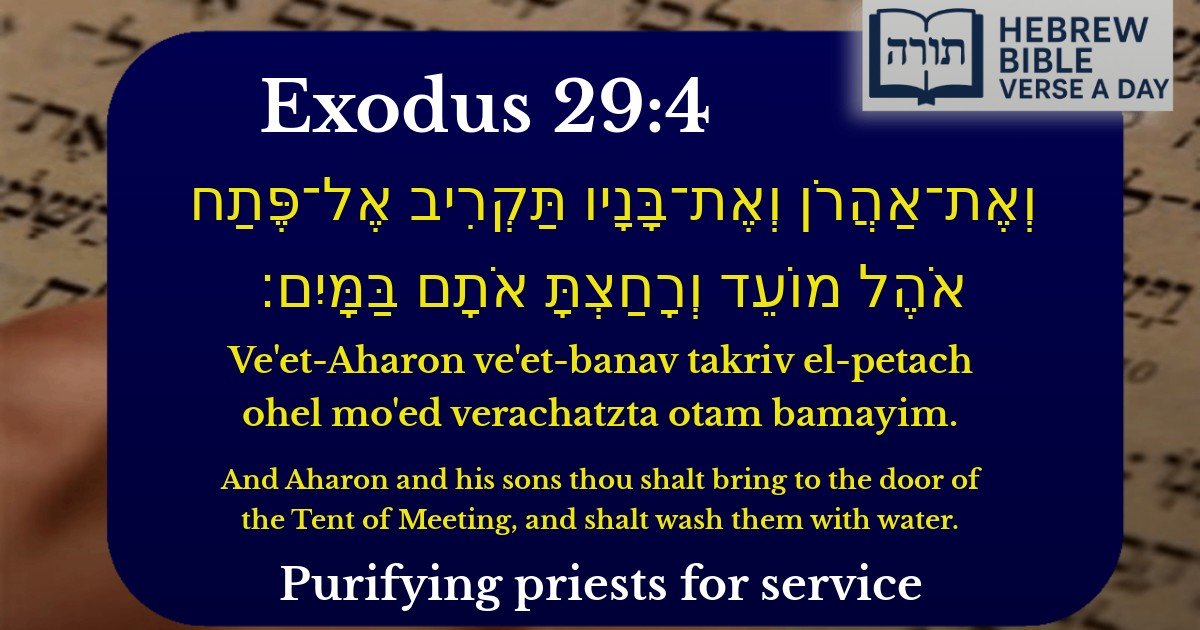

Introduction to the Verse
The verse (Shemot 29:4) describes the initial step in the consecration of Aharon and his sons as Kohanim (priests) for service in the Mishkan (Tabernacle). The washing with water symbolizes purification and preparation for their sacred duties.
Rashi's Commentary
Rashi explains that the washing was performed in a kior (laver), a special basin made for this purpose. He emphasizes that this washing was not merely for physical cleanliness but a spiritual purification, as the verse states, "And thou shalt wash them with water" (Shemot 29:4). Rashi further notes that this act was a prerequisite for all future service in the Mishkan, teaching that one must approach sacred duties in a state of purity.
Rambam's Perspective (Hilchot Klei HaMikdash 5:4)
Rambam (Maimonides) elaborates on the halachic (legal) aspects of this washing, stating that it was performed using living water (mayim chayim), such as from a spring or river, to signify renewal and vitality. He also clarifies that this washing was a one-time initiation ritual, distinct from the regular hand and foot washing required before service in the Mishkan.
Midrashic Insights (Sifra, Tzav)
The Midrash connects this washing to the concept of teshuvah (repentance), teaching that just as water purifies the body, sincere repentance purifies the soul. The Sifra adds that Aharon and his sons were washed at the entrance of the Ohel Moed (Tent of Meeting) to signify their transition from ordinary life to a higher level of sanctity.
Symbolism of the Washing
Practical Halachic Implications
The Gemara (Zevachim 19b) derives from this verse that a Kohen who serves without washing his hands and feet is liable for death at the hands of Heaven, underscoring the seriousness of proper preparation for divine service. This principle extends to later generations, where Kohanim in the Beit HaMikdash (Temple) were required to wash before performing sacred duties.