Frequently Asked Questions
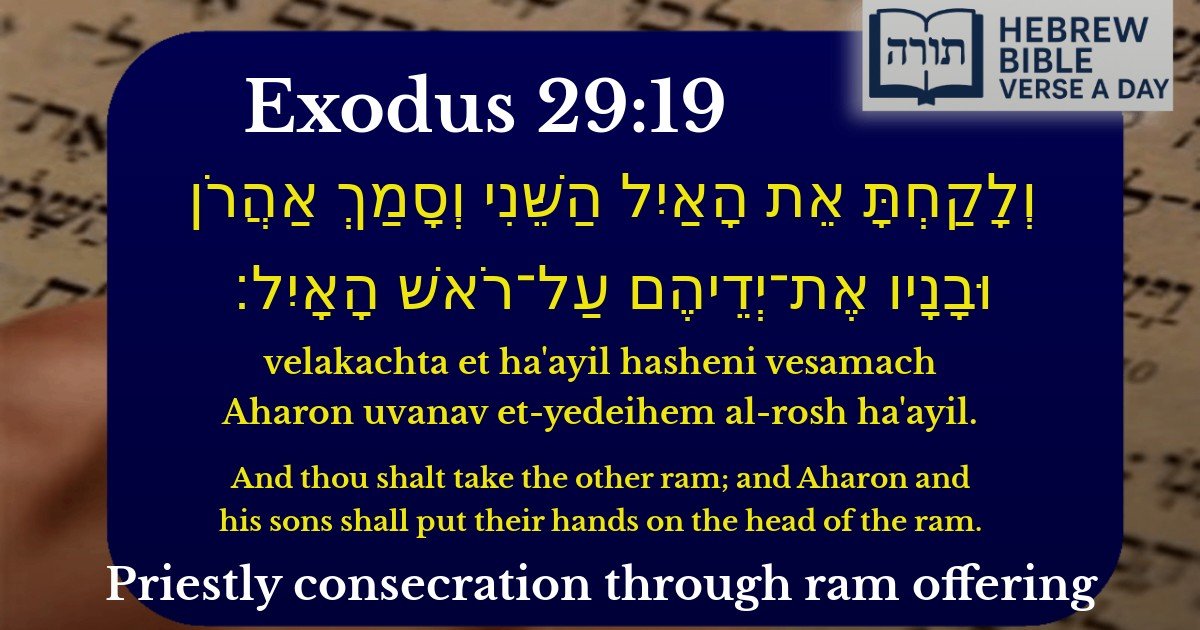
Q: What does it mean to 'put their hands on the head of the ram' in Exodus 29:19?
A: This act, called 'semichah' in Hebrew, symbolizes transferring ownership or responsibility. According to Rashi, when Aharon and his sons placed their hands on the ram's head, it represented that this sacrifice was being offered on their behalf for atonement and dedication to service in the Mishkan (Tabernacle).
Q: Why was a second ram used in Exodus 29:19?
A: The second ram (as opposed to the first one mentioned earlier in the chapter) was specifically for the inauguration ceremony of the Kohanim (priests). The Rambam explains that this ram was part of the 'ram of consecration' (איל המילואים), which completed the process of sanctifying Aharon and his sons for their priestly duties.
Q: What lesson can we learn from the laying of hands in Exodus 29:19?
A: The Talmud (Menachot 93b) teaches that semichah (laying hands) demonstrates personal involvement and commitment. Even though the Kohanim were being elevated to sacred service, they had to actively participate in the process - teaching us that spiritual growth requires our own effort and dedication.
Q: Does the practice of laying hands on sacrifices still apply today?
A: While we currently don't bring sacrifices without the Beit Hamikdash (Temple), the principle remains relevant. The Sefer Hachinuch explains that the physical act of semichah created a psychological readiness for repentance. Today, we can apply this by physically engaging in mitzvot (like shaking a lulav) to enhance our spiritual focus.
Q: Why did only Aharon and his sons perform this act in Exodus 29:19?
A: This was part of their unique inauguration as Kohanim. The Midrash (Tanchuma Tzav 14) explains that this ceremony established the eternal priesthood - teaching that spiritual leadership requires both divine selection (Aharon was chosen by Hashem) and familial continuity (his sons after him).


Context in the Torah
The verse (Shemot 29:19) is part of the detailed instructions for the consecration of Aharon and his sons as Kohanim (priests) in the Mishkan (Tabernacle). The "second ram" refers to the Ayil HaMiluim (the ram of inauguration), which was offered as a sacrifice to complete the sanctification process.
Rashi's Explanation
Rashi (Rabbi Shlomo Yitzchaki) explains that the laying of hands (semichah) by Aharon and his sons on the ram's head symbolizes transferring ownership and atonement. The act demonstrates that the sacrifice is being offered on their behalf as part of their initiation into the priesthood. Rashi further notes that this ram was distinct from the first ram mentioned earlier (Shemot 29:15), which was an olah (burnt offering).
Rambam's Perspective
In Hilchot Maaseh HaKorbanot (3:15), the Rambam (Maimonides) elaborates on the halachic significance of semichah, stating that it is a mandatory part of certain sacrifices, including this inauguration offering. The physical act of pressing one's hands on the animal signifies complete identification with the korban (sacrifice) and submission to Hashem's will.
Midrashic Insights
Symbolism of the Second Ram
The Kli Yakar (Rabbi Shlomo Ephraim Luntschitz) explains that the two rams correspond to two aspects of the priesthood: the first ram (olah) represents the Kohen's personal commitment to Hashem, while the second ram (miluim) signifies their role in atoning for and elevating the Jewish people. The semichah on the second ram thus emphasizes their responsibility to intercede on behalf of Klal Yisrael.