Frequently Asked Questions
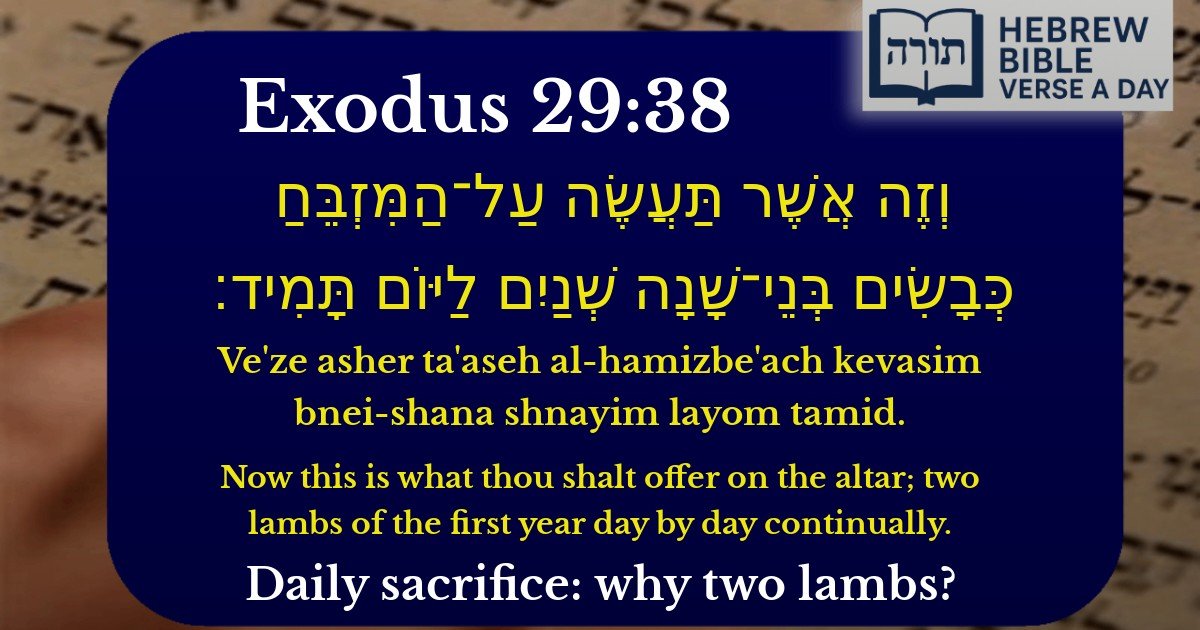
Q: What does Exodus 29:38 mean?
A: Exodus 29:38 instructs the Jewish people to bring two one-year-old lambs as daily offerings on the altar—one in the morning and one in the afternoon. This is known as the 'Korban Tamid' (תָמִיד), meaning the 'continual offering.' Rashi explains that this mitzvah (commandment) demonstrates our constant devotion to Hashem, as the offerings are brought every day without interruption.
Q: Why were two lambs offered daily in the Temple?
A: The two daily lambs (Korban Tamid) symbolize the Jewish people's unwavering commitment to serving Hashem. The Rambam (Hilchot Temidim u'Musafim 1:1) teaches that this offering maintains a constant connection between the Jewish people and the Divine, ensuring that the altar is never left empty. The morning and afternoon offerings also represent the cycle of day and night, showing that our service to Hashem is continuous.
Q: How does Exodus 29:38 apply today without the Temple?
A: Although we no longer have the Beit HaMikdash (Temple), the Talmud (Berachot 26b) teaches that our daily prayers (Shacharit and Mincha) correspond to the morning and afternoon Tamid offerings. The Midrash (Tanchuma Tetzaveh 14) also explains that Torah study and acts of kindness can serve as spiritual substitutes for sacrifices. Thus, we maintain the lesson of constant devotion in our daily lives.
Q: Why were the lambs required to be one year old?
A: Rashi (on Exodus 29:38) explains that the requirement for the lambs to be 'bnei shanah' (one year old) signifies purity and freshness, as young animals are free from blemish. The Midrash (Sifra) adds that this teaches us to serve Hashem with the freshness and enthusiasm of youth, dedicating our best to Him.
Q: What is the significance of the word 'Tamid' (continual) in this verse?
A: The word 'Tamid' (תָמִיד) emphasizes consistency in serving Hashem. The Talmud (Yoma 33a) teaches that the Tamid offering was so important that even if the community could not afford two lambs daily, they would collect funds to ensure it was never missed. This teaches us that our relationship with Hashem must be steady and unwavering, not dependent on circumstances.


Explanation of the Verse
The verse (Shemot 29:38) describes the daily Korban Tamid (continual offering), which consisted of two yearling lambs offered each day on the Mizbe'ach (altar). This mitzvah is foundational in the Avodah (Temple service) and is elaborated upon in Parashat Pinchas (Bamidbar 28:1-8).
Rashi's Commentary
Rashi explains that the phrase "שְׁנַיִם לַיּוֹם" ("two per day") refers to one lamb in the morning and one in the afternoon, as derived from the wording in Bamidbar 28:4. This establishes the Korban Tamid as a perpetual obligation, symbolizing the unbroken connection between Klal Yisrael and Hashem.
Rambam's Perspective
In Hilchot Temidin uMusafin (1:1-3), the Rambam codifies this mitzvah as one of the most essential offerings in the Beit HaMikdash. He emphasizes that the Tamid must be brought even on Shabbat and Yom Tov, underscoring its unchanging nature.
Symbolism in Midrashic Sources
Halachic Significance
The Gemara (Berachot 26b) derives from this verse that the times of the Tamid offerings establish the framework for Shacharit and Mincha prayers. Thus, even in the absence of the Beit HaMikdash, tefillah serves as a substitute for the Korbanot.