

Join Our Newsletter To Be Informed When New Videos Are Posted
Hebrew Text
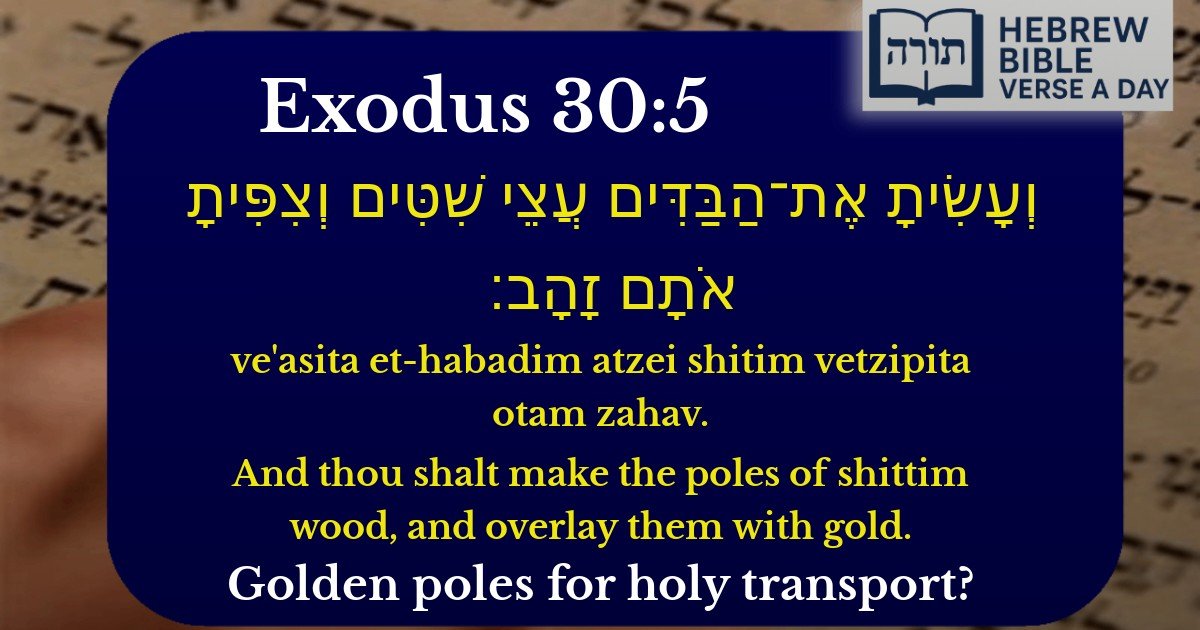
וְעָשִׂיתָ אֶת־הַבַּדִּים עֲצֵי שִׁטִּים וְצִפִּיתָ אֹתָם זָהָב׃
English Translation
And thou shalt make the poles of shittim wood, and overlay them with gold.
Transliteration
Ve'asita et-habadim atzei shitim vetzipita otam zahav.
Hebrew Leining Text
וְעָשִׂ֥יתָ אֶת־הַבַּדִּ֖ים עֲצֵ֣י שִׁטִּ֑ים וְצִפִּיתָ֥ אֹתָ֖ם זָהָֽב׃
🎵 Listen to leining
Parasha Commentary
📚 Talmud Citations
This verse is quoted in the Talmud.
📖 Yoma 72a
The verse is discussed in the context of the construction of the Ark and its poles, emphasizing the materials used and their significance.
📖 Menachot 98a
The verse is referenced in a discussion about the materials and craftsmanship involved in the making of the Tabernacle's utensils.
The Poles of the Ark: Materials and Symbolism
The verse (Shemot 25:13) commands the construction of the badim (poles) for the Aron HaKodesh (Holy Ark) using atzei shittim (shittim wood) overlaid with gold. Rashi explains that these poles were never to be removed from the Ark, as stated later in Shemot 25:15 ("לא יסרו ממנו"), symbolizing the eternal connection between the Jewish people and the Torah.
Choice of Shittim Wood
Rabbeinu Bachya notes that atzei shittim (acacia wood) was chosen because it was readily available in the wilderness and is a durable, non-decaying wood. The Midrash Tanchuma (Terumah 9) adds that this wood was planted by Yaakov Avinu in Egypt and later taken by Bnei Yisrael during the Exodus, showing divine foresight in preparing materials for the Mishkan.
Gold Overlay: Spiritual Significance
The Ramban explains that overlaying the wooden poles with gold represents the synthesis of the physical (etz, wood) and the spiritual (zahav, gold). This duality reflects how Torah must be carried in both our material and spiritual lives. The Kli Yakar emphasizes that the gold covering the wood symbolizes how Torah study should refine and elevate our natural inclinations.
Halachic Dimensions