

Join Our Newsletter To Be Informed When New Videos Are Posted
Hebrew Text
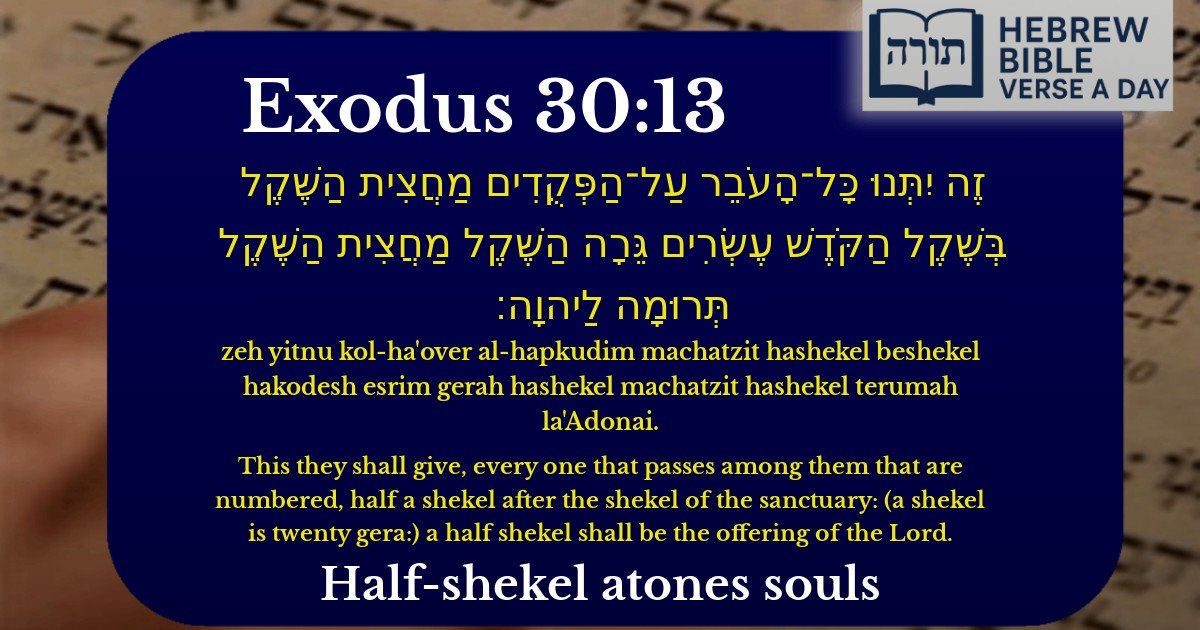
זֶה יִתְּנוּ כָּל־הָעֹבֵר עַל־הַפְּקֻדִים מַחֲצִית הַשֶּׁקֶל בְּשֶׁקֶל הַקֹּדֶשׁ עֶשְׂרִים גֵּרָה הַשֶּׁקֶל מַחֲצִית הַשֶּׁקֶל תְּרוּמָה לַיהוָה׃
English Translation
This they shall give, every one that passes among them that are numbered, half a shekel after the shekel of the sanctuary: (a shekel is twenty gera:) a half shekel shall be the offering of the Lord.
Transliteration
Zeh yitnu kol-ha'over al-hapkudim machatzit hashekel beshekel hakodesh esrim gerah hashekel machatzit hashekel terumah la'Adonai.
Hebrew Leining Text
זֶ֣ה&thinsp
🎵 Listen to leining
Parasha Commentary
📚 Talmud Citations
This verse is quoted in the Talmud.
📖 Shekalim 2a
The verse is discussed in the context of the half-shekel tax that was collected for the Temple service.
📖 Megillah 29b
The verse is referenced in a discussion about the importance of communal offerings and the half-shekel contribution.
📖 Bava Kamma 12b
The verse is cited in a discussion about monetary values and the shekel of the sanctuary.
The Half-Shekel Contribution
The verse (Shemot 30:13) commands every Israelite to give a half-shekel as a contribution to the Mishkan (Tabernacle). Rashi explains that this was a census method—rather than counting individuals directly (which could invite the "evil eye"), they would count the half-shekels instead. The half-shekel also served as atonement, particularly for the sin of the Golden Calf, as the Midrash (Tanchuma Ki Tisa 10) teaches.
The Shekel HaKodesh (Sacred Shekel)
The Torah specifies that the half-shekel must be given according to the "shekel of the sanctuary." Rambam (Hilchot Shekalim 1:3) clarifies that this refers to a standardized weight used for all contributions to the Mishkan and later the Beit HaMikdash. The value was fixed at twenty gerah, ensuring uniformity in donations.
Symbolism of the Half-Shekel
Practical Halachic Details
According to the Mishnah (Shekalim 1:1), the half-shekel was collected annually before Rosh Chodesh Nissan to fund public sacrifices. The Shulchan Aruch (Orach Chayim 694) later applies this concept to the custom of giving Machatzit HaShekel before Purim, commemorating this mitzvah.