Frequently Asked Questions
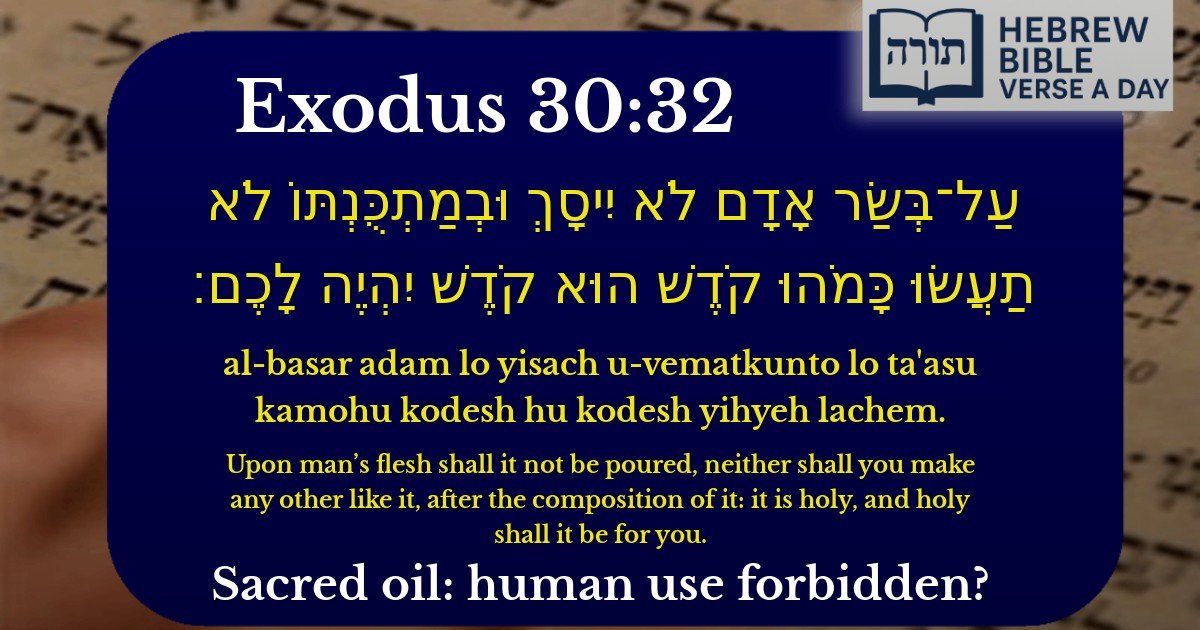
Q: What does Exodus 30:32 mean when it says 'Upon man’s flesh shall it not be poured'?
A: This verse refers to the sacred anointing oil described earlier in Exodus 30. According to Rashi and Jewish tradition, this means the special oil used to anoint the Mishkan (Tabernacle), its vessels, and the Kohanim (priests) must never be used for personal purposes like anointing ordinary people. It was reserved exclusively for holy use in the service of Hashem.
Q: Why was it forbidden to make a similar oil with the same ingredients?
A: The Rambam (Hilchos Kelei HaMikdash 1:3) explains that duplicating this sacred oil for personal use would diminish its holiness and uniqueness. The Torah emphasizes 'it is holy' to teach that this specific blend was set apart exclusively for sanctifying the Mishkan and its service. Making copies would violate this sanctity.
Q: What practical lesson can we learn from Exodus 30:32 today?
A: The Talmud (Kerisos 5b) derives from this verse the concept of respecting holy objects and not using them for mundane purposes. Today, this teaches us to treat sacred items (like siddurim, Torah scrolls, or tallis) with reverence and not to use them inappropriately, maintaining the distinction between holy and ordinary.
Q: What was the punishment for violating this commandment about the anointing oil?
A: The Talmud (Kerisos 7a) states that one who intentionally uses the sacred anointing oil improperly or makes a copy of it for personal use is subject to kares (spiritual excision). This severe punishment underscores how seriously the Torah views the misuse of items designated for holy purposes.
Q: How does this verse connect to the concept of kedushah (holiness) in Judaism?
A: As the Sforno explains, this verse teaches that kedushah isn't just about avoiding impurity, but actively setting things apart for divine service. The repetition of 'holy shall it be for you' emphasizes that we must consciously recognize and preserve the sanctity of objects dedicated to Hashem's service, both in the Mishkan and in our own relationship with holiness today.


Context and Source
The verse (Shemot 30:32) pertains to the sacred anointing oil (שמן המשחה) used in the Mishkan and later in the Beit HaMikdash. This oil was uniquely prepared according to Divine instruction and reserved exclusively for sanctifying vessels and consecrating Kohanim and kings.
Prohibition of Personal Use
"Upon man’s flesh shall it not be poured": Rashi explains that this prohibits using the oil for personal pleasure or anointing oneself like ordinary perfumes. The Rambam (Hilchot Kelei HaMikdash 1:3) further clarifies that this applies even to Kohanim—no individual may use it for personal benefit, as its sanctity is reserved for Divine service.
Prohibition of Replication
"Neither shall you make any other like it": The Talmud (Keritot 5a) states that one who replicates the exact formula of the anointing oil—even for sacred purposes—violates a Torah prohibition. The Rambam (Hilchot Kelei HaMikdash 1:4) adds that this applies only to replicating the complete formula; creating a similar oil with fewer ingredients is permitted.
Its Sacred Status
"It is holy, and holy shall it be for you": The Midrash (Shemot Rabbah 35:3) emphasizes that the oil’s holiness is intrinsic and eternal. The repetition of "holy" teaches that its sanctity persists even after the Mishkan era. The Ramban notes that this phrase reinforces the oil’s exclusive designation for mitzvot, not human use.
Practical Implications