Frequently Asked Questions
Q: What does Exodus 30:35 mean when it talks about making a 'perfume'?
A: Exodus 30:35 refers to the Ketoret (incense) that was offered daily in the Mishkan (Tabernacle) and later in the Beit Hamikdash (Holy Temple). According to Rashi, this was a special blend of spices that created a holy fragrance when burned. The Torah emphasizes that it must be made skillfully ('after the art of the perfumer') and with precise ingredients to maintain its sanctity.
Q: Why does the verse mention that the incense should be 'mingled with salt'?
A: The Talmud (Keritot 6b) explains that salt was added to the Ketoret to enhance its fragrance. Rambam (Hilchot Klei Hamikdash 2:4) adds that salt represents the eternal covenant between Hashem and the Jewish people, just as salt preserves food, the covenant preserves our relationship with G-d. The inclusion of salt teaches us that our service to G-d should be enduring and steadfast.
Q: What does it mean that the incense must be 'pure and holy'?
A: The Midrash (Shemot Rabbah 43:7) teaches that 'pure' refers to the physical quality - the ingredients must be unadulterated and of the finest quality. 'Holy' refers to its purpose - it was designated exclusively for divine service in the Mishkan/Temple. This teaches us that when serving Hashem, both our materials and intentions must be of the highest standard.
Q: Can we make this incense today?
A: The Rambam (Hilchot Klei Hamikdash 1:3) explains that the exact formula and preparation of the Ketoret was specific to Temple service. Since we don't have the Temple today, we don't prepare or use this incense. However, we remember it in our prayers (like during the Ketoret recitation in the morning service) and learn from its spiritual lessons about devotion to Hashem.
Q: What practical lesson can we learn from this verse today?
A: The Sforno teaches that just as the Ketoret required careful preparation with specific ingredients, our mitzvot today require proper preparation and intention. The 'salt' reminds us that our service should be enduring, and the 'pure and holy' requirement teaches that our actions should be sincere and dedicated to holiness. This applies to prayer, Torah study, and all mitzvot we perform.

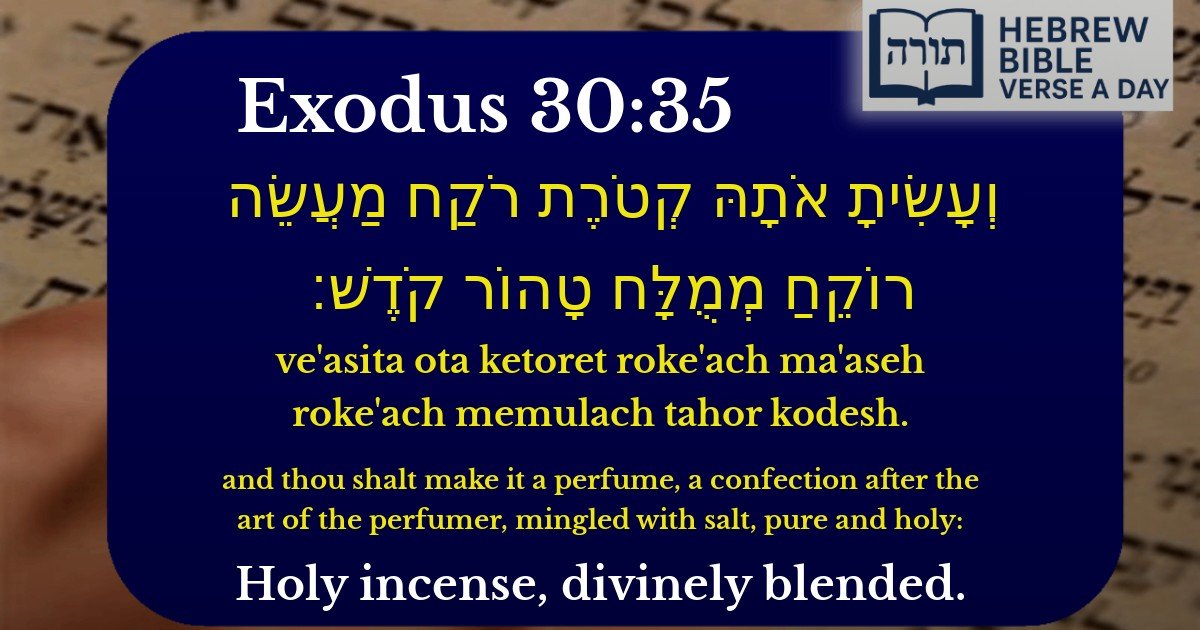

The Composition of the Ketoret (Incense)
The verse (Shemot 30:35) describes the preparation of the Ketoret, the sacred incense offered in the Mishkan (Tabernacle) and later in the Beit HaMikdash (Temple). Rashi explains that the phrase "רֹקַח מַעֲשֵׂה רוֹקֵחַ" ("a confection after the art of the perfumer") emphasizes the precision required in blending the ingredients, as the Ketoret was a finely ground mixture of eleven spices (Keritot 6b). The Talmud (Keritot 6a) elaborates that the art of compounding the Ketoret was a specialized skill, passed down through tradition.
The Significance of Salt
The instruction to include salt ("מְמֻלָּח") teaches that the Ketoret must be well-blended, as salt preserves and unifies flavors (Rambam, Hilchot Klei HaMikdash 2:4). The Midrash (Sifrei Bamidbar) connects this to the covenant of salt (Bamidbar 18:19), symbolizing the eternal bond between Hashem and the Jewish people. Salt also represents purification, as it prevents decay, aligning with the incense's role in atonement (Yoma 44a).
Purity and Holiness
The terms "טָהוֹר קֹדֶשׁ" ("pure and holy") underscore the Ketoret's sanctity. The Ramban explains that its holiness required it to be made exclusively for divine service, with no personal use permitted (based on Shemot 30:37-38). The Talmud (Zevachim 88b) further states that the Ketoret atoned for sins of lashon hara (evil speech), as its rising smoke parallels the ascent of prayers.
Spiritual Lessons