Frequently Asked Questions
Q: What does Exodus 30:36 mean?
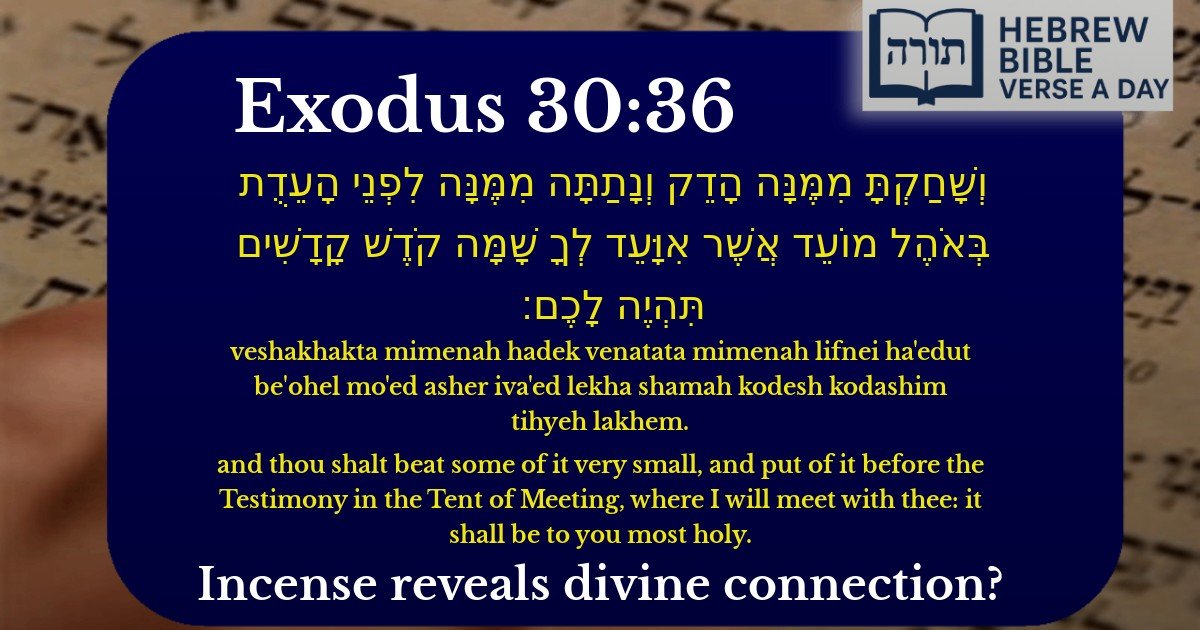
A: Exodus 30:36 describes the preparation of the ketoret (incense) used in the Mishkan (Tabernacle). The verse instructs to finely grind part of the incense and place it before the Testimony (the Ark containing the Tablets) in the Ohel Moed (Tent of Meeting). This incense was designated as 'kodesh kodashim' (most holy), meaning it was set aside exclusively for sacred use in the Divine service.
Q: Why was the incense beaten very small?
A: Rashi explains that the incense needed to be ground very finely to ensure a smooth, even burn without any lumps. This reflects the idea that our service to Hashem should be thorough and without imperfections. The Talmud (Keritot 6b) also notes that the fine grinding symbolized the need for humility and refinement in our spiritual approach.
Q: What is the significance of placing the incense before the Testimony?
A: The incense was placed before the Ark, which contained the Luchot (Tablets of the Testimony), to symbolize that our prayers and service to Hashem should be directed with pure intention, just as the smoke of the ketoret ascended straight upward. The Midrash (Tanchuma, Tetzaveh 15) teaches that the incense atoned for lashon hara (evil speech), showing the power of refined actions to correct spiritual flaws.
Q: Why is the incense called 'most holy'?
A: The ketoret is called 'kodesh kodashim' (most holy) because it was uniquely designated for the Mishkan's service and could not be used for any other purpose. The Rambam (Hilchot Klei HaMikdash 2:5) explains that items with this status had strict limitations—only kohanim (priests) could handle them, and they could not be eaten or used outside the Mishkan (or later, the Temple).
Q: How does this verse apply to us today?
A: Although we no longer bring the ketoret, the verse teaches timeless lessons: (1) Our prayers are compared to incense (Tehillim 141:2), reminding us to approach Hashem with sincerity. (2) Just as the incense was finely ground, we must refine our character. (3) The holiness of the ketoret reminds us to treat sacred matters with reverence. The Mishnah (Avot 1:2) also connects this idea to the importance of Divine service as a foundation of the world.


Context in the Torah
This verse (Shemot 30:36) is part of the instructions regarding the preparation of the ketoret (incense) used in the Mishkan (Tabernacle) and later in the Beit HaMikdash (Holy Temple). The verse specifies the process of grinding the incense finely and placing a portion before the Edut (Testimony, i.e., the Ark containing the Luchot) in the Ohel Moed (Tent of Meeting).
Rashi's Commentary
Rashi (Shemot 30:36) explains that the phrase "וְשָׁחַקְתָּ מִמֶּנָּה הָדֵק" ("and thou shalt beat some of it very small") refers to the meticulous grinding of the incense to ensure it is finely powdered. He notes that this process must be done daily, as the incense was offered each morning and evening. Rashi further clarifies that the portion placed before the Testimony was a memorial portion, separate from the incense burned on the Golden Altar.
Rambam's Explanation
In Hilchot Klei HaMikdash (2:4), the Rambam (Maimonides) elaborates on the practical aspects of preparing the incense. He emphasizes that the grinding must be done with great care to achieve a uniform consistency, as any coarse particles would invalidate the offering. The Rambam also discusses the holiness of the incense, noting that it is "קֹדֶשׁ קָדָשִׁים" ("most holy"), meaning it could only be handled by Kohanim (priests) and was subject to stringent laws of purity.
Midrashic Insights
The Midrash (Shemot Rabbah 43:7) connects the finely ground incense to the idea of unity among the Jewish people. Just as the incense was composed of multiple spices ground into one harmonious mixture, so too must the Jewish people strive for unity. The Midrash also teaches that the incense atoned for the sin of lashon hara (evil speech), as the word "הָדֵק" (very small) alludes to the need to "crush" harmful speech.
Symbolism of the Incense
Halachic Implications
The Talmud (Yoma 44a) discusses the precise measurements and procedures for preparing the incense, noting that any deviation from the prescribed method rendered it invalid. The Gemara also emphasizes that the incense was a central component of the Avodah (Temple service), and its absence would disrupt the entire sacrificial order.