Frequently Asked Questions
Q: Who was Betzalel in the Torah?
A: Betzalel was the chief artisan chosen by Hashem to build the Mishkan (Tabernacle) and its vessels. He was from the tribe of Yehuda and was known for his wisdom, understanding, and knowledge in craftsmanship (Exodus 31:2-3). Rashi explains that Betzalel's name means 'in the shadow of God,' hinting at his divine inspiration.
Q: Why was Betzalel specifically chosen to build the Mishkan?
A: Betzalel was chosen because he possessed unique wisdom (chochmah), understanding (tevunah), and knowledge (da'at) in craftsmanship (Exodus 31:3). The Midrash (Shemot Rabbah 48:4) teaches that Betzalel even understood the secrets of creation, showing his deep spiritual connection to the work of the Mishkan.
Q: What is the significance of Betzalel's lineage being mentioned (son of Uri, son of Hur)?
A: The Torah mentions Betzalel's lineage to highlight his noble heritage. Hur was the son of Miriam and Caleb (Sotah 11b) and was martyred for protesting the sin of the Golden Calf (Sanhedrin 7a). By mentioning his grandfather Hur, the Torah emphasizes that Betzalel came from a family of great righteousness and sacrifice.
Q: What can we learn from Betzalel's appointment in the Torah?
A: We learn that Hashem values both spiritual wisdom and practical skills. Betzalel was not just a craftsman but a person imbued with divine wisdom (Exodus 31:3). This teaches us that all talents—whether artistic, intellectual, or physical—can be used for holiness when directed toward serving Hashem.
Q: Why is the tribe of Yehuda mentioned in connection with Betzalel?
A: Yehuda was the royal tribe, and the Mishkan's construction required leadership qualities. Rashi (on Exodus 31:2) notes that Yehuda's descendants were often chosen for important roles. Additionally, the future Beit HaMikdash (Temple) would be built in Yehuda's territory, linking Betzalel's work to Jerusalem's holiness.

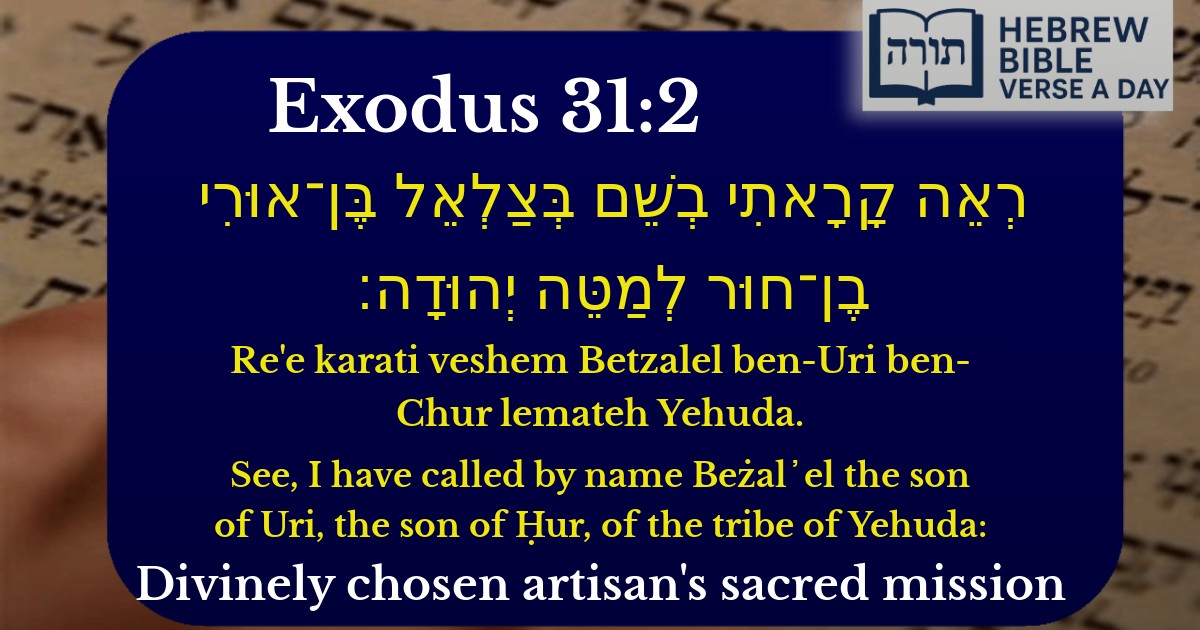

The Divine Appointment of Betzalel
The verse (Shemot 31:2) states: "See, I have called by name Betzalel, the son of Uri, the son of Ḥur, of the tribe of Yehuda." This marks Betzalel's divine selection to oversee the construction of the Mishkan (Tabernacle). Rashi explains that Hashem "called him by name" to emphasize that Betzalel was personally and specifically chosen for this sacred task, indicating his unique qualifications.
Betzalel's Lineage and Significance
The Torah traces Betzalel's lineage back to Ḥur, who, according to the Midrash (Shemot Rabbah 48:3), was martyred for opposing the sin of the Golden Calf. This connection highlights that Betzalel's appointment was not only due to his own merits but also the righteousness of his ancestors. The Ramban adds that mentioning his tribe, Yehuda, underscores the royal and leadership qualities associated with this tribe, fitting for one entrusted with building the Mishkan.
The Meaning of "Betzalel"
The name Betzalel (בְּצַלְאֵל) translates as "in the shadow of G-d" (בְּצֵל אֵל). The Talmud (Berachot 55a) explains that this name reflects his divine wisdom in craftsmanship, as he was endowed with ruach hakodesh (holy inspiration) to understand the intricate details of the Mishkan's construction. The Sforno notes that his abilities were not merely technical but rooted in spiritual insight.
Lessons from Betzalel's Selection