Frequently Asked Questions
Q: What does it mean that Betzalel was filled with 'the spirit of God' in wisdom, understanding, and knowledge?
A: According to Rashi (Exodus 31:3), this means that Betzalel was granted exceptional Divine inspiration to carry out the intricate work of building the Mishkan (Tabernacle). The 'spirit of God' refers to a special level of ruach hakodesh (Divine spirit) given to him for this holy task. The terms 'wisdom, understanding, and knowledge' (chochma, tevuna, da'at) represent different levels of intellectual and creative ability needed for the craftsmanship.
Q: Why was Betzalel given these special qualities?
A: The Midrash (Shemot Rabbah 40:2) explains that Betzalel needed these unique gifts because constructing the Mishkan required more than ordinary skill—it demanded spiritual insight to translate heavenly concepts into physical form. Rambam (Guide for the Perplexed 3:54) adds that such Divinely granted wisdom was necessary to properly execute the sacred vessels and structure that would house God's Presence.
Q: How do 'wisdom, understanding, and knowledge' differ in this verse?
A: Traditional Jewish sources define them as distinct levels: 1) Chochma (wisdom) is raw creative inspiration, 2) Tevuna (understanding) is the ability to analyze and apply wisdom practically, and 3) Da'at (knowledge) is the deep internalization of these concepts (see Ibn Ezra on Exodus 31:3). The Talmud (Berachot 55a) states that Betzalel's name itself ('in God's shadow') hinted at his ability to grasp even the hidden meanings behind the Mishkan's design.
Q: Can people today receive this kind of Divine wisdom for creative work?
A: While Betzalel's level was unique to the Mishkan's construction, the Talmud (Megillah 6b) teaches that God grants wisdom to those who use their talents for sacred purposes. Rambam (Hilchot Klei HaMikdash 1:8) notes that skilled artisans building holy items still require yirat Shamayim (awe of Heaven). Today, this teaches that when we dedicate our abilities to mitzvot—whether art, construction, or other crafts—we can merit siyata d'Shmaya (Heavenly assistance).
Q: Why does the verse mention 'all manner of workmanship' after listing wisdom traits?
A: Rashi explains that 'all manner of workmanship' (kol melacha) refers to practical skills like weaving, metalwork, and carpentry needed for the Mishkan. The Sforno adds that true holiness combines spiritual wisdom (ruach Elokim) with tangible action—the verse shows that Betzalel mastered both. This reflects a Jewish ideal: elevating physical work through spiritual intent, as later codified in Jewish law regarding hiddur mitzvah (beautifying commandments).

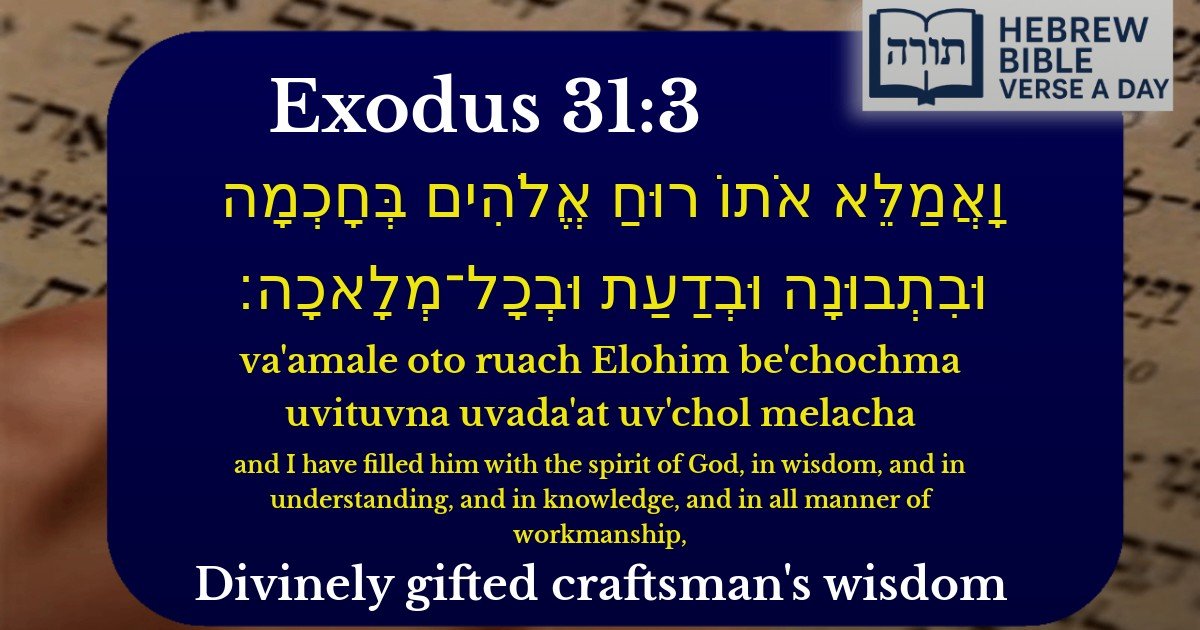

Explanation of the Verse
The verse (Exodus 31:3) describes how Betzalel, the chief artisan of the Mishkan (Tabernacle), was endowed by Hashem with divine wisdom and skill. The terms "wisdom (חָכְמָה), understanding (תְּבוּנָה), and knowledge (דַּעַת)" reflect distinct intellectual and spiritual gifts necessary for the sacred work of constructing the Mishkan.
Interpretation of the Terms
Significance of "All Manner of Workmanship"
The phrase "and in all manner of workmanship" emphasizes that Betzalel was not merely a skilled artisan but was granted comprehensive mastery over every aspect of the Mishkan's construction. The Talmud (Berachot 55a) notes that he even understood the mystical secrets of creation, aligning the Mishkan's design with the divine blueprint of the universe.
Spiritual Lessons
This verse teaches that true craftsmanship in sacred service requires more than technical skill—it demands divine inspiration and alignment with Torah wisdom. As the Sforno comments, Betzalel's abilities were not innate but granted by Hashem specifically for this holy task, illustrating that spiritual success comes through divine assistance and devotion.