

Join Our Newsletter To Be Informed When New Videos Are Posted
Hebrew Text
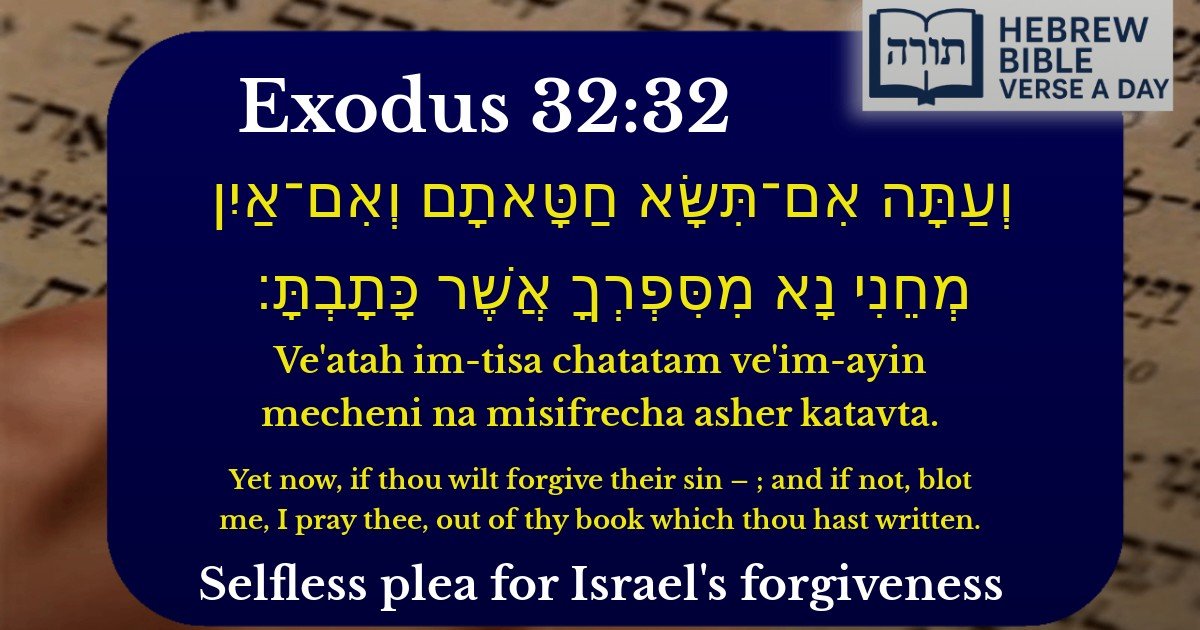
וְעַתָּה אִם־תִּשָּׂא חַטָּאתָם וְאִם־אַיִן מְחֵנִי נָא מִסִּפְרְךָ אֲשֶׁר כָּתָבְתָּ׃
English Translation
Yet now, if thou wilt forgive their sin – ; and if not, blot me, I pray thee, out of thy book which thou hast written.
Transliteration
Ve'atah im-tisa chatatam ve'im-ayin mecheni na misifrecha asher katavta.
Hebrew Leining Text
וְעַתָּ֖ה אִם־תִּשָּׂ֣א חַטָּאתָ֑ם וְאִם־אַ֕יִן מְחֵ֣נִי נָ֔א מִֽסִּפְרְךָ֖ אֲשֶׁ֥ר כָּתָֽבְתָּ׃
🎵 Listen to leining
Parasha Commentary
📚 Talmud Citations
This verse is quoted in the Talmud.
📖 Berakhot 32a
The verse is referenced in the context of discussing Moses' plea to God to forgive the Israelites or to remove him from God's book, illustrating the extent of Moses' dedication to his people.
Context of the Verse
The verse (Exodus 32:32) appears in the aftermath of the sin of the Golden Calf, where Moshe Rabbeinu (Moses) pleads with Hashem to forgive Bnei Yisrael (the Children of Israel) for their grave transgression. Moshe's words reflect his deep devotion to the Jewish people and his willingness to sacrifice his own spiritual status for their sake.
Moshe's Self-Sacrifice
Rashi explains that Moshe's plea, "blot me out of Your book," refers to the Torah itself—meaning that if Hashem would not forgive Bnei Yisrael, Moshe would rather not be mentioned in the Torah at all than to be recorded without his people. This demonstrates Moshe's extraordinary leadership and love for Klal Yisrael (the Jewish people). The Ramban (Nachmanides) adds that Moshe was willing to forfeit his share in the World to Come (Olam Haba) if the Jewish people were not forgiven.
The "Book" in Question
The Talmud (Menachot 29b) discusses the nature of the "book" Moshe refers to. Some opinions suggest it is the Sefer HaChaim (Book of Life), which records the righteous. Others interpret it as the Torah, as Rashi explains. The Midrash (Shemot Rabbah 47:9) states that Moshe was willing to be erased from all divine records if his people were not granted atonement.
Halachic and Ethical Implications
Divine Response
Hashem ultimately rejects Moshe's request to be erased (Exodus 32:33), teaching that individuals are judged based on their own merits. However, Moshe's plea was effective in securing partial forgiveness, as seen in the subsequent verses. This illustrates the balance between divine justice and the power of a righteous advocate.