

Join Our Newsletter To Be Informed When New Videos Are Posted
Hebrew Text
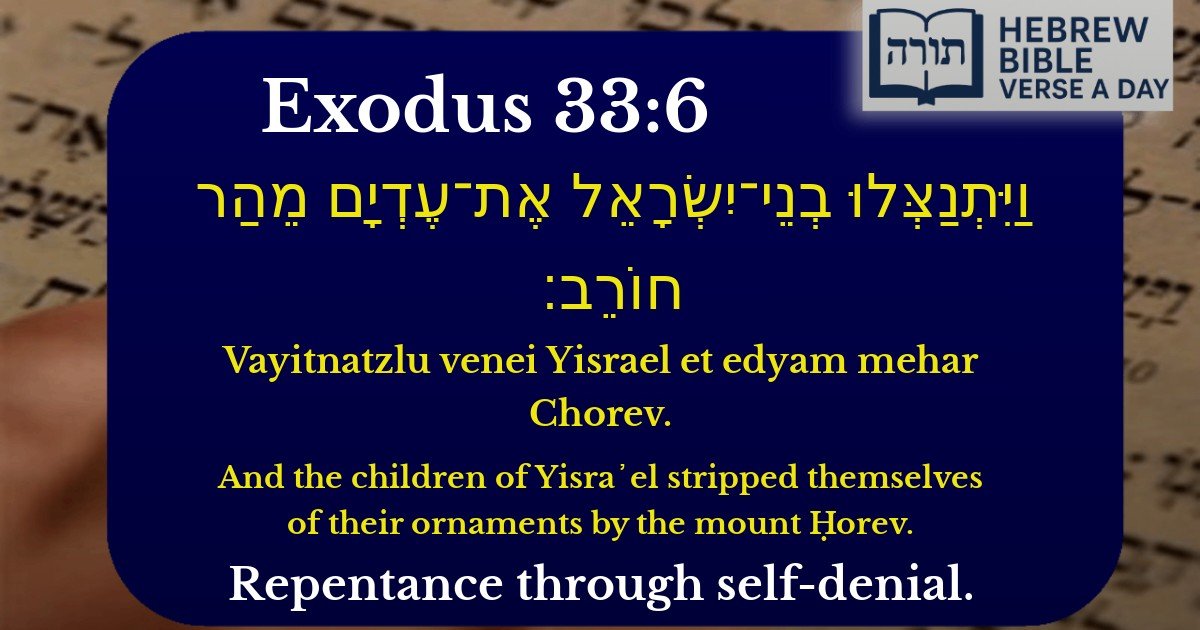
וַיִּתְנַצְּלוּ בְנֵי־יִשְׂרָאֵל אֶת־עֶדְיָם מֵהַר חוֹרֵב׃
English Translation
And the children of Yisra᾽el stripped themselves of their ornaments by the mount Ḥorev.
Transliteration
Vayitnatzlu venei Yisrael et edyam mehar Chorev.
Hebrew Leining Text
וַיִּֽתְנַצְּל֧וּ בְנֵֽי־יִשְׂרָאֵ֛ל אֶת־עֶדְיָ֖ם מֵהַ֥ר חוֹרֵֽב׃
🎵 Listen to leining
Parasha Commentary
📚 Talmud Citations
This verse is not quoted in the Talmud.
Context of the Verse
The verse (Shemot 33:6) describes the reaction of Bnei Yisrael after the sin of the Golden Calf. Following Moshe's rebuke and Hashem's displeasure, the people removed their ornaments as a sign of mourning and repentance. Har Chorev (Mount Sinai) is mentioned as the location where this occurred.
Rashi's Explanation
Rashi (Rabbi Shlomo Yitzchaki) explains that the phrase "וַיִּתְנַצְּלוּ" ("stripped themselves") implies that Bnei Yisrael removed their ornaments permanently, as an act of teshuvah (repentance). He connects this to the earlier verse (Shemot 33:4), where the people mourned upon hearing Hashem's decree that He would not dwell among them due to their sin. The removal of their finery symbolized their recognition of wrongdoing and their desire to return to Hashem.
Rambam's Perspective on Repentance
Rambam (Maimonides) in Hilchot Teshuvah (Laws of Repentance 2:3) teaches that true repentance requires abandoning the sin, regretting past actions, and resolving not to repeat the transgression. The stripping of ornaments aligns with this principle, as it was an outward demonstration of their inward remorse.
Midrashic Insights
The Significance of Har Chorev
Har Chorev (another name for Har Sinai) is highlighted to remind Bnei Yisrael of their original covenant with Hashem. By removing their ornaments there, they acknowledged their failure to uphold the sanctity of the place where they had received the Torah. The Kli Yakar (Rabbi Shlomo Ephraim Luntschitz) notes that this location intensified their sense of loss—having once stood in purity at Sinai, they now stood in disgrace.
Practical Lesson in Avodas Hashem
The Or HaChaim (Rabbi Chaim ibn Attar) teaches that this episode underscores the importance of sincerity in repentance. External actions—like removing ornaments—must reflect genuine inner change. This aligns with the principle in Mesillat Yesharim (Path of the Just) that true spiritual growth requires both outward and inward alignment with mitzvot.