Frequently Asked Questions
Q: What does Exodus 34:6 mean when it says 'The Lord passed by before him'?
A: This verse describes a moment when Hashem revealed His divine attributes to Moshe (Moses). According to Rashi, this occurred after Moshe asked to understand Hashem's ways (Exodus 33:13). The 'passing by' refers to Hashem making His qualities of mercy known to Moshe in a profound way.
Q: Why does the verse repeat 'The Lord, The Lord'?
A: The double mention of Hashem's name teaches about His dual nature of judgment and mercy, as explained in the Talmud (Rosh Hashanah 17b). The first mention represents strict justice, while the second represents mercy - showing that Hashem balances both in His relationship with the world.
Q: What do the 13 attributes of mercy in Exodus 34:6 teach us?
A: These attributes (merciful, gracious, etc.) form the foundation of how Hashem relates to the world. The Midrash (Exodus Rabbah 34:1) explains they are like a 'formula' for divine compassion that we invoke, especially during repentance. They show that even when we fail, Hashem is ready to forgive when we sincerely return to Him.
Q: How do we apply Exodus 34:6 in our daily lives?
A: The Rambam teaches (Hilchot Teshuva 2:4) that we should emulate these divine attributes in our own behavior - being merciful, patient, and truthful with others. Just as Hashem is slow to anger, we too should work on controlling our temper and showing kindness to others.
Q: Why is Exodus 34:6 so important in Jewish tradition?
A: This verse is central to Jewish prayer and repentance. The Talmud (Rosh Hashanah 17b) states that Hashem taught Moshe this 'prayer formula' to guarantee forgiveness. It's recited during Selichot, Yom Kippur, and fast days as we ask for mercy, reminding us that no matter our mistakes, Hashem's compassion is always available.

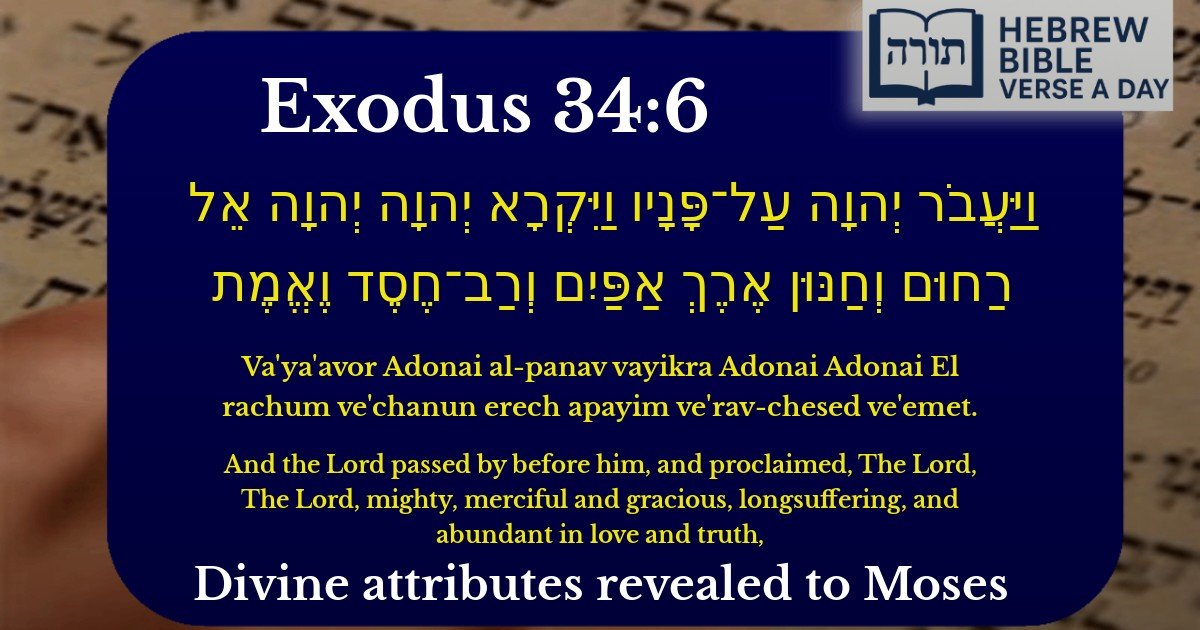

The Revelation of Hashem's Thirteen Attributes of Mercy
This verse (Shemot 34:6) describes the pivotal moment when Hashem reveals His Thirteen Attributes of Mercy to Moshe Rabbeinu after the sin of the Golden Calf. This revelation established the eternal paradigm for how we seek divine forgiveness.
Rashi's Explanation
Rashi explains that Hashem "passed before him" wrapped in a tallit like a shaliach tzibbur (prayer leader), demonstrating to Moshe the proper way to invoke mercy. The double mention of "Hashem, Hashem" teaches that He is merciful both before a person sins (giving them the benefit of the doubt) and after they sin (when they repent).
The Thirteen Attributes
Halachic Significance
The Talmud (Rosh Hashana 17b) teaches that Hashem established a covenant that these attributes will never return empty-handed when properly invoked. This forms the basis for our recitation of these attributes during selichot and fast days.
Kabbalistic Dimension
The Zohar explains that this revelation represented a unique configuration of divine energy (tzimtzum) allowing for the possibility of teshuvah (repentance) in the world. The attributes correspond to different sefirot through which divine compassion flows.