Frequently Asked Questions
Q: What does 'not offer the blood of my sacrifice with leaven' mean in Exodus 34:25?
A: This verse teaches that the Passover sacrifice (Korban Pesach) must not be offered while chametz (leaven) is present. According to Rashi, this means that no chametz should be seen in one's possession when offering the sacrifice, emphasizing the complete removal of chametz before Pesach as a symbol of removing arrogance and impurity (Exodus 12:19, Pesachim 5a).
Q: Why can't the Passover sacrifice be left until morning?
A: The Torah commands that the Passover sacrifice must be eaten the same night it is offered and not left until morning (Exodus 12:10). Rambam explains that this ensures the mitzvah is performed with urgency and devotion, reflecting the haste of the Exodus from Egypt (Mishneh Torah, Hilchot Korban Pesach 8:15). Any leftovers must be burned before dawn.
Q: How does Exodus 34:25 apply to Passover observance today?
A: Although we no longer bring the Passover sacrifice without the Temple, the prohibition of chametz during Pesach remains central. The verse reminds us to remove all chametz before the holiday (Bedikat Chametz) and to eat matzah instead, fulfilling the mitzvah as a remembrance of the Exodus (Pesachim 2a, Shulchan Aruch Orach Chaim 431:1).
Q: What is the connection between chametz and the Passover sacrifice?
A: Chametz symbolizes pride and corruption (as it 'puffs up'), while the Passover sacrifice represents humility and redemption. The Talmud (Berachot 17a) teaches that removing chametz parallels removing negative traits. Thus, the verse links spiritual purity (no chametz) with proper sacrificial worship (Korban Pesach).
Q: Why is this verse repeated in Exodus after earlier Passover laws?
A: Rashi notes that Exodus 34 repeats certain mitzvot to emphasize their importance after the sin of the Golden Calf. This repetition reinforces the eternal covenant and the unique holiness of Pesach (Exodus 34:1, Mechilta). Ramban adds that it connects Passover observance to receiving the Second Tablets, showing renewal of commitment to Torah.

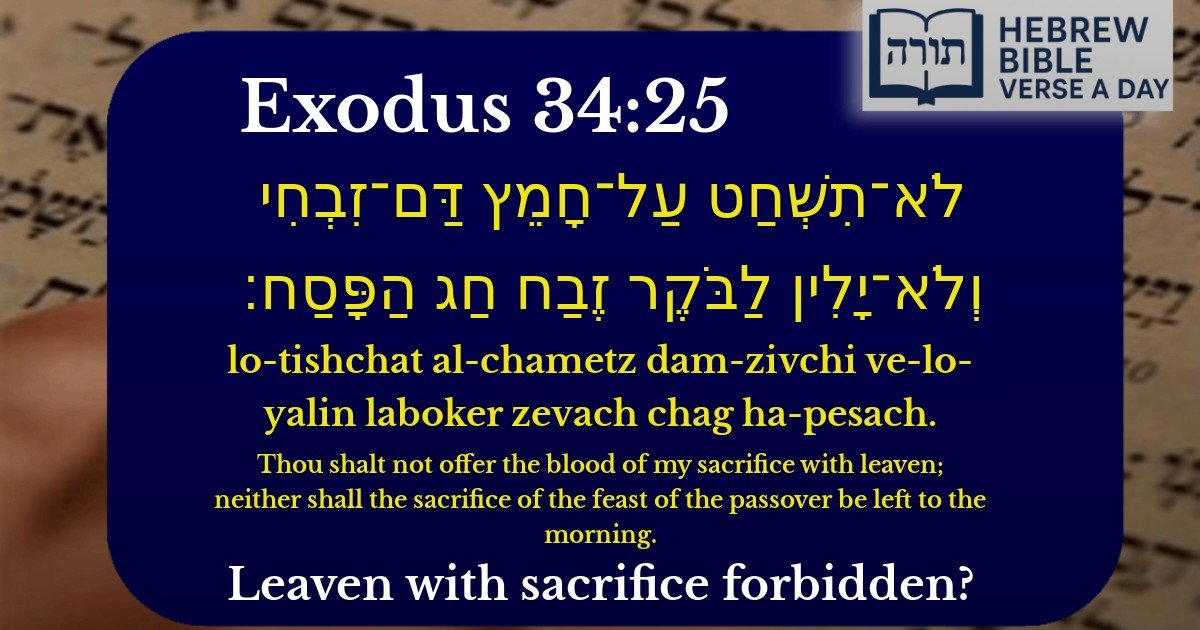

Prohibition of Offering Sacrifice with Chametz
The verse states: "לֹא־תִשְׁחַט עַל־חָמֵץ דַּם־זִבְחִי" ("Thou shalt not offer the blood of my sacrifice with leaven"). Rashi (Exodus 34:25) explains that this prohibition refers to the Pesach sacrifice, which may not be slaughtered while chametz is still present in one's possession. This is derived from the juxtaposition of this verse with the laws of Pesach. The Rambam (Hilchot Korban Pesach 1:5) further clarifies that one who slaughters the Pesach sacrifice while owning chametz violates a negative commandment.
Prohibition of Leaving the Pesach Sacrifice Overnight
The second part of the verse states: "וְלֹא־יָלִין לַבֹּקֶר זֶבַח חַג הַפָּסַח" ("neither shall the sacrifice of the feast of the passover be left to the morning"). Rashi (Exodus 23:18) notes that this refers to the notar (remaining flesh) of the Pesach sacrifice, which must not be left past midnight. The Talmud (Pesachim 84b) derives from this verse that the proper time for consuming the Pesach offering is until midnight, and any leftovers must be burned afterward.
Connection Between Chametz and the Pesach Sacrifice
The Mechilta (Bo, Masechta d'Pischa 10) connects these two prohibitions, teaching that just as chametz must be removed before the Pesach sacrifice is offered, so too must the sacrifice itself be consumed in its proper time. This underscores the theme of haste and vigilance associated with Yetziat Mitzrayim (the Exodus from Egypt). The Ramban (Exodus 12:10) adds that leaving the sacrifice overnight would resemble the ways of idolaters, who would leave offerings for their deities to "consume" them.
Practical Halachic Implications