

Join Our Newsletter To Be Informed When New Videos Are Posted
Hebrew Text
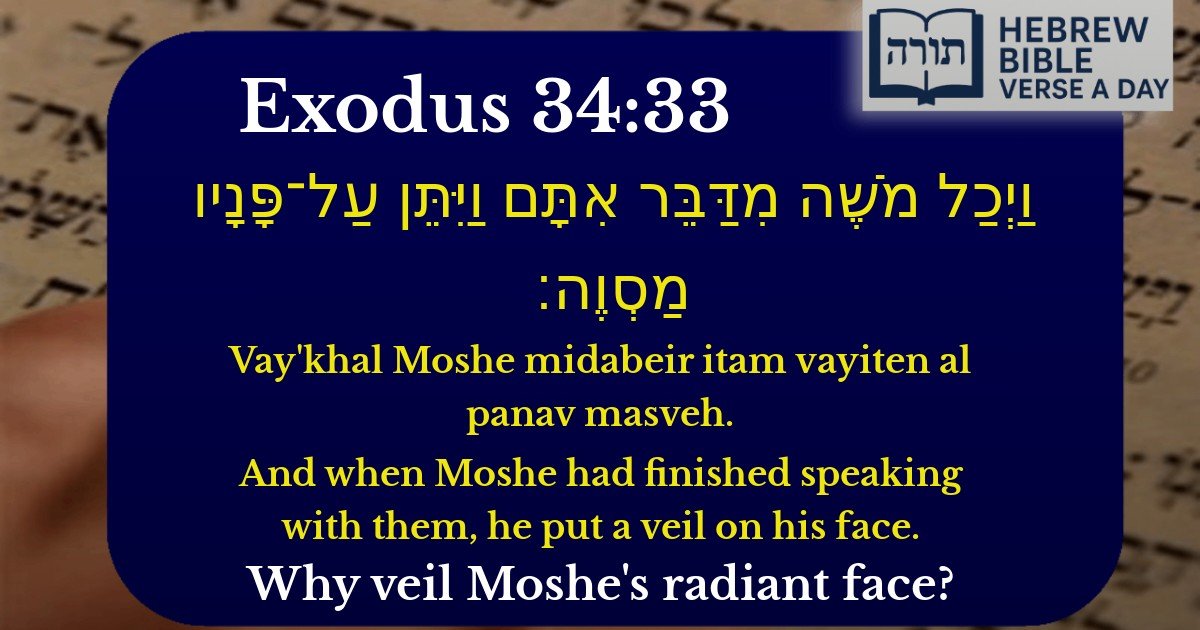
וַיְכַל מֹשֶׁה מִדַּבֵּר אִתָּם וַיִּתֵּן עַל־פָּנָיו מַסְוֶה׃
English Translation
And when Moshe had finished speaking with them, he put a veil on his face.
Transliteration
Vay'khal Moshe midabeir itam vayiten al panav masveh.
Hebrew Leining Text
וַיְכַ֣ל מֹשֶׁ֔ה מִדַּבֵּ֖ר אִתָּ֑ם וַיִּתֵּ֥ן עַל־פָּנָ֖יו מַסְוֶֽה׃
🎵 Listen to leining
Parasha Commentary
📚 Talmud Citations
This verse is quoted in the Talmud.
📖 Yevamot 49b
The verse is referenced in a discussion about Moses' practice of wearing a veil after speaking with the Israelites, highlighting the distinction between his direct communication with God and his interactions with the people.
Context of the Verse
The verse (Shemot 34:33) describes Moshe Rabbeinu placing a masveh (veil) over his face after speaking with Bnei Yisrael. This occurs after Moshe descends from Har Sinai with the second set of Luchot, his face radiant from encountering the Divine Presence.
Rashi's Explanation
Rashi (Shemot 34:33) explains that Moshe would remove the veil when speaking with Hashem or conveying His words to Bnei Yisrael, but would cover his face afterward. The veil was necessary because the people were afraid to approach him due to the intense radiance (keren or) of his face (Shemot 34:30).
Rambam's Perspective
In Moreh Nevuchim (1:37), Rambam suggests that Moshe's radiant face symbolized his supreme prophetic level. The veil served both as a physical barrier for those unprepared to witness this holiness and as a metaphor for the concealed depths of Torah wisdom that not all can perceive directly.
Talmudic Insights
Midrashic Interpretations
The Midrash Tanchuma (Ki Tisa 37) compares Moshe's radiant face to a lantern - when lit, it illuminates for others, but must be covered when not in use. This teaches that Divine wisdom must be shared appropriately according to the recipient's capacity.
Kabbalistic Dimension
The Zohar (2:99a) interprets the veil as representing the pargod (heavenly curtain) that separates different levels of spiritual reality. Moshe's ability to remove and replace the veil demonstrated his mastery over both revealed and hidden aspects of Torah.
Halachic Implications
The Sefer HaChinuch (Mitzvah 115) derives from this episode the importance of showing proper reverence for holy matters, as exemplified by Bnei Yisrael's awe before Moshe's radiant countenance.