Frequently Asked Questions
Q: What is the Tabernacle (Mishkan) mentioned in Exodus 35:11?
A: The Tabernacle (Mishkan) was a portable sanctuary built by the Israelites in the wilderness as a dwelling place for the Divine Presence (Shechinah). It served as the center of worship and sacrifices until the construction of the Holy Temple in Jerusalem. Rashi explains that the Mishkan was a temporary structure that allowed the Israelites to maintain a connection with Hashem during their travels.
Q: Why does the verse list all the parts of the Tabernacle like the boards, bars, and sockets?
A: The detailed listing of the Tabernacle's components in Exodus 35:11 emphasizes the importance of every part in creating a sacred space. The Talmud (Yoma 72a) teaches that each element had spiritual significance, and the meticulous construction reflected the unity and dedication of the Jewish people in serving Hashem. Rambam (Hilchot Beit HaBechirah 1:1) also notes that these details provide practical instructions for building a place of holiness.
Q: What can we learn from the construction of the Tabernacle today?
A: The construction of the Tabernacle teaches us that every detail in serving Hashem matters. Just as the Mishkan required precision and care, our mitzvot (commandments) and daily actions should be performed with intention and devotion. The Midrash (Tanchuma, Terumah 8) compares the Mishkan to the human heart, suggesting that we must also make ourselves into a 'dwelling place' for holiness through righteous deeds.
Q: Why were the sockets (adanim) of the Tabernacle important?
A: The sockets (adanim) were the foundation of the Tabernacle's structure, holding the boards upright. Rashi (on Exodus 26:19) explains that they were made from silver, symbolizing stability and purity. The Talmud (Shekalim 6a) teaches that the adanim were funded by the half-shekel contributions of all Israelites, showing that the community's collective efforts uphold holiness.
Q: How does the Tabernacle relate to modern synagogue construction?
A: The Tabernacle serves as the prototype for all future Jewish places of worship, including synagogues. The Shulchan Aruch (Orach Chaim 150:1) states that a synagogue should be built with dignity, mirroring the Mishkan's sanctity. Just as the Tabernacle was central to the Israelites' spiritual life, synagogues today remain centers of prayer, Torah study, and community.

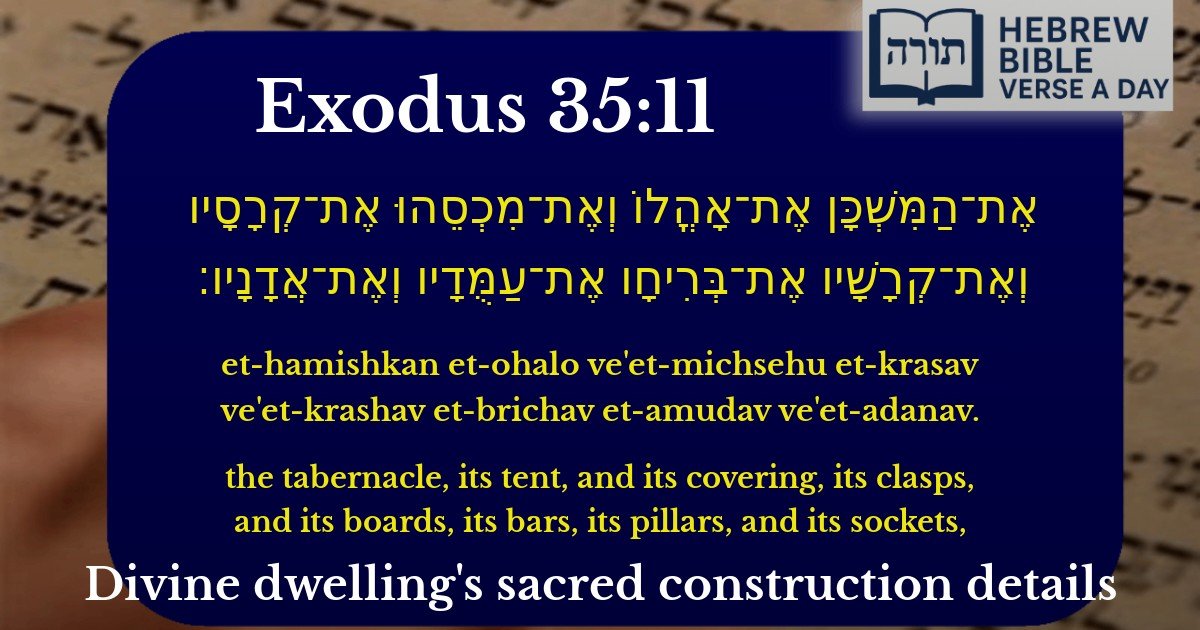

Overview of the Verse
The verse (Exodus 35:11) enumerates the components of the Mishkan (Tabernacle), detailing its structure and the materials used in its construction. This list is part of Hashem's command to Moshe regarding the building of the Mishkan, emphasizing the precision and sanctity of each element.
Commentary on the Components
Spiritual Significance
The detailed enumeration of the Mishkan's components teaches that every aspect of avodat Hashem requires care and precision. The Mishkan is a microcosm of the world, and its construction mirrors the creation of the universe (Midrash Tanchuma, Pekudei 2). Each part, no matter how small, contributes to the sanctity of the whole, reflecting the idea that every mitzvah and detail in Torah observance is essential.