Frequently Asked Questions
Q: What does Exodus 35:25 mean?
A: Exodus 35:25 describes the skilled women who spun threads of blue (techelet), purple (argaman), scarlet (tola'at shani), and fine linen (shesh) for the Mishkan (Tabernacle). These materials were used in making the sacred garments for the Kohanim (priests) and the coverings for the Mishkan. Rashi explains that these women were 'wisehearted,' meaning they had special wisdom and skill in spinning these materials.
Q: Why were these specific colors (blue, purple, scarlet) important for the Mishkan?
A: The colors—blue (techelet), purple (argaman), and scarlet (tola'at shani)—had deep symbolic meaning. Techelet (blue) represents the heavens and divine connection (Talmud, Menachot 43b). Purple (argaman) was a royal color, symbolizing dignity, while scarlet (tola'at shani) represented atonement and sacrifice (Midrash Tanchuma, Terumah 8). These colors were essential for the Mishkan’s holiness and its connection to Hashem.
Q: What can we learn from the 'wisehearted women' in this verse?
A: The 'wisehearted women' teach us the value of using our talents for a sacred purpose. They willingly contributed their skills to build the Mishkan, showing devotion to Hashem. The Rambam (Hilchot Klei HaMikdash 8:9) highlights that such voluntary service is praiseworthy and sets an example for dedicating our abilities to mitzvot and community needs.
Q: How does spinning thread relate to serving Hashem today?
A: Just as the women spun threads for the Mishkan, we can 'spin' our daily actions into spiritual service. The Talmud (Shabbat 49a) connects spinning to the idea of refining our deeds. Today, we serve Hashem by performing mitzvot with sincerity, turning ordinary tasks—like work or kindness—into offerings for holiness.
Q: Why is fine linen (shesh) mentioned separately in this verse?
A: Fine linen (shesh) was a high-quality material used for the Kohen Gadol’s garments (Exodus 28:39) and the Mishkan’s curtains. Rashi notes that it was spun separately because it required exceptional skill. Its purity symbolizes moral refinement, teaching that serving Hashem demands both external beauty and inner integrity (Midrash Rabbah, Shemot 48:4).

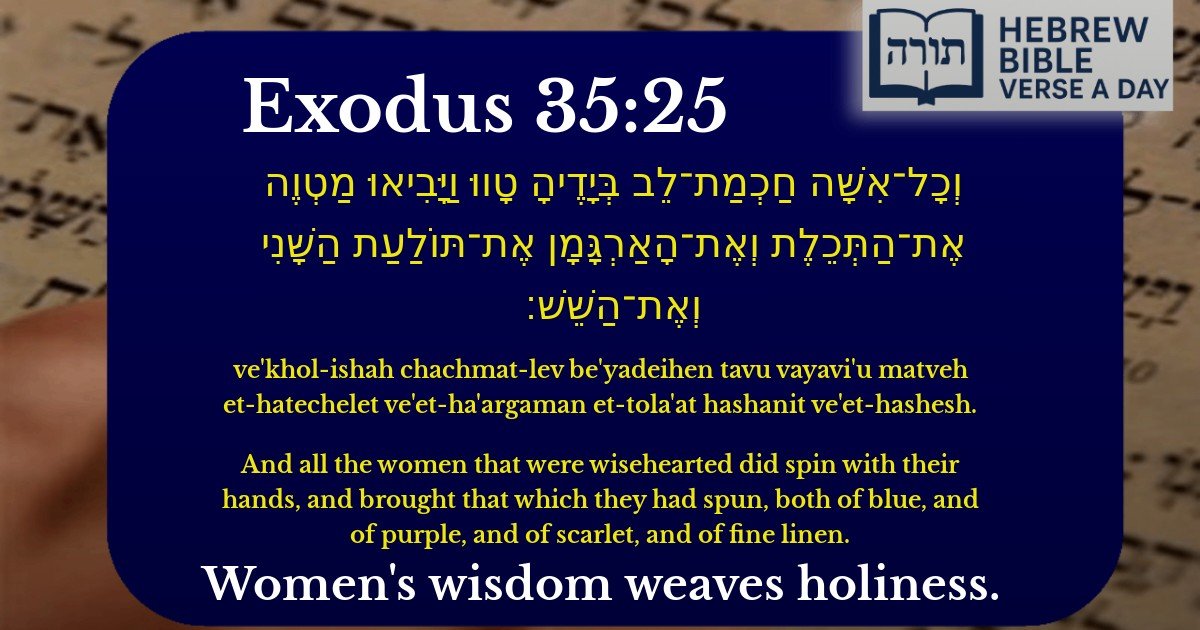

The Wisdom of the Women in Contributing to the Mishkan
The verse (Shemot 35:25) describes the women of Israel who were חַכְמַת־לֵב ("wisehearted") and spun the materials for the Mishkan (Tabernacle) with their own hands. Rashi explains that the term "wisehearted" refers to their exceptional wisdom in understanding the intricate spinning techniques required for the sacred fabrics, particularly the תְּכֵלֶת (blue), אַרְגָּמָן (purple), תּוֹלַעַת הַשָּׁנִי (scarlet), and שֵׁשׁ (fine linen).
The Significance of the Materials
According to the Midrash (Shemot Rabbah 48:4), the women's spinning of these materials was not merely a technical skill but a spiritual act. Each material held deep symbolic meaning:
The Women’s Voluntary Contribution
The Ramban (Nachmanides) emphasizes that the women's spinning was a voluntary act of generosity (נְדָבָה), demonstrating their eagerness to participate in the construction of the Mishkan. The Talmud (Shabbat 99a) further praises their wisdom, noting that they spun the materials while they were still attached to the animal or plant, a technique requiring great skill.
Spiritual Lessons from the Verse
The Midrash Tanchuma (Pekudei 9) teaches that the women's wisdom extended beyond craftsmanship—they understood the deeper purpose of the Mishkan as a means to draw closer to Hashem. Their willingness to contribute with both wisdom and action serves as a model for Jewish women in all generations, highlighting the importance of combining intellectual understanding with practical devotion to mitzvot.