

Join Our Newsletter To Be Informed When New Videos Are Posted
Hebrew Text
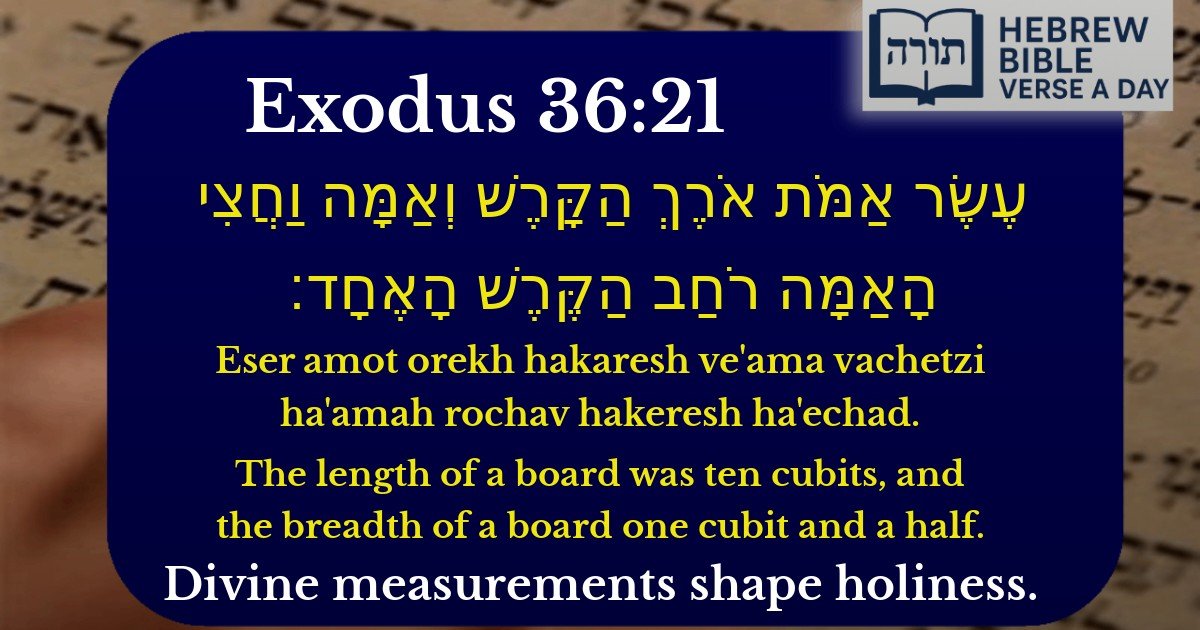
עֶשֶׂר אַמֹּת אֹרֶךְ הַקָּרֶשׁ וְאַמָּה וַחֲצִי הָאַמָּה רֹחַב הַקֶּרֶשׁ הָאֶחָד׃
English Translation
The length of a board was ten cubits, and the breadth of a board one cubit and a half.
Transliteration
Eser amot orekh hakaresh ve'ama vachetzi ha'amah rochav hakeresh ha'echad.
Hebrew Leining Text
עֶ֥שֶׂר אַמֹּ֖ת אֹ֣רֶךְ הַקָּ֑רֶשׁ וְאַמָּה֙ וַחֲצִ֣י הָֽאַמָּ֔ה רֹ֖חַב הַקֶּ֥רֶשׁ הָאֶחָֽד׃
🎵 Listen to leining
Parasha Commentary
📚 Talmud Citations
This verse is not quoted in the Talmud.
Dimensions of the Mishkan's Boards
The verse (Shemot 26:16) describes the dimensions of the wooden boards (kerashim) used in the construction of the Mishkan (Tabernacle). Each board was ten cubits in length and one and a half cubits in width. Rashi explains that these measurements were divinely ordained, reflecting the precise design given to Moshe at Har Sinai.
Symbolism of the Measurements
According to the Midrash (Shemot Rabbah 35:6), the dimensions carry deeper spiritual significance:
Structural Insights from the Talmud
The Talmud (Shabbat 98b) discusses the arrangement of the boards, noting that their width (1.5 cubits) allowed for stability when placed side by side. The boards stood upright, with their ten-cubit height forming the walls of the Mishkan. Rambam (Hilchot Beit HaBechirah 1:12) derives architectural principles from these measurements, emphasizing the precision required in sacred construction.
Kabbalistic Interpretation
The Zohar (Terumah 152a) connects the boards' dimensions to the spiritual structure of the universe: