Frequently Asked Questions
Q: What does Exodus 36:27 mean when it says 'six boards for the side of the tabernacle westward'?
A: This verse describes the construction of the Mishkan (Tabernacle) in the desert. The western side had six wooden boards covered in gold (as described in earlier verses). Rashi explains that these boards formed the back wall of the Mishkan, showing how every detail of G-d's sanctuary was precisely measured and arranged according to divine instruction.
Q: Why is the number of boards (six) important in Exodus 36:27?
A: The six boards on the western side, together with two corner boards mentioned in the next verse (Exodus 36:28), completed the structure. The Talmud (Shabbat 98b) discusses how these measurements reflect the divine wisdom in the Mishkan's construction. The precise number teaches us about the importance of following exact specifications when fulfilling mitzvot (commandments).
Q: What can we learn today from the detailed construction of the Mishkan in Exodus 36:27?
A: The Rambam teaches that the meticulous details of the Mishkan's construction remind us that serving G-d requires attention to detail in our mitzvah observance. Just as the boards had to be made exactly as commanded, we should strive to perform mitzvot with care and precision in our daily lives.
Q: Why does the Torah specify the western side of the Mishkan in this verse?
A: The Midrash (Tanchuma Terumah 11) explains that each side of the Mishkan had spiritual significance. The west, where the sun sets, represents the Divine Presence that never 'sets' or departs from Israel. This teaches that even when things seem dark (symbolized by sunset), G-d's presence remains with His people.
Q: How were the six boards of the Mishkan's western side different from other sides?
A: While all sides used similar gold-covered acacia wood boards, the western side was unique in having exactly six main boards (plus two special corner boards). The Kli Yakar notes this shows the western side's importance as it faced the Holy of Holies, teaching that what appears to be 'behind' us (west) can actually be most sacred in spiritual matters.

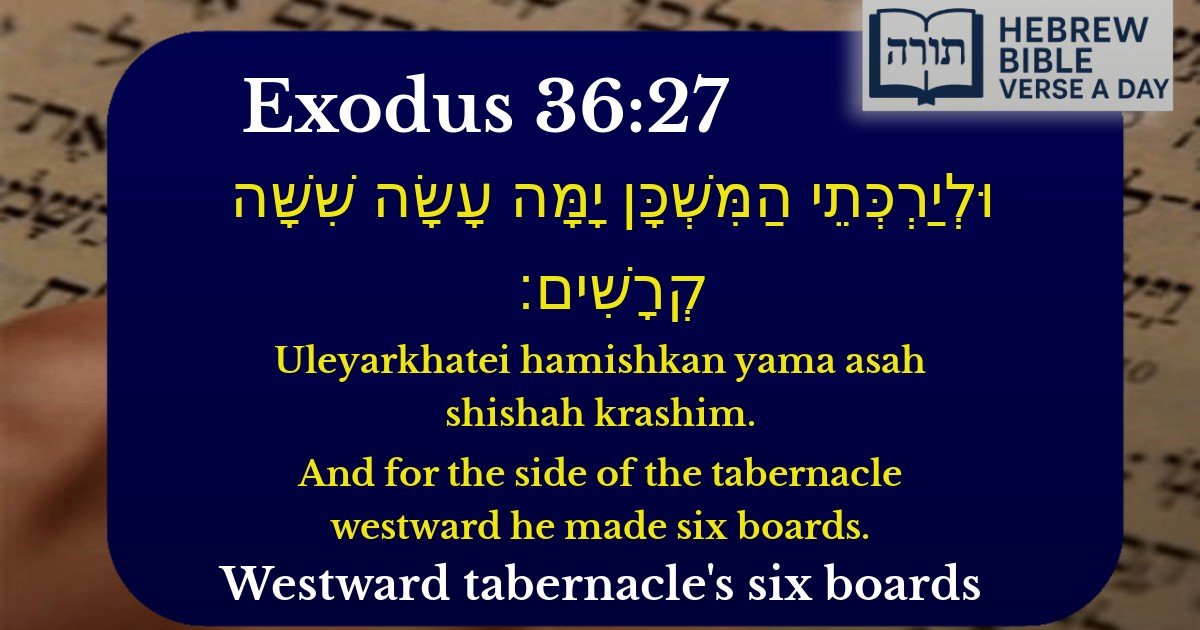

The West Side of the Mishkan
The verse (Shemot 36:27) describes the construction of the western side of the Mishkan (Tabernacle) with six kerashim (boards). Rashi explains that the western side was unique because it required only six boards, whereas the northern and southern sides each had twenty boards (Shemot 26:18-25). The difference in number highlights the precision of the Divine blueprint given to Moshe.
Symbolism of the Six Boards
According to the Midrash (Tanchuma, Terumah 11), the six boards correspond to the six days of Creation, emphasizing that the Mishkan was a microcosm of the universe. The western side, facing the setting sun, represents the completion of the work, just as Shabbat concludes the six days of labor.
Structural Insights from the Rambam
The Rambam (Hilchot Beit HaBechirah 1:12) notes that the western side's reduced number of boards teaches a lesson in efficiency—the Mishkan's design ensured stability without unnecessary materials. This reflects the principle of hiddur mitzvah (beautifying a commandment) while avoiding waste.
Talmudic Interpretation
The Talmud (Shabbat 98b) discusses how the boards were arranged, noting that their placement required exact alignment. The western side's six boards were flanked by two corner boards (Shemot 26:23), which the Talmud explains as a means to reinforce the structure, symbolizing the unity of Klal Yisrael.
Kabbalistic Perspective
The Zohar (Terumah 161a) associates the six boards with the six sefirot from Chesed to Yesod, representing the divine attributes through which Hashem interacts with the world. The west, corresponding to Malchut, signifies the Shechinah's presence in the Mishkan.