

Join Our Newsletter To Be Informed When New Videos Are Posted
Hebrew Text
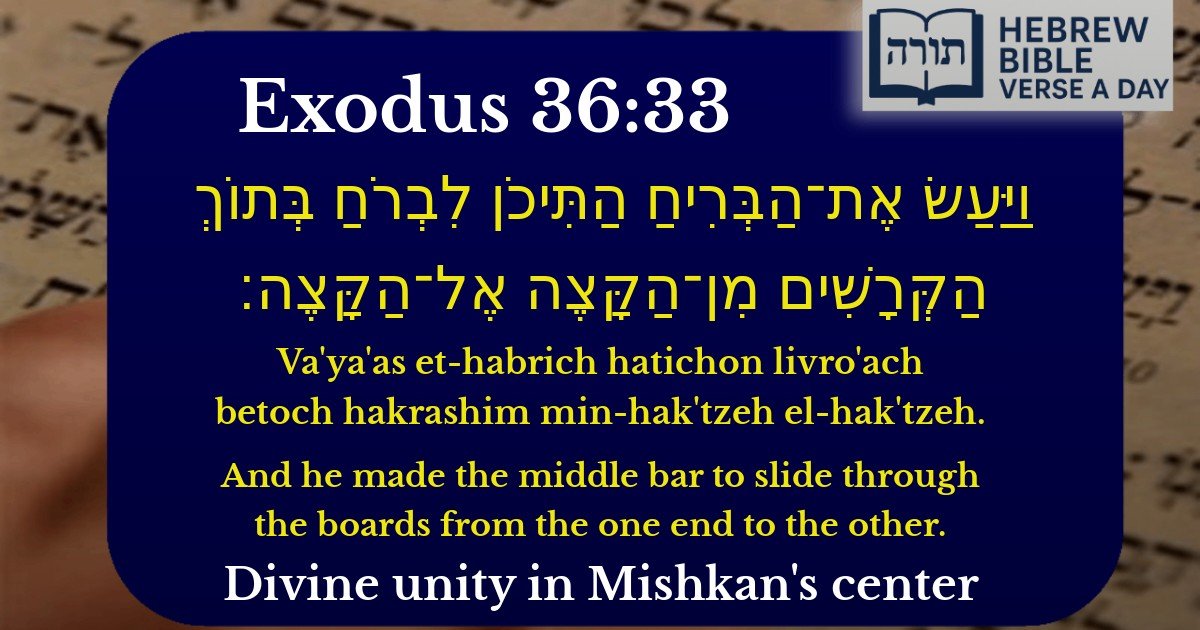
וַיַּעַשׂ אֶת־הַבְּרִיחַ הַתִּיכֹן לִבְרֹחַ בְּתוֹךְ הַקְּרָשִׁים מִן־הַקָּצֶה אֶל־הַקָּצֶה׃
English Translation
And he made the middle bar to slide through the boards from the one end to the other.
Transliteration
Va'ya'as et-habrich hatichon livro'ach betoch hakrashim min-hak'tzeh el-hak'tzeh.
Hebrew Leining Text
וַיַּ֖עַשׂ אֶת־הַבְּרִ֣יחַ הַתִּיכֹ֑ן לִבְרֹ֙חַ֙ בְּת֣וֹךְ הַקְּרָשִׁ֔ים מִן־הַקָּצֶ֖ה אֶל־הַקָּצֶֽה׃
🎵 Listen to leining
Parasha Commentary
📚 Talmud Citations
This verse is not quoted in the Talmud.
Context of the Verse
The verse (Shemot 36:33) describes the construction of the Mishkan (Tabernacle), specifically the assembly of its wooden boards (kerashim) and the placement of the middle crossbar (habriach hatichon). This bar was unique in that it spanned the entire length of the Mishkan's walls, sliding through rings attached to the boards to hold them firmly together.
Rashi's Explanation
Rashi (Shemot 26:28) explains that the middle bar was miraculously fashioned—it was a single piece of acacia wood that bent and curved to pass through all the boards from one end to the other. This was a divine miracle, as no natural piece of wood could bend so precisely through all the rings. The purpose of this bar was to ensure the structural integrity of the Mishkan, symbolizing the unity and cohesion of Klal Yisrael.
Symbolism of the Middle Bar
Halachic Insights from the Talmud
The Talmud (Shabbat 98b) discusses whether the middle bar was visible from the outside or concealed within the boards. According to one opinion, it was hidden, symbolizing that true unity often operates behind the scenes, unseen but essential. This reflects the idea that internal harmony (shalom bayit) is foundational to kedushah (holiness).
Midrashic Interpretation
The Midrash Tanchuma (Pekudei 11) connects the middle bar to the concept of Torah sheb'al peh (Oral Torah), which, like the bar, weaves through all aspects of Jewish life, providing structure and continuity. Just as the bar extended from one end to the other, Torah sustains the Jewish people through all generations.