Frequently Asked Questions
Q: What is the holy anointing oil mentioned in Exodus 37:29?
A: The holy anointing oil (shemen hamishcha) was a special mixture made according to the Torah's instructions (Exodus 30:22-25). It was used to anoint the Mishkan (Tabernacle), its vessels, and the Kohanim (priests) for service. Rashi explains that this oil was prepared with precise measurements of four specific spices in olive oil, and it was forbidden to replicate this mixture for personal use (Exodus 30:32-33).
Q: Why was the incense in Exodus 37:29 called 'pure'?
A: The incense (ketoret) was called 'pure' (tahor) because it was made from specific, high-quality spices without any additives or impurities. The Talmud (Keritot 6b) discusses the 11 ingredients used in the ketoret. Rambam (Hilchot Klei HaMikdash 2:4) explains that the purity refers both to the quality of ingredients and the intent behind its preparation - it was made solely for sacred use in the Mishkan.
Q: What does 'according to the work of the perfumer' mean in this verse?
A: This phrase means the anointing oil and incense were prepared by skilled artisans who specialized in blending spices, just as a perfumer expertly mixes fragrances. The Midrash (Shemot Rabbah 36:1) emphasizes that Betzalel, who made these items, had divinely inspired wisdom for this sacred work. The Sforno notes this highlights the care and expertise required when preparing items for holy service.
Q: Are the anointing oil and incense still used today?
A: Since the destruction of the Temple, we no longer prepare or use the sacred anointing oil. The Rambam (Hilchot Klei HaMikdash 1:7) writes that the original formula was hidden away. While we don't bring the ketoret today, its recitation remains part of our prayers. The Talmud (Berachot 43b) states that studying the ketoret's laws brings spiritual protection, showing its ongoing significance.
Q: What lesson can we learn from the preparation of these sacred items?
A: This teaches us about hiddur mitzvah - beautifying commandments. Just as the anointing oil and incense required the finest ingredients and skilled preparation, we should perform mitzvot with care and excellence. The Or HaChaim notes that the word 'tahor' (pure) teaches us that our service to Hashem must be with pure intentions, not for personal honor or gain.

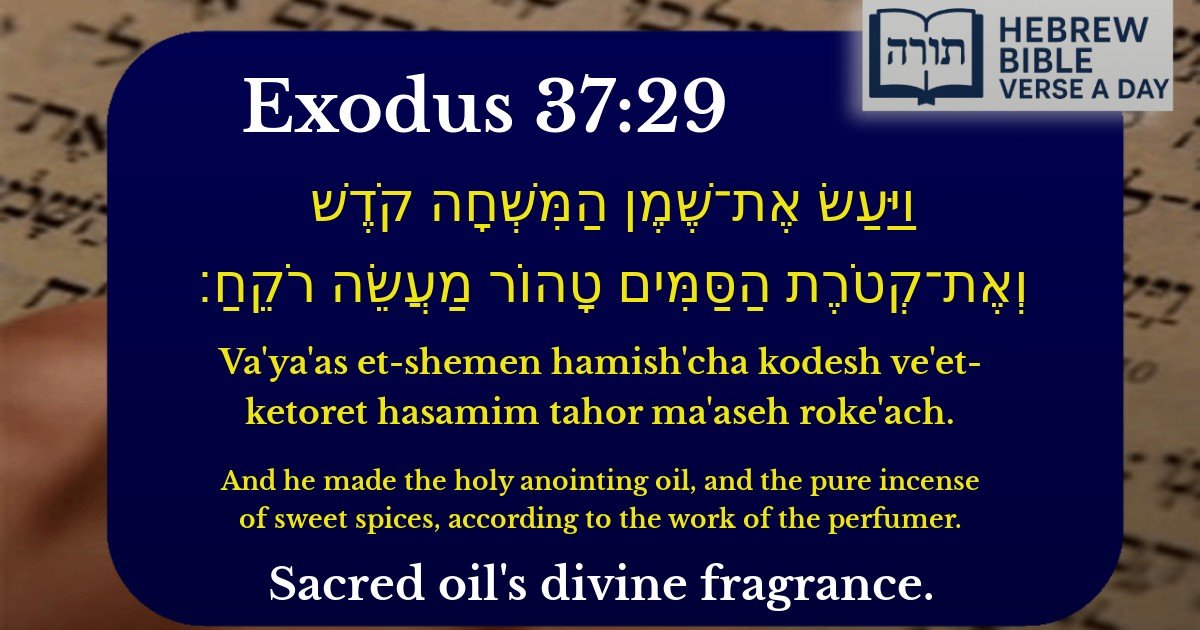

The Holy Anointing Oil (Shemen HaMishcha)
The verse describes the preparation of the sacred anointing oil (Shemen HaMishcha) and the incense (Ketoret). According to Rashi (Shemot 30:25), the anointing oil was made from a specific blend of spices and olive oil, as detailed in Shemot 30:22-25. This oil was used to consecrate the Mishkan (Tabernacle), its vessels, and the Kohanim (priests), imbuing them with holiness for divine service.
The Pure Incense (Ketoret HaSamim)
The Ketoret was a unique blend of eleven spices (Keritot 6a), prepared by skilled perfumers. Rambam (Hilchot Klei HaMikdash 2:4) explains that the Ketoret was burned twice daily on the golden altar, symbolizing the spiritual elevation of the Jewish people. The Talmud (Yoma 44a) teaches that the Ketoret had the power to atone for sins, particularly lashon hara (evil speech), as hinted by its name—"Ketoret" (related to "kesher," binding).
The Role of the Perfumer (Rokeach)
The phrase "ma'aseh rokeach" ("the work of the perfumer") emphasizes the precision required in preparing these sacred substances. The Midrash (Shemot Rabbah 40:1) notes that the same care taken in compounding the Ketoret should be applied to the "blending" of Torah scholars—each contributing unique wisdom while maintaining unity.