

Join Our Newsletter To Be Informed When New Videos Are Posted
Hebrew Text
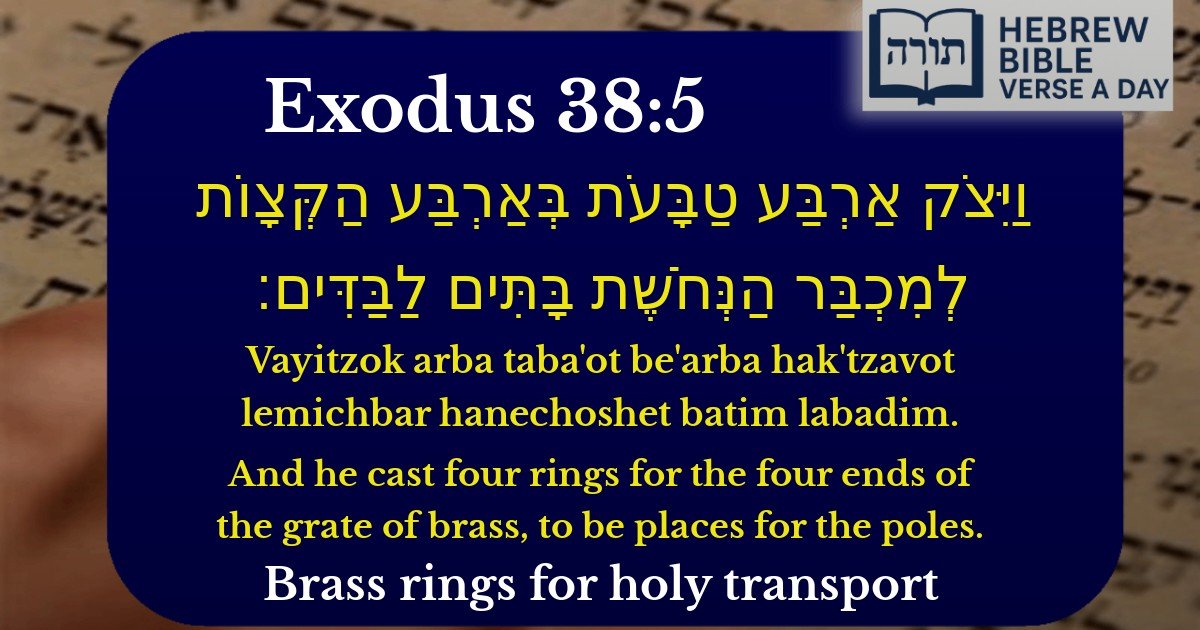
וַיִּצֹק אַרְבַּע טַבָּעֹת בְּאַרְבַּע הַקְּצָוֺת לְמִכְבַּר הַנְּחֹשֶׁת בָּתִּים לַבַּדִּים׃
English Translation
And he cast four rings for the four ends of the grate of brass, to be places for the poles.
Transliteration
Vayitzok arba taba'ot be'arba hak'tzavot lemichbar hanechoshet batim labadim.
Hebrew Leining Text
וַיִּצֹ֞ק אַרְבַּ֧ע טַבָּעֹ֛ת בְּאַרְבַּ֥ע הַקְּצָוֺ֖ת לְמִכְבַּ֣ר הַנְּחֹ֑שֶׁת בָּתִּ֖ים לַבַּדִּֽים׃
🎵 Listen to leining
Parasha Commentary
📚 Talmud Citations
This verse is quoted in the Talmud.
📖 Yoma 72a
The verse is referenced in a discussion about the construction and details of the Tabernacle, particularly concerning the rings and poles used for the altar.
Explanation of the Verse (Exodus 38:5)
The verse describes the construction of the copper grate (michbar ha-nechoshet) for the altar in the Mishkan (Tabernacle), specifically the attachment of four rings at its four corners to hold the carrying poles (badim).
Rashi's Commentary
Rashi (Exodus 38:5) explains that the copper grate was a lattice-like structure placed beneath the altar to allow air circulation for the fire. The four rings were cast (vayitzok) directly onto the grate, rather than being attached later, ensuring durability. These rings served as housings (batim) for the poles used to transport the altar.
Rambam's Insight (Hilchot Beit HaBechirah 2:7)
The Rambam emphasizes the functional design of the Mishkan’s vessels, noting that the rings and poles were essential for the Levites to carry the altar during travel. The term batim (housings) implies a secure fit, preventing the poles from slipping during transport.
Midrashic Perspective (Midrash Tanchuma, Terumah 11)
The Midrash connects the four rings to the four corners of the earth, symbolizing that the altar’s service atones for all humanity. The copper material (nechoshet) signifies strength and judgment, reflecting the altar’s role in rectifying transgressions.
Practical Halachic Considerations (Talmud Yoma 72a)
Symbolism of the Four Rings
Rabbeinu Bachya (Exodus 38:5) teaches that the four rings correspond to the four foundational mitzvot of the altar:
Just as the rings supported the altar, these four pillars uphold divine service.