Frequently Asked Questions
Q: What does Exodus 38:10 describe?
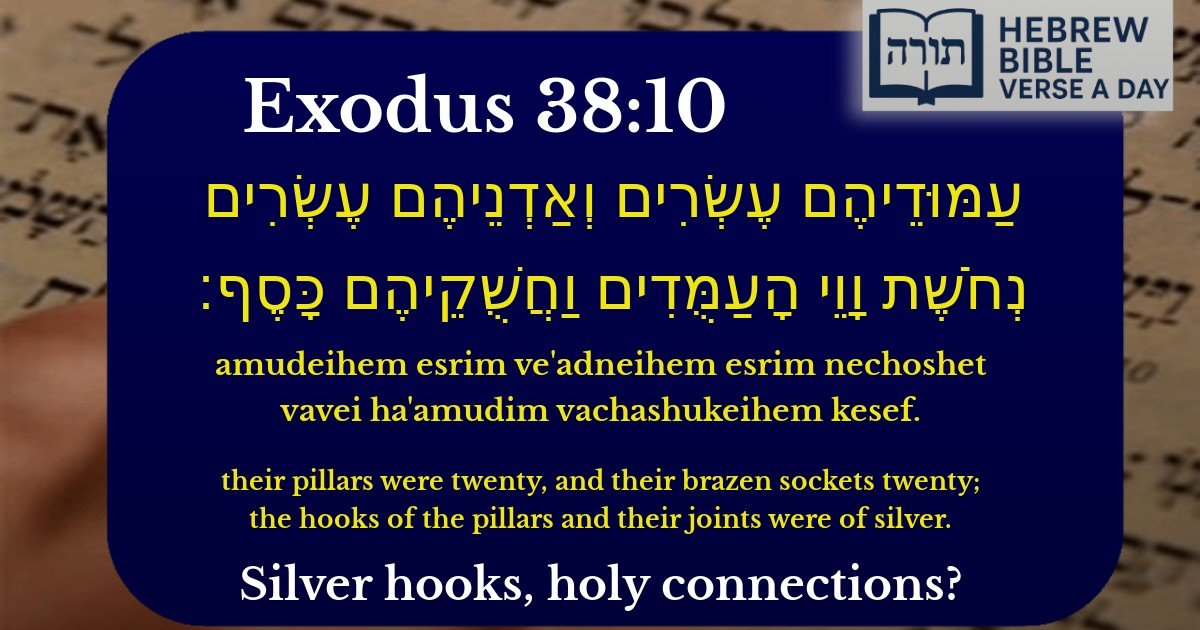
A: Exodus 38:10 describes part of the construction of the Mishkan (Tabernacle), specifically the courtyard hangings. It mentions 20 pillars with 20 copper sockets, as well as silver hooks and bands for the pillars. These details highlight the precision and beauty of the Mishkan's construction as commanded by Hashem.
Q: Why were some parts made of copper and others of silver in the Mishkan?
A: According to Rashi and other commentators, different metals were used in the Mishkan to symbolize different spiritual concepts. Copper (nechoshet), used for the sockets, represents durability and strength, while silver (kesef), used for hooks and bands, represents purity and refinement. This teaches that every detail in the Mishkan had spiritual significance.
Q: What can we learn from the detailed descriptions of the Mishkan's construction?
A: The detailed descriptions teach us the importance of hiddur mitzvah (beautifying commandments) and doing mitzvot with precision and care. The Talmud (Shabbat 133b) derives from this the principle 'This is my G-d and I will glorify Him' - that we should perform mitzvot in the most beautiful way possible, just as the Mishkan was built with exactness and beauty.
Q: Why does the Torah give such specific measurements for the Mishkan?
A: The Rambam explains that every measurement in the Mishkan corresponds to spiritual truths. The number 20 (for pillars and sockets) may allude to completeness, as our Sages note that 20 is numerically significant (e.g., 20 silver shekels for redeeming a firstborn). The precise measurements teach that serving Hashem requires both exact adherence to halacha and attention to spiritual symbolism.
Q: How does the Mishkan's construction apply to our lives today?
A: Just as the Mishkan was a dwelling place for the Divine Presence, our homes and synagogues can become 'mikdash me'at' (small sanctuaries). The emphasis on quality materials teaches us to value our mitzvot and prayer spaces. The combination of different metals also symbolizes how different people contribute different qualities to build a holy community, as explained in Midrash Tanchuma.


Context in the Mishkan
This verse (Exodus 38:10) describes part of the construction of the Mishkan (Tabernacle), specifically the courtyard's hangings on the north side. The materials and measurements reflect the precision required in building a dwelling place for the Divine Presence.
Pillars and Sockets
Rashi explains that the 20 copper pillars corresponded to the 20 planks on the north side of the Mishkan's inner structure (Exodus 26:18-21). The symmetry teaches that the outer courtyard reflected the inner sanctum's holiness in microcosm.
The Kli Yakar notes that copper (nechoshet) symbolizes durability and judgment (din), appropriate for the outer courtyard where sacrifices were processed. Silver (kesef), used for the hooks and bands, represents mercy (rachamim), showing how divine judgment is always tempered with mercy.
Numerical Significance
Structural Symbolism
The Midrash Tanchuma teaches that the silver hooks (vavei ha'amudim) symbolize the interconnectedness of Israel - just as hooks link the curtains, mitzvot link Jews together. The Malbim adds that the silver bands (chashukeihem) surrounding the pillars represent the Torah's unifying embrace of the Jewish people.