Frequently Asked Questions
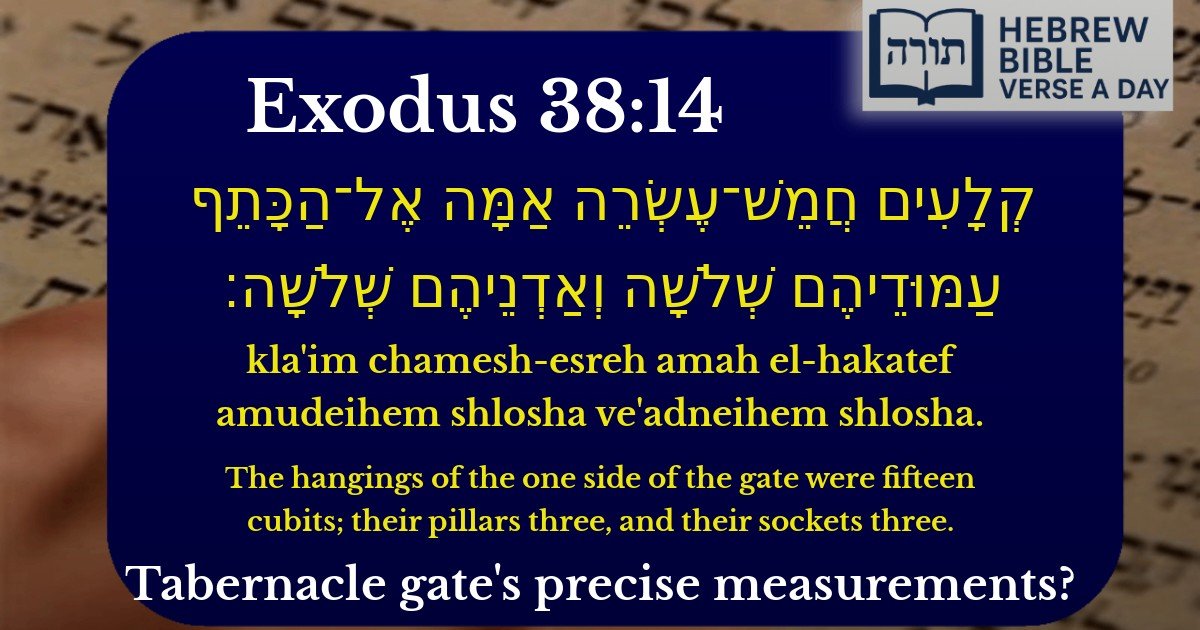
Q: What does Exodus 38:14 describe?
A: Exodus 38:14 describes part of the construction of the Mishkan (Tabernacle), specifically the hangings (קְלָעִים) for one side of the courtyard entrance. It mentions that the hangings were 15 cubits long, supported by three pillars standing on three sockets (bases). This was part of the detailed instructions for building the sacred space where the Israelites worshipped in the wilderness.
Q: Why were the hangings in the Mishkan 15 cubits long?
A: The 15-cubit measurement for the hangings was part of Hashem's precise instructions for the Mishkan's construction (Exodus 27:9-18). According to Rashi and other commentators, these measurements created a dignified and enclosed space for Divine service. The symmetry and exactness teach us the importance of order and beauty in serving Hashem, as derived from the principle of 'Hiddur Mitzvah' (beautifying commandments).
Q: What is the significance of the three pillars mentioned in Exodus 38:14?
A: The three pillars supporting the hangings symbolize stability and strength in the Mishkan's structure. The Midrash (Tanchuma Terumah 11) connects the number three to foundational Jewish concepts like the three Patriarchs (Avraham, Yitzchak, and Yaakov), showing that our worship is built upon the legacy of our ancestors. The Rambam (Hilchot Beit HaBechirah 1:12) also notes that proper structure is essential for sacred spaces.
Q: How do the details in Exodus 38:14 apply to us today?
A: Though we no longer have the Mishkan, the Talmud (Berachot 55a) teaches that the details of its construction offer eternal lessons. The hangings and pillars remind us to create boundaries (physical and spiritual) for holiness in our lives, just as the Mishkan was separated from the camp. The three pillars can also inspire us to build our lives on strong foundations—Torah, Avodah (prayer/service), and Gemilut Chasadim (acts of kindness)—as taught in Pirkei Avot (1:2).
Q: What materials were used for the hangings and pillars in Exodus 38:14?
A: Earlier in Exodus (27:9-10), the Torah specifies that the courtyard hangings were made of fine twisted linen, and the pillars were made of acacia wood overlaid with silver (with silver hooks and bands). Rashi explains that these materials were chosen for durability and beauty, reflecting the honor due to the Mishkan. The sockets (bases) mentioned in our verse were likely made of copper, as described in Exodus 38:17.


Context in the Mishkan (Tabernacle)
The verse (Exodus 38:14) describes the dimensions and structure of the hangings (kelaim) for the courtyard of the Mishkan. According to Rashi, these hangings were made of fine twisted linen and served as partitions surrounding the courtyard. The fifteen-cubit measurement refers to the length of the hangings on one side of the entrance, supported by three pillars with their corresponding sockets (adanim).
Symbolism of the Measurements
The Midrash (Bamidbar Rabbah 12:21) notes that the number fifteen alludes to the fifteen "Songs of Ascents" (Shir HaMa'alot) in Tehillim (Psalms 120-134), symbolizing the spiritual elevation of those who enter the Mishkan. The three pillars, as explained by the Rambam in Hilchot Beit HaBechirah, represent the three foundational principles of Torah, Avodah (service), and Gemilut Chasadim (acts of kindness), which uphold the sanctity of the space.
Structural Details
Halachic Implications
The Talmud (Zevachim 59b) derives from this verse that the entrance to the Mishkan's courtyard required specific dimensions to maintain its sanctity. The Shulchan Aruch (Orach Chaim 151:1) later applies this principle to synagogue entrances, emphasizing the importance of dignified entryways for places of worship.