
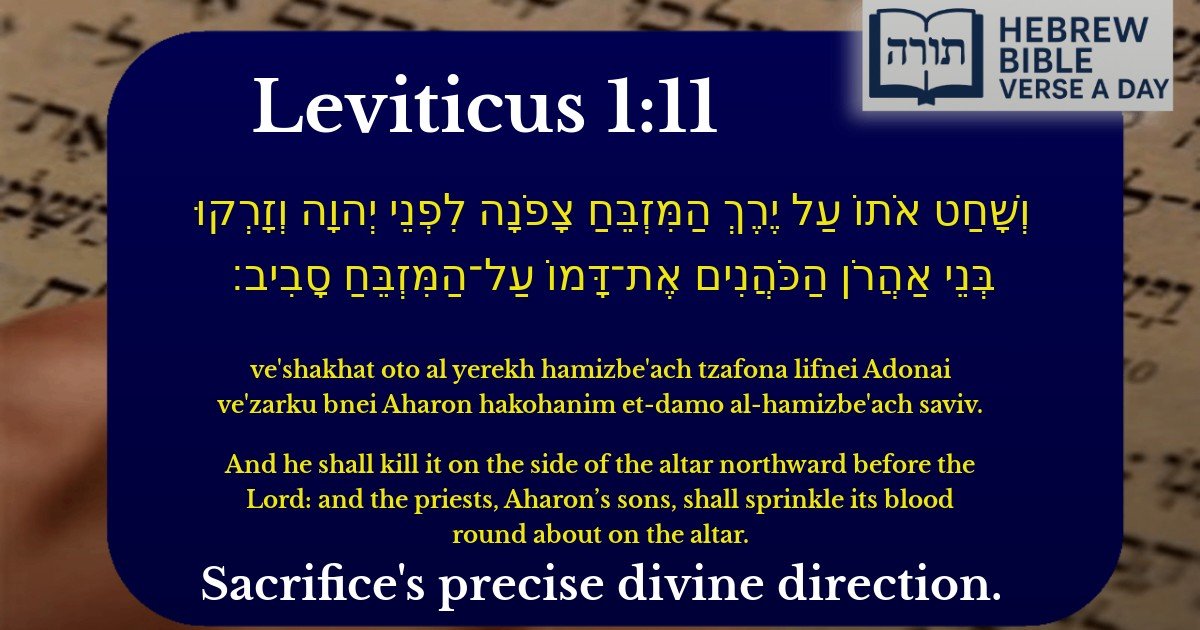

Leviticus 1:11 - Sacrifice's precise divine direction.

Leviticus 1:11 - ויקרא 1:11

Hebrew Text

וְשָׁחַט אֹתוֹ עַל יֶרֶךְ הַמִּזְבֵּחַ צָפֹנָה לִפְנֵי יְהוָה וְזָרְקוּ בְּנֵי אַהֲרֹן הַכֹּהֲנִים אֶת־דָּמוֹ עַל־הַמִּזְבֵּחַ סָבִיב׃

English Translation

And he shall kill it on the side of the altar northward before the Lord: and the priests, Aharon’s sons, shall sprinkle its blood round about on the altar.

Transliteration

Ve'shakhat oto al yerekh hamizbe'ach tzafona lifnei Adonai ve'zarku bnei Aharon hakohanim et-damo al-hamizbe'ach saviv.

Hebrew Leining Text

וְשָׁחַ֨ט אֹת֜וֹ עַ֣ל יֶ֧רֶךְ הַמִּזְבֵּ֛חַ צָפֹ֖נָה לִפְנֵ֣י יְהֹוָ֑ה וְזָרְק֡וּ בְּנֵי֩ אַהֲרֹ֨ן הַכֹּהֲנִ֧ים אֶת־דָּמ֛וֹ עַל־הַמִּזְבֵּ֖חַ סָבִֽיב׃

🎵 Listen to leining

Parasha Commentary

Location of the Slaughter

The verse specifies that the slaughter of the korban (sacrifice) must take place "on the side of the altar northward" (עַל יֶרֶךְ הַמִּזְבֵּחַ צָפֹנָה). Rashi (Vayikra 1:11) explains that this refers to the northern side of the Mizbeach (altar), which was designated specifically for the slaughter of most korbanot. The Zevachim (5:1) in Mishnah elaborates that this applies to kodshim kalim (offerings of lesser sanctity) but not to kodshei kodashim (offerings of higher sanctity), which had different slaughtering locations.

Significance of the North

The Talmud (Yoma 19b) and Midrash (Bamidbar Rabbah 7:8) suggest symbolic reasons for the northern placement:

  • The north is associated with gevurah (strength or judgment), as it is the direction from which darkness emerges (Yirmiyahu 1:14). The korban serves to mitigate divine judgment.
  • Alternatively, the north is linked to the Beis Hamikdash's future redemption, as Yechezkel (1:4) describes divine revelation coming from the north.

Role of the Kohanim

The verse states that "the priests, Aharon’s sons, shall sprinkle its blood" (וְזָרְקוּ בְּנֵי אַהֲרֹן הַכֹּהֲנִים אֶת־דָּמוֹ). Rambam (Hilchos Maaseh HaKorbanos 5:1-2) details that the zerikah (sprinkling) must be performed by a kohen, emphasizing the priestly role in facilitating atonement. The blood is sprinkled "around the altar" (סָבִיב), which the Mishnah (Zevachim 5:4) clarifies means on the lower half of the Mizbeach for most korbanot.

Spiritual Lessons

The Sefer HaChinuch (Mitzvah 95) derives ethical teachings from this process:

  • The precise details teach submission to divine will, as every step reflects Hashem’s command.
  • The blood’s sprinkling symbolizes life’s sanctity, as the blood represents the nefesh (Devarim 12:23).

📚 Talmud Citations

This verse is quoted in the Talmud.

📖 Zevachim 53b
The verse is discussed in the context of the laws regarding the slaughter of sacrifices and the proper sprinkling of blood on the altar.
📖 Menachot 27b
Referenced in a discussion about the positioning and procedures for various offerings, emphasizing the north side of the altar for certain sacrifices.

Frequently Asked Questions

Q: Why does the animal sacrifice need to be slaughtered on the north side of the altar?
A: According to Rashi (Leviticus 1:11), the north side of the altar was designated specifically for slaughtering certain sacrifices, including the burnt offering (olah). This teaches us about the precision and order required in serving Hashem, as every detail in the Temple service has significance.
Q: What is the significance of sprinkling the blood around the altar?
A: The sprinkling of the blood (zerikat hadam) symbolizes the atonement process and the dedication of the sacrifice to Hashem. The Talmud (Zevachim 6a) explains that this act connects the offering to the altar, representing the bond between the Jewish people and Hashem through proper service.
Q: Why are only the sons of Aharon (the Kohanim) allowed to sprinkle the blood?
A: The Torah assigns specific roles to the Kohanim (priests) in the Temple service. Rambam (Hilchot Maaseh HaKorbanot 5:1) explains that this emphasizes the importance of proper authority and structure in avodat Hashem (service to G-d). Only those designated for this sacred task may perform it.
Q: What lesson can we learn today from the details of the sacrificial service?
A: Even though we no longer bring sacrifices, the Midrash (Vayikra Rabbah 2:11) teaches that prayer has replaced sacrifices. The precision and devotion required in the Temple service remind us to approach prayer with the same focus, sincerity, and attention to detail.
Q: Why is the direction 'before the Lord' mentioned in this verse?
A: The phrase 'before the Lord' (lifnei Hashem) teaches that every act in the Temple service must be done with awareness of Hashem's presence. Rashi (Leviticus 1:9) notes that this reminds us that our actions should always be directed toward serving Hashem with proper intention (kavanah).