Frequently Asked Questions
Q: What does it mean to 'lift off all its fat' in Leviticus 4:19?
A: In Leviticus 4:19, 'lifting off all its fat' refers to the process of separating the fatty portions of a sacrificial animal, which were considered the choicest parts. According to Rashi, these fats were designated exclusively for offering on the altar to Hashem, symbolizing giving the best of what we have in service to Him.
Q: Why were the fats burned on the altar in this verse?
A: The fats were burned on the altar because they were considered the most desirable parts of the animal, representing devotion and surrender to Hashem. The Talmud (Chullin 49a) explains that fats were not consumed by humans but reserved for the altar as a 'pleasing aroma' to Hashem, showing complete dedication in worship.
Q: What lesson can we learn from Leviticus 4:19 today?
A: Leviticus 4:19 teaches us the importance of giving our best to Hashem in all aspects of life, not just sacrifices. The Rambam (Hilchot Ma'aseh HaKorbanot) explains that this principle applies to prayer, charity, and mitzvot—we should always offer our highest quality efforts with sincerity and devotion.
Q: Does this verse apply if there is no Temple today?
A: While we cannot bring physical sacrifices without the Temple, the spiritual message of Leviticus 4:19 remains relevant. The Midrash (Vayikra Rabbah 3:3) teaches that acts of kindness, Torah study, and prayer now substitute for sacrifices. Just as fats were wholly offered, we should dedicate our hearts fully to serving Hashem.
Q: What types of fats were included in this offering?
A: The verse refers to specific fats listed earlier in Leviticus (3:9-10), including the fat covering the innards, the kidneys, and the lobe of the liver. Rashi clarifies that only these designated fats—not all body fat—were to be removed and burned on the altar as part of the sin-offering (chatat) described in Leviticus 4.

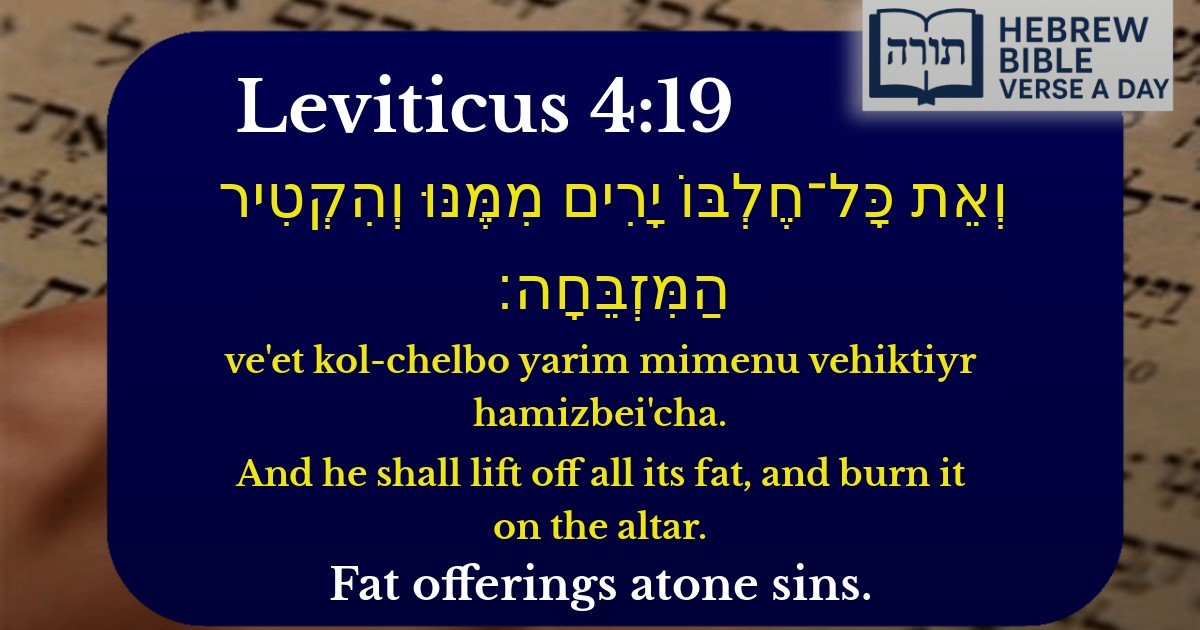

Explanation of the Verse
The verse "וְאֵת כָּל־חֶלְבּוֹ יָרִים מִמֶּנּוּ וְהִקְטִיר הַמִּזְבֵּחָה" (And he shall lift off all its fat, and burn it on the altar) appears in the context of the sacrificial service, particularly regarding the offering of animals in the Beit HaMikdash (Holy Temple). The fat (חֵלֶב) mentioned here refers to specific fatty portions of the animal that were designated for burning on the altar.
Halachic and Symbolic Significance
According to Rashi (Vayikra 3:3), the term "חלב" refers to the layers of fat that are separated from the animal's innards. The Torah prohibits consuming these fats (חֵלֶב), as they are reserved exclusively for the altar (see Vayikra 7:23-25). The Rambam (Hilchot Ma'aseh HaKorbanot 5:13) elaborates that the removal and burning of the fat symbolize the elevation of the physical to the spiritual, as the altar represents divine service.
Midrashic Insights
The Midrash Tanchuma (Tzav 14) explains that the fat represents indulgence and physical desires. By offering it on the altar, we demonstrate our commitment to sanctifying even our material inclinations in service of Hashem. The Sforno (Vayikra 3:16) adds that the burning of the fat signifies the complete dedication of one's physical vitality to divine worship.
Practical Implications in Avodah (Temple Service)