

Join Our Newsletter To Be Informed When New Videos Are Posted
Hebrew Text
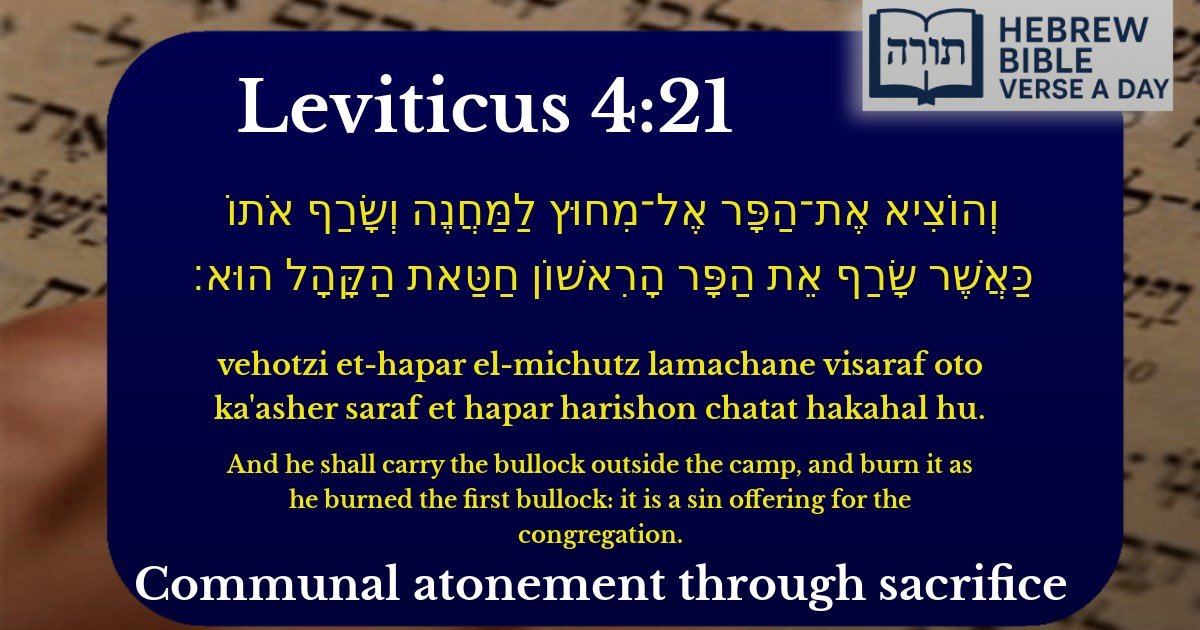
וְהוֹצִיא אֶת־הַפָּר אֶל־מִחוּץ לַמַּחֲנֶה וְשָׂרַף אֹתוֹ כַּאֲשֶׁר שָׂרַף אֵת הַפָּר הָרִאשׁוֹן חַטַּאת הַקָּהָל הוּא׃
English Translation
And he shall carry the bullock outside the camp, and burn it as he burned the first bullock: it is a sin offering for the congregation.
Transliteration
Vehotzi et-hapar el-michutz lamachane visaraf oto ka'asher saraf et hapar harishon chatat hakahal hu.
Hebrew Leining Text
וְהוֹצִ֣יא אֶת־הַפָּ֗ר אֶל־מִחוּץ֙ לַֽמַּחֲנֶ֔ה וְשָׂרַ֣ף אֹת֔וֹ כַּאֲשֶׁ֣ר שָׂרַ֔ף אֵ֖ת הַפָּ֣ר הָרִאשׁ֑וֹן חַטַּ֥את הַקָּהָ֖ל הֽוּא׃ {פ}
🎵 Listen to leining
Parasha Commentary
📚 Talmud Citations
This verse is quoted in the Talmud.
📖 Yoma 68a
The verse is referenced in the discussion about the burning of the sin offering bullock outside the camp as part of the Yom Kippur service.
📖 Horayot 6a
The verse is cited in the context of discussing communal sin offerings and the procedures for atonement.
Context and Source
The verse (Vayikra 4:12) describes the procedure for the sin offering (chatat) brought on behalf of the entire congregation (kahal) when they inadvertently transgress a commandment. The bullock (par) is taken outside the camp and burned, similar to the first bullock mentioned earlier in the parsha.
Rashi's Explanation
Rashi (Vayikra 4:12) clarifies that "the first bullock" refers to the bullock of the anointed Kohen (Kohen Gadol) mentioned earlier in the parsha (Vayikra 4:3-12). Both the Kohen Gadol's bullock and the congregation's bullock are burned outside the camp because they share the same status as a chatat whose blood is brought into the Kodesh (the Sanctuary). This distinguishes them from other sin offerings, whose meat is eaten by the Kohanim.
Rambam's Halachic Perspective
In Hilchot Ma'aseh HaKorbanot (7:6), the Rambam codifies the law that any sin offering whose blood is brought into the Kodesh must be entirely burned outside the camp. This includes both the Kohen Gadol's bullock and the congregation's bullock, as their blood is sprinkled in the Kodesh before the Parochet (the curtain separating the Holy of Holies).
Symbolism of Burning Outside the Camp
The Midrash (Torat Kohanim 4:12) explains that burning the bullock outside the camp serves as a public demonstration of atonement. By removing and destroying the offering outside the community's boundaries, it symbolizes the removal of sin from the midst of the people. This act reinforces the seriousness of communal transgression and the need for collective repentance.
Distinction Between Individual and Communal Offerings
Chizkuni's Additional Insight
Chizkuni (Vayikra 4:12) notes that the phrase "as he burned the first bullock" teaches that the same meticulous procedure applies to both offerings. This includes the location of burning, the method of disposal, and the requirement that it be done by the Kohen himself, ensuring uniformity in the atonement process.