
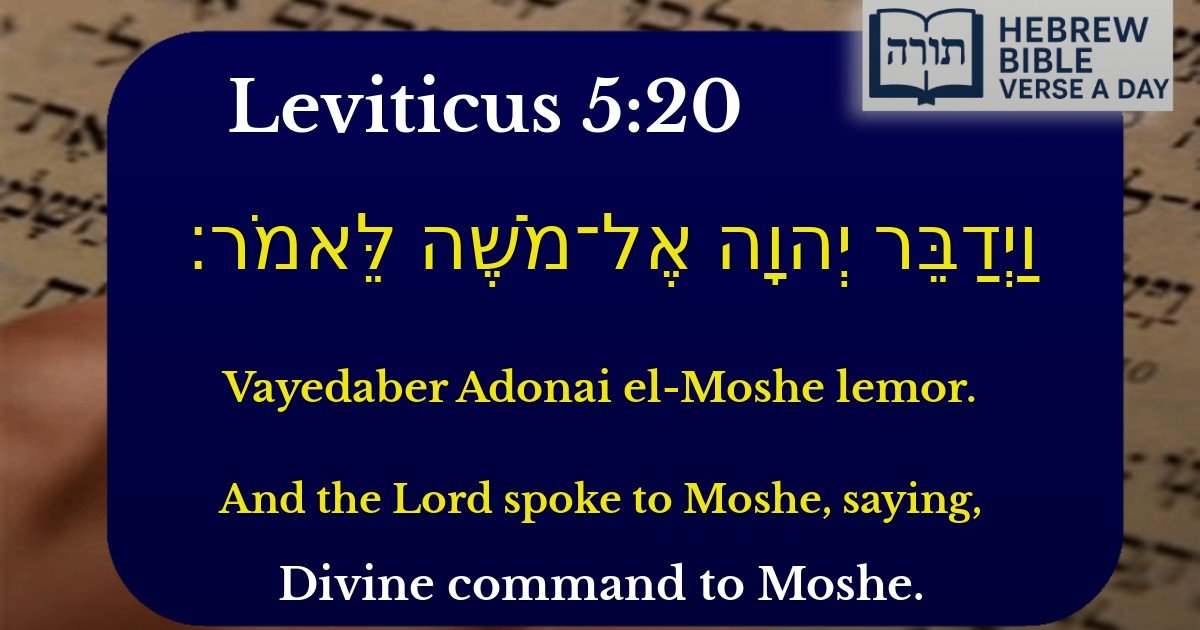

Leviticus 5:20 - Divine command to Moshe.

Leviticus 5:20 - ויקרא 5:20

Hebrew Text

וַיְדַבֵּר יְהוָה אֶל־מֹשֶׁה לֵּאמֹר׃

English Translation

And the Lord spoke to Moshe, saying,

Transliteration

Vayedaber Adonai el-Moshe lemor.

Hebrew Leining Text

וַיְדַבֵּ֥ר יְהֹוָ֖ה אֶל־מֹשֶׁ֥ה לֵּאמֹֽר׃

🎵 Listen to leining

Parasha Commentary

The Divine Communication to Moshe

The phrase "וַיְדַבֵּר יְהוָה אֶל־מֹשֶׁה לֵּאמֹר" ("And the Lord spoke to Moshe, saying") appears frequently in the Torah, marking the transmission of divine commandments and teachings. Rashi (on Shemot 6:2) explains that this expression signifies a clear and direct communication from Hashem to Moshe, emphasizing the unique prophetic level of Moshe Rabbeinu, who received the Torah with unparalleled clarity (aspaklaria ha-me'ira).

The Significance of "לֵּאמֹר" ("Saying")

The word "לֵּאמֹר" is interpreted in multiple ways by our sages:

  • Ramban (Bereishit 1:3): Suggests it indicates that Moshe was to transmit these words to Bnei Yisrael, underscoring his role as the intermediary.
  • Sforno (Shemot 25:1): Explains that it implies Moshe was to repeat the words exactly as received, without alteration.
  • Midrash Tanchuma (Vayikra 1): Teaches that "לֵּאמֹר" hints at the eternal nature of Torah, meaning these words were to be said for all generations.

Moshe's Unique Prophecy

The Rambam (Hilchos Yesodei HaTorah 7:6) elaborates that Moshe's prophecy differed from all other prophets in three key ways:

  • He received prophecy while fully awake and cognizant (be'aspaklaria ha-me'ira).
  • Hashem spoke to him directly, not through visions or allegories.
  • He could receive prophecy at any time, without preparatory conditions.

The Structure of Divine Commandments

Ibn Ezra (Shemot 6:10) notes that this phrasing often introduces mitzvos, highlighting the authoritative chain of transmission from Hashem to Moshe to Klal Yisrael. The Mechilta (Bo 1) adds that each instance of "וַיְדַבֵּר יְהוָה אֶל־מֹשֶׁה" reinforces the divine origin of halacha.

📚 Talmud Citations

This verse is not quoted in the Talmud.

Frequently Asked Questions

Q: What does it mean when the verse says 'And the Lord spoke to Moshe, saying'?
A: This phrase is a common introduction in the Torah indicating that Hashem is giving a direct commandment or instruction to Moshe Rabbeinu (Moses our teacher) to transmit to the Jewish people. Rashi explains that this wording emphasizes the divine origin of the commandments and the precision with which Moshe conveyed them.
Q: Why does the Torah repeat 'saying' after 'spoke'?
A: The double language of 'spoke... saying' teaches that Moshe was commanded not only to hear the words from Hashem but also to actively teach and transmit them to the Jewish people (based on Mechilta and Rashi). This shows the importance of oral transmission in Torah learning.
Q: How many times does this phrase appear in the Torah?
A: The exact phrase 'And the Lord spoke to Moshe, saying' appears over 80 times in the Torah, showing how frequently Hashem communicated with Moshe. The Talmud (Megillah 31b) notes that this demonstrates the intimate relationship between Hashem and Moshe.
Q: Why is Moshe referred to by name here instead of as 'Moshe Rabbeinu'?
A: The Torah typically refers to Moshe simply by his name to show that while he was the greatest prophet, he was still human. Rambam (Maimonides) explains in Yesodei HaTorah that this prevents people from deifying Moshe, while still recognizing his unique prophetic level.
Q: What can we learn from how Hashem spoke to Moshe?
A: The Midrash (Sifra) teaches that Hashem always spoke to Moshe clearly and directly, showing the ideal teacher-student relationship. This models how Torah should be taught - with clarity and care. The Talmud (Yevamot 49b) also notes that Moshe was unique in receiving prophecy 'face to face' with Hashem.