
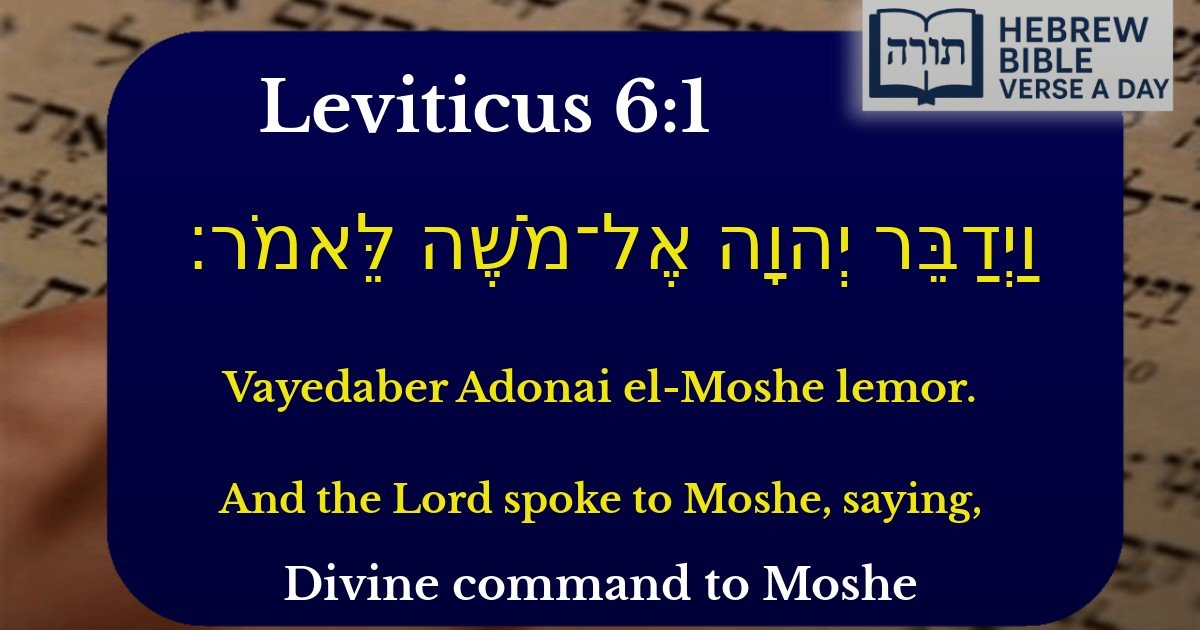

Leviticus 6:1 - Divine command to Moshe

Leviticus 6:1 - ויקרא 6:1

Hebrew Text

וַיְדַבֵּר יְהוָה אֶל־מֹשֶׁה לֵּאמֹר׃

English Translation

And the Lord spoke to Moshe, saying,

Transliteration

Vayedaber Adonai el-Moshe lemor.

Hebrew Leining Text

וַיְדַבֵּ֥ר יְהֹוָ֖ה אֶל־מֹשֶׁ֥ה לֵּאמֹֽר׃

🎵 Listen to leining

Parasha Commentary

The Divine Communication to Moshe

The phrase "וַיְדַבֵּר יְהוָה אֶל־מֹשֶׁה לֵּאמֹר" ("And the Lord spoke to Moshe, saying") appears frequently in the Torah, marking the transmission of divine commandments and teachings. Rashi (Shemot 6:2) explains that this expression signifies a clear and direct communication from Hashem to Moshe, often introducing mitzvot or prophetic messages intended for Bnei Yisrael.

The Significance of "Dibbur" (Speaking)

Rambam (Hilchos Yesodei HaTorah 7:6) emphasizes that Moshe's prophecy was unique in that he received divine communication in a state of complete wakefulness, unlike other prophets who experienced visions or dreams. The term "וַיְדַבֵּר" (spoke) underscores the clarity and immediacy of this revelation.

  • Midrash Tanchuma (Vayikra 1) notes that "dibbur" implies a tone of strictness, often associated with commandments that require precise adherence.
  • Ramban (Bamidbar 12:6) contrasts Moshe's prophecy with that of other nevi'im, highlighting that only Moshe merited direct speech ("panim el panim") from Hashem.

The Role of "Lemor" (Saying)

The word "לֵּאמֹר" ("saying") indicates that Moshe was to transmit the message to others, typically to Bnei Yisrael or Aharon. The Talmud (Yoma 4b) derives from this that Moshe faithfully relayed Hashem's words without alteration.

  • Sforno (Shemot 19:3) explains that "lemar" implies an obligation to teach and clarify the divine word to the people.
  • Ohr HaChaim (Vayikra 1:1) suggests that this phrasing hints at Moshe's humility—he served purely as a conduit for Hashem's will.

📚 Talmud Citations

This verse is not quoted in the Talmud.

Frequently Asked Questions

Q: What does it mean that 'the Lord spoke to Moshe, saying'?
A: This phrase, which appears frequently in the Torah, signifies that Hashem communicated directly with Moshe Rabbeinu to give him commandments or instructions for Bnei Yisrael. According to Rashi, this emphasizes the divine origin of the Torah's laws.
Q: Why does the Torah keep repeating 'the Lord spoke to Moshe'?
A: The Rambam explains in Moreh Nevuchim that this repetition serves to show that each commandment comes directly from Hashem. The Talmud (Sanhedrin 56a) teaches that it also emphasizes Moshe's unique role as the transmitter of the Torah to the Jewish people.
Q: What can we learn from how Hashem spoke to Moshe?
A: The Midrash (Shemos Rabbah 28:6) teaches that Hashem always spoke to Moshe clearly and directly, showing the special relationship between them. This teaches us about the importance of clear communication when transmitting Torah values to others.
Q: How does this verse relate to us today?
A: The Sforno explains that while we no longer have prophecy like Moshe did, we maintain this connection to Hashem through studying the Torah that was given through Moshe. This verse reminds us of the divine origin of our Torah learning and mitzvah observance.
Q: Why does it say 'saying' after 'spoke to Moshe'?
A: Rashi explains that the word 'saying' (לאמר) means Moshe was commanded to repeat these words to Bnei Yisrael. This teaches us about the chain of Torah transmission - from Hashem to Moshe, and from Moshe to the people.