Frequently Asked Questions
Q: What does Leviticus 6:19 mean when it says the priest shall eat the sin offering?
A: According to Rashi and traditional Jewish interpretation, this verse teaches that certain sin offerings (חַטָּאת) were eaten by the kohanim (priests) in the courtyard of the Mishkan (Tabernacle). This was part of the atonement process, where the priest's consumption of the offering helped achieve kapara (atonement) for the person who brought it. The Torah emphasizes that this must be done in a holy place - the courtyard of the Mishkan.
Q: Why was the sin offering eaten only in a holy place?
A: The Rambam explains in Mishneh Torah that eating the sin offering in the holy courtyard of the Mishkan (and later the Temple) showed reverence for the sacred service. Since the offering was brought for atonement, it had to be treated with utmost holiness. The Talmud (Zevachim 56b) also teaches that eating it in the holy area helped maintain the spiritual purity of the atonement process.
Q: What can we learn today from Leviticus 6:19 about holiness?
A: Even though we don't have the Temple service today, this verse teaches us that holiness requires proper boundaries and respect. Just as the sin offering could only be eaten in a designated holy area, we learn from our sages that we should treat mitzvot and spiritual matters with proper reverence in appropriate settings. The Midrash (Torat Kohanim) connects this to how we should approach all holy matters in life with seriousness and the right environment.
Q: Who was allowed to eat the sin offering mentioned in Leviticus 6:19?
A: Only the specific kohen (priest) who performed the sacrificial service for that particular sin offering was permitted to eat it, as the verse states 'the priest that offers it.' The Talmud (Zevachim 97b) explains this was limited to male kohanim in a state of ritual purity. Other priests or non-priests could not partake of this offering.
Q: Why did the priest eat part of the sin offering?
A: Rashi explains that the priest's eating of the offering was part of the kapara (atonement) process. By consuming it in holiness, the kohen helped complete the spiritual rectification for the person who brought the sacrifice. The Ramban adds that this showed the offering was fully accepted by Hashem, as it became part of the priest who served in the Divine service.


Context of the Verse
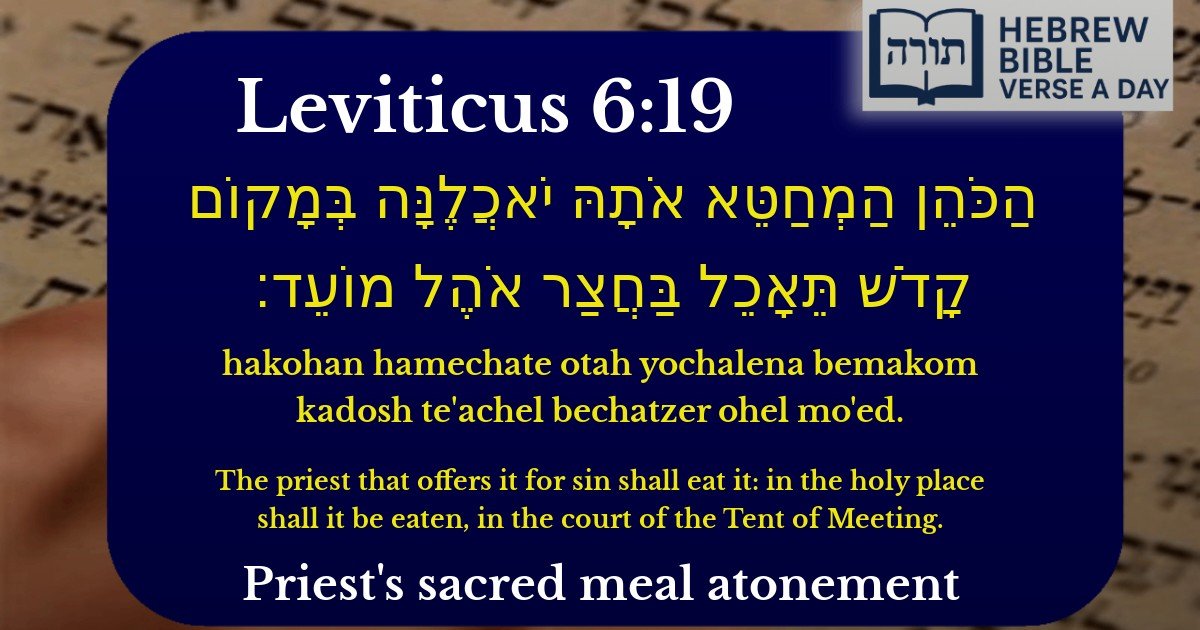
The verse (Vayikra 6:19) discusses the consumption of the chatat (sin offering) by the kohen (priest) who performed the sacrificial service. This is part of the broader laws of sacrifices, particularly those related to the korbanot brought for unintentional sins.
Explanation of the Verse
Rashi explains that the phrase "הַכֹּהֵן הַמְחַטֵּא אֹתָהּ" ("the priest that offers it for sin") refers specifically to the priest who performs the sprinkling of the blood of the chatat on the altar. Only this priest is permitted to eat the flesh of the offering, as derived from the words "יֹאכֲלֶנָּה" ("shall eat it").
The verse further specifies that the offering must be eaten "בְּמָקוֹם קָדֹשׁ" ("in the holy place"), which Rashi clarifies as the עזרה (the courtyard of the Mishkan or Beit HaMikdash). This is based on the continuation of the verse, "בַּחֲצַר אֹהֶל מוֹעֵד" ("in the court of the Tent of Meeting").
Halachic Implications
Spiritual Significance
The Midrash (Torat Kohanim) teaches that the consumption of the chatat by the priest serves as a form of atonement, symbolizing the complete eradication of the sin. By eating the offering in a holy place, the priest internalizes the sanctity of the repentance process, reinforcing the idea that atonement requires both ritual and spiritual purity.
The Kli Yakar adds that the restriction to the עזרה underscores the idea that true atonement must be connected to the Divine presence, as the courtyard of the Mishkan was the closest accessible point to the Kodesh HaKodashim (Holy of Holies).