
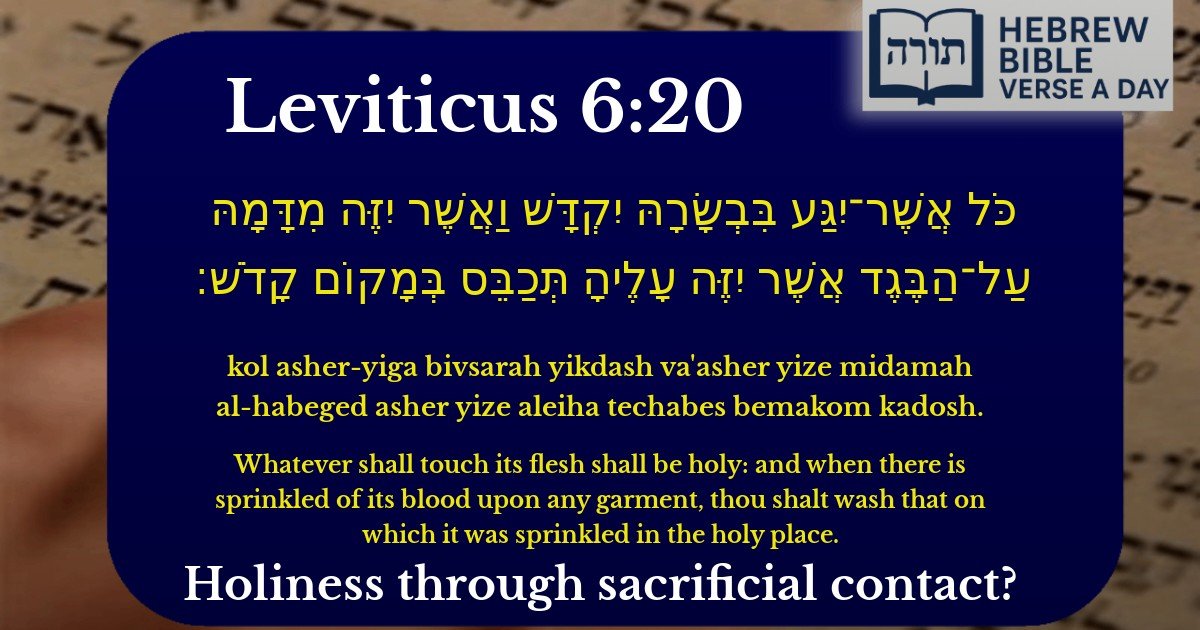

Leviticus 6:20 - Holiness through sacrificial contact?

Leviticus 6:20 - ויקרא 6:20

Hebrew Text

כֹּל אֲשֶׁר־יִגַּע בִּבְשָׂרָהּ יִקְדָּשׁ וַאֲשֶׁר יִזֶּה מִדָּמָהּ עַל־הַבֶּגֶד אֲשֶׁר יִזֶּה עָלֶיהָ תְּכַבֵּס בְּמָקוֹם קָדֹשׁ׃

English Translation

Whatever shall touch its flesh shall be holy: and when there is sprinkled of its blood upon any garment, thou shalt wash that on which it was sprinkled in the holy place.

Transliteration

Kol asher-yiga bivsarah yikdash va'asher yize midamah al-habeged asher yize aleiha techabes bemakom kadosh.

Hebrew Leining Text

כֹּ֛ל אֲשֶׁר־יִגַּ֥ע בִּבְשָׂרָ֖הּ יִקְדָּ֑שׁ וַאֲשֶׁ֨ר יִזֶּ֤ה מִדָּמָהּ֙ עַל־הַבֶּ֔גֶד אֲשֶׁר֙ יִזֶּ֣ה עָלֶ֔יהָ תְּכַבֵּ֖ס בְּמָק֥וֹם קָדֹֽשׁ׃

🎵 Listen to leining

Parasha Commentary

Context of the Verse

This verse (Vayikra 6:20) appears in the context of the laws concerning the Minchah (meal offering) brought by the Kohen Gadol (High Priest). The Torah discusses the sanctity of the offering and the precautions required when handling its components.

Explanation of the Verse

The verse states that anything that touches the flesh of the Minchah becomes holy (yikdash), and if blood is sprinkled on a garment, it must be washed in a holy place. Rashi explains that the sanctity of the offering transfers to objects that come into contact with it, requiring special handling to maintain purity.

Key Interpretations from Traditional Sources

  • Rashi (Vayikra 6:20): Explains that "whatever touches its flesh shall be holy" refers to the sanctity transferring to vessels or hands that come into contact with the offering. This teaches that sacred items impart holiness to other objects.
  • Rambam (Hilchot Pesulei HaMukdashin 13:1): Discusses how objects that absorb sanctified substances (like blood) must be treated with reverence, hence the requirement to wash them in a holy place.
  • Talmud (Zevachim 97b): Analyzes the laws of laundering garments stained with sacrificial blood, emphasizing that such garments must be cleansed within the boundaries of the Temple courtyard (Azarah).
  • Midrash Torat Kohanim: Expands on the concept of kedushah (holiness) spreading through contact, illustrating the principle that sacred items elevate their surroundings.

Practical Halachic Implications

This verse establishes important halachic principles regarding the handling of sanctified objects:

  • Objects that absorb sacrificial blood or flesh must be treated with the same sanctity as the offering itself.
  • Laundering such garments in a holy place ensures that the sanctity is not diminished through improper treatment.
  • The concept of holy contagion (kedushah spreading through contact) applies to Temple service and serves as a model for reverence in mitzvot.

📚 Talmud Citations

This verse is not quoted in the Talmud.

Frequently Asked Questions

Q: What does 'whatever touches its flesh shall be holy' mean in Leviticus 6:20?
A: This verse refers to the sanctity of the Mincha (meal) offering in the Temple. Rashi explains that any vessel or utensil that comes into contact with the flesh of this offering becomes sanctified and must be treated with holiness, meaning it can only be used for holy purposes afterwards.
Q: Why does the Torah say to wash blood-sprinkled garments in a holy place?
A: The Rambam (Hilchos Klei Hamikdash 8:4) teaches that this teaches us about the great sanctity of Temple service. Since the blood was part of a sacred offering, anything it touched (like a priest's garment) required special treatment in the Temple area to maintain proper reverence for holy things.
Q: What practical lesson can we learn from Leviticus 6:20 today?
A: The Midrash (Toras Kohanim) derives from this verse that we should be careful about how we treat holy objects. Just as Temple vessels and garments required special care, today we show respect for holy books, synagogue items, and other religious objects by handling them properly and keeping them in dignified places.