Frequently Asked Questions
Q: What does 'most holy' mean in Leviticus 6:22?
A: The term 'most holy' (קֹדֶשׁ קָדָשִׁים) refers to offerings that have the highest level of sanctity in the Temple service. According to Rashi, these offerings could only be eaten by male kohanim (priests) within the sacred precincts of the Mishkan (Tabernacle) or later the Beit Hamikdash (Temple). They could not be eaten by non-priests or even by priestly women.
Q: Why could only male priests eat the 'most holy' offerings?
A: The Torah specifies that only male kohanim may eat these offerings because they were the ones actively involved in the Temple service. Rambam (Hilchot Ma'aseh HaKorbanot 10:1) explains that this privilege was given to them as part of their sacred duties and responsibilities in maintaining the holiness of the sacrificial service.
Q: What practical lesson can we learn from Leviticus 6:22 today?
A: Even though we no longer have the Temple service today, this verse teaches us about the importance of respecting holy matters and maintaining proper boundaries. Just as the most holy offerings had strict rules about who could partake of them, we learn to treat sacred things with reverence and follow halachic guidelines in our approach to mitzvot and kedusha (holiness).
Q: Where were these 'most holy' offerings eaten?
A: The Talmud (Zevachim 56b) states that the most holy offerings had to be eaten within the courtyard of the Mishkan or Beit Hamikdash. They could not be taken outside these sacred boundaries. This restriction emphasizes the elevated sanctity of these offerings and the care required in handling them.
Q: What types of offerings were considered 'most holy'?
A: According to traditional sources (Rashi on Leviticus 6:10, Rambam Hilchot Ma'aseh HaKorbanot 10:2), the 'most holy' category included the sin offerings (chatat), guilt offerings (asham), the communal peace offerings, and certain parts of other sacrifices. These had stricter rules than other offerings regarding who could eat them and where they could be consumed.

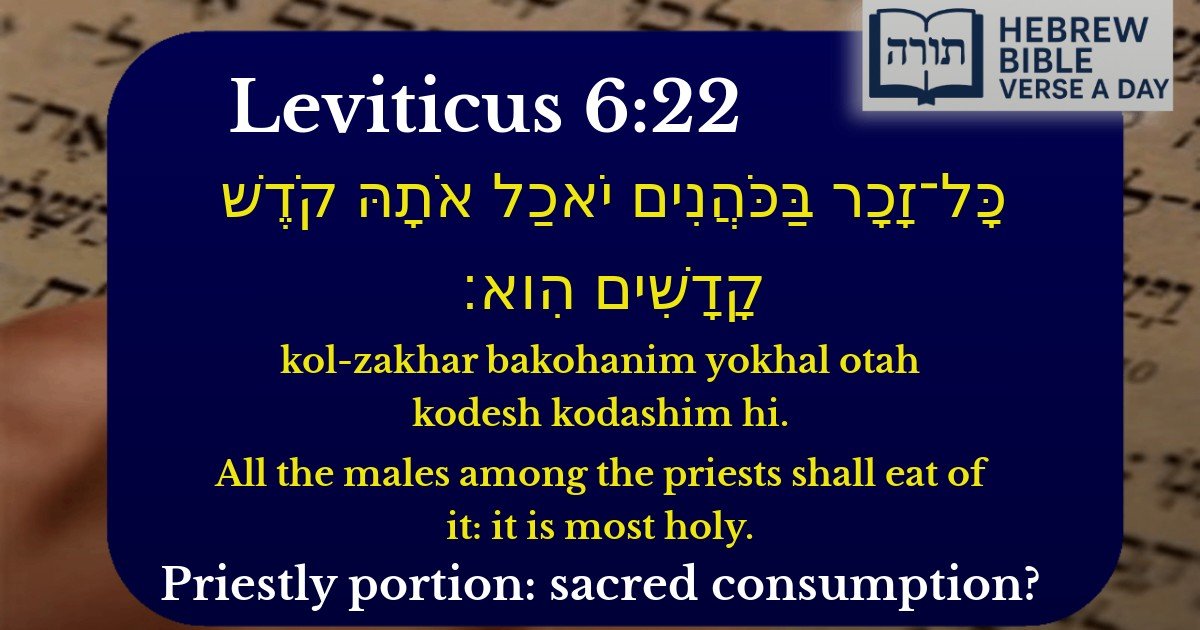

Context of the Verse
The verse (Vayikra 6:22) discusses the consumption of the mincha (meal offering) brought by the kohen (priest) himself. Unlike other meal offerings, which may be eaten by both male and female members of a priest's household, this particular offering is designated exclusively for male priests, as it is kodesh kodashim (most holy).
Explanation of "Kodesh Kodashim"
Rashi explains that the term kodesh kodashim indicates the highest level of sanctity, reserved for offerings that may only be consumed within the sacred precincts of the Mishkan or Beit HaMikdash (Tabernacle or Temple) and only by male priests. This is derived from the double usage of the word kodesh, emphasizing its stringent holiness (Rashi on Vayikra 6:22).
Exclusivity to Male Priests
The Rambam (Hilchot Ma'aseh HaKorbanot 10:12) elaborates that the restriction to male priests stems from the unique sanctity of this offering. Since it is entirely burned on the altar except for a small portion eaten by the priests, its consumption is limited to those actively engaged in the Temple service—namely, the male kohanim.
Halachic Implications
Symbolic Meaning
The Midrash (Torat Kohanim) suggests that the exclusivity of this offering to male priests underscores their role as intermediaries between Bnei Yisrael and Hashem. By partaking of the kodesh kodashim, they affirm their dedication to divine service and their responsibility to uphold the sanctity of the Mishkan or Beit HaMikdash.